

Prusa's INDX saves filament on every single color change

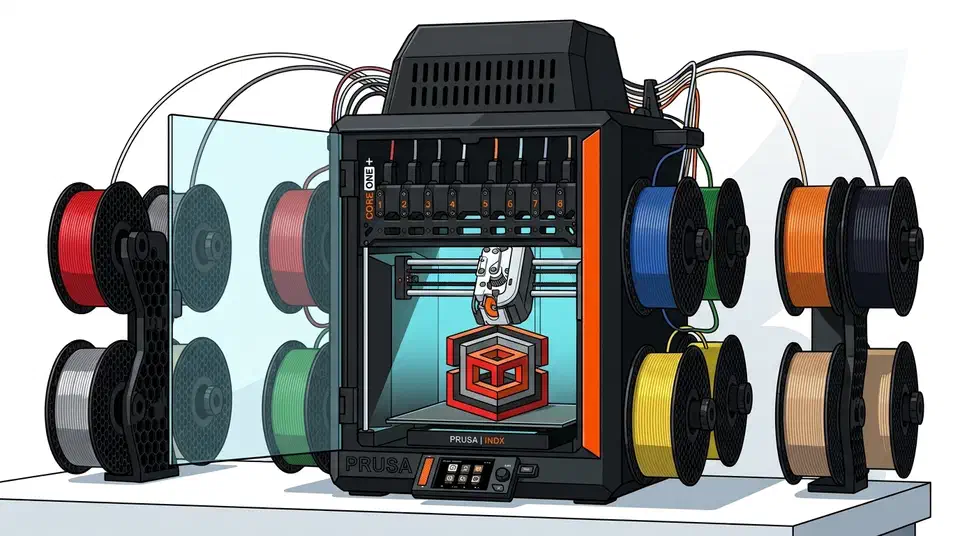
INDX vs AMS purge waste starts at 83 grams. That is what Bambu Studio reports for one four-colour test cube. The cube takes 153 colour changes, and every change flushes plastic. On a Bondtech INDX , every material keeps its own nozzle, so the same print flushes nothing at all.
Key Takeaways
- Every material on the INDX gets its own nozzle, so nothing is flushed.
- Single-nozzle machines push the old colour out on every swap.
- One four-colour test cube throws away 83 grams of filament.
- That waste weighs more than the cube it came from.
- Per print the money saved is small, so the kit pays back over volume.
What purging is and why single-nozzle systems cannot avoid it
A single hot end holds a few cubic millimetres of melted plastic at all times. When the slicer calls for a new colour, that old plastic is still sitting in the melt zone. The printer has to push it out before the new colour prints clean.
Bambu Lab’s own documentation calls this step flushing, and it explains why the volume changes from pair to pair. Dark to light needs a big flush, because a trace of black shows up in white. Light to dark needs much less. The flushed plastic lands in a purge blob beside the plate. Some of it goes into a prime tower, which grows as tall as the highest layer with a colour change.
The flush volume depends on the nozzle and the colour pair, and the size of your part has no bearing on it. A 5 gram keychain in four colours pays the same per-swap toll as a 500 gram vase.
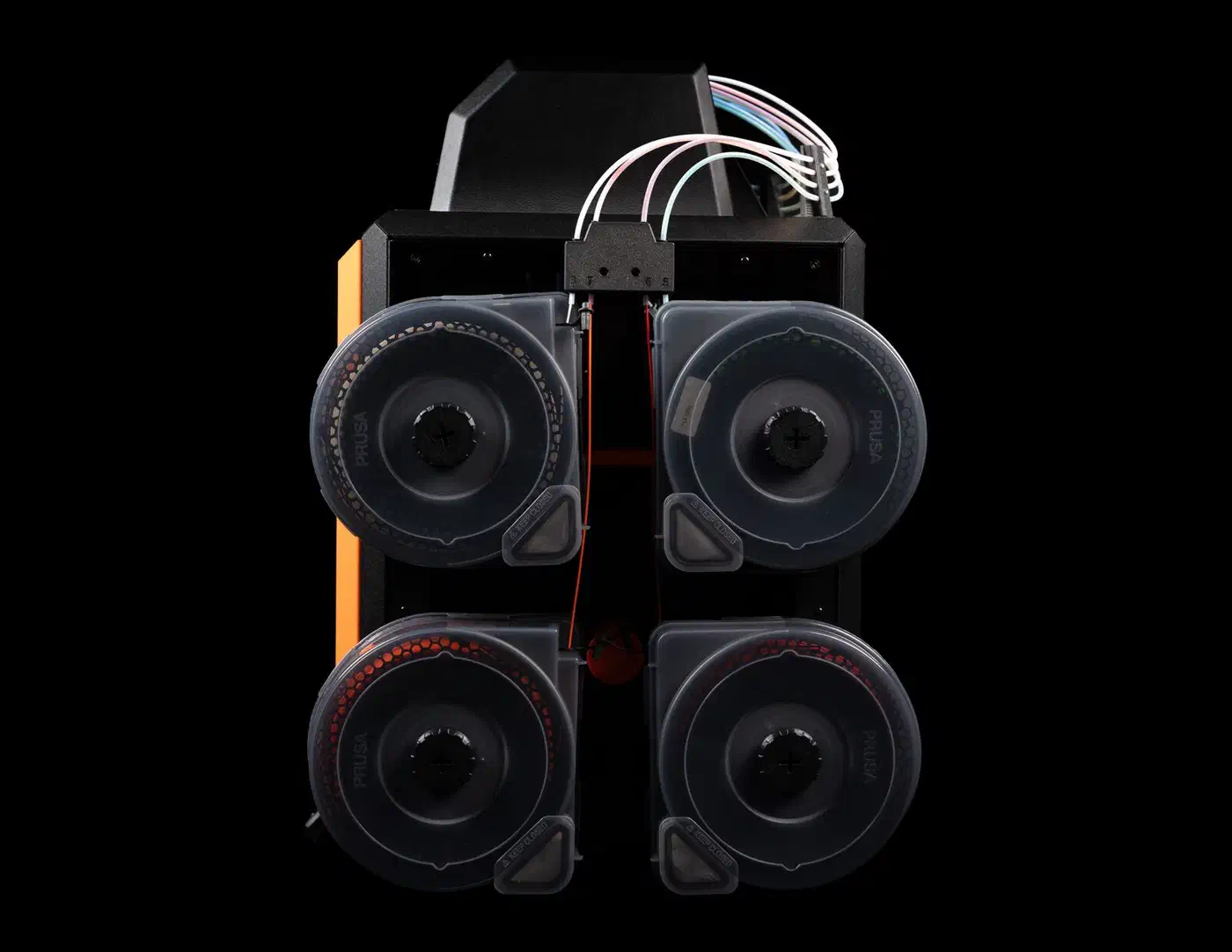
The Bondtech INDX upgrade for the Prusa CORE One removes the step instead of shrinking it. Each of the eight materials sits in its own thin passive tool with its own filament path and nozzle. Nothing ever shares a melt zone, so there is nothing to flush. A cheaper two-nozzle printer does the same for two materials, dropping the flush without paying for eight tools.
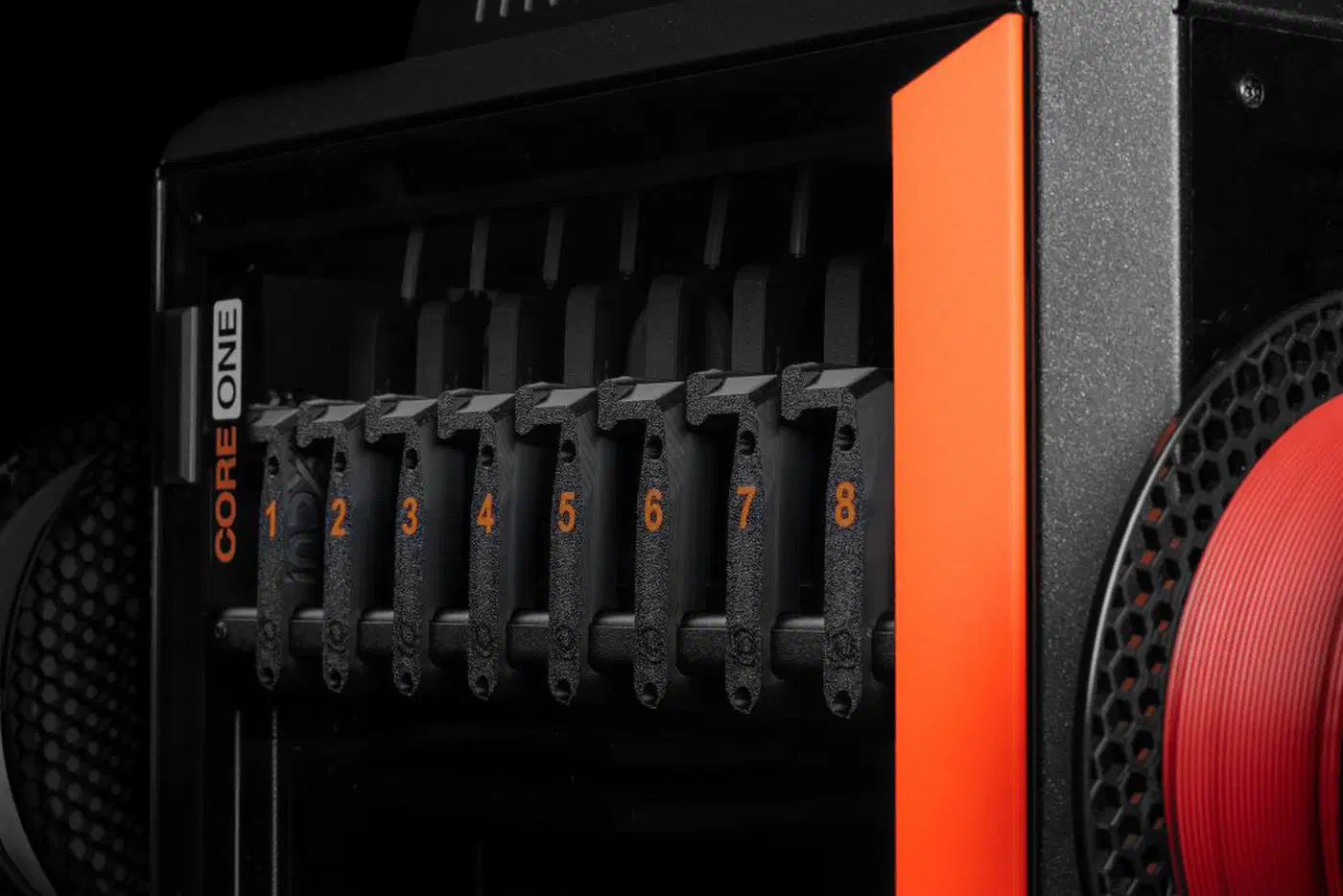
Filament-swapping systems like MMU or AMS have to unload and load the filament back and forth, which is slow and wasteful, as the previous color has to be purged out of the nozzle.
That is a vendor describing a rival architecture, so treat it as a claim rather than a measurement.
How much filament does a purge tower waste?
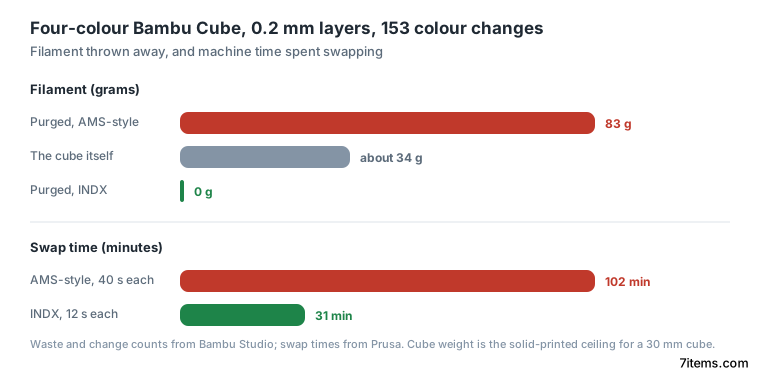
A four-colour Bambu Cube sliced at 0.2 mm layers needs 153 filament changes and 83 grams of wasted filament. Raise the layer height to 0.28 mm and both drop together, to 111 changes and 61 grams.
| Measure | AMS-style single nozzle | INDX dedicated nozzles |
|---|---|---|
| Colour changes | 153 | 153 |
| Flushed per change | about 0.54 g | 0 g |
| Flushed in total | 83 g | 0 g |
| Filament cost of the waste | €2.49 | €0.00 |
| Time per swap | over 40 s | from 12 s |
| Swap time in total | about 1 h 42 m | about 31 min |
Money uses Prusament PLA at €29.99 per kilo, which works out at three cents a gram. The 12 second tool change is Prusa’s own figure for the INDX. The 40 second swap is Prusa’s figure for filament-switching systems in general, so it’s the softest number in the table.
A Bambu Cube is a 30 mm cube. Printed solid it couldn’t weigh more than about 34 grams, so the purge outweighs the part by more than double.
In a harsher case from Bambu Lab’s documentation, one roughly 35 gram model was printed standing upright rather than flat on its side. That single choice burned an extra 180 grams and eleven extra hours. Orientation alone moved five times the model’s weight into the bin.
INDX vs AMS purge waste measured in print hours
Filament is cheap, and machine time is the scarcer of the two. The gap between the architectures is wider on time than it is on grams.
On every AMS-style swap the printer retracts the old filament, cuts it, then feeds the new one. It extrudes until the colour runs true, wipes, and travels to the prime tower and back. None of that lays down part geometry. Across 153 swaps it adds up to well over an hour on a print that might only be four hours of actual extrusion.
An INDX swap parks the current tool, moves, picks up the next one, heats it and resumes. Prusa quotes as little as 12 seconds for the whole sequence. The passive tools carry no heater and no wiring, which is what keeps them light enough to swap that fast.
Longer prints also fail more often, and the extra hours drive that risk far more than the extra grams do. A 30 hour multicolour print that fails at hour 26 costs far more than €2.49 of purge. For a hobbyist printing one showpiece a month, the difference is an evening. For a small workshop running a plate a day, it is roughly a working day recovered each month.
What could cancel the saving
Dedicated nozzles move the waste rather than abolish it. A parked passive tool still holds hot plastic near the melt zone, and oozing during long docked periods puts some of that plastic somewhere. No published measurement of INDX ooze exists, so anyone quoting a true zero is guessing.
Tool changes also cost time even when they cost no plastic. On a print with hundreds of very short colour swaps, the docking travel can eat the whole advantage the missing purge gave you.
Saving 83 grams per cube is worth about €2.49. The eight-tool Prusa Edition conversion kit for the CORE One costs $999, or €899 including VAT, and the four-tool version costs $749 or €669. PrintNexus documents both alongside the staged Founders Edition rollout. On filament savings alone, that kit needs roughly 360 four-colour cubes before it breaks even. The kit only fits Prusa’s own machine, and the 2026 CORE One refresh held that printer’s price steady even after adding hardware.
Prusa showed a CORE One printing eight materials at once on the Formnext floor, so the architecture runs in front of an audience. A trade-show demo is still not a reliability figure over a thousand hours.
Buy the INDX because you want eight materials, faster swaps and fewer failed overnight prints. Most of what the architecture hands back is hours, and the filament you stop throwing away is a rebate on top.