

Bambu's X2D is the cheapest dual nozzle printer yet
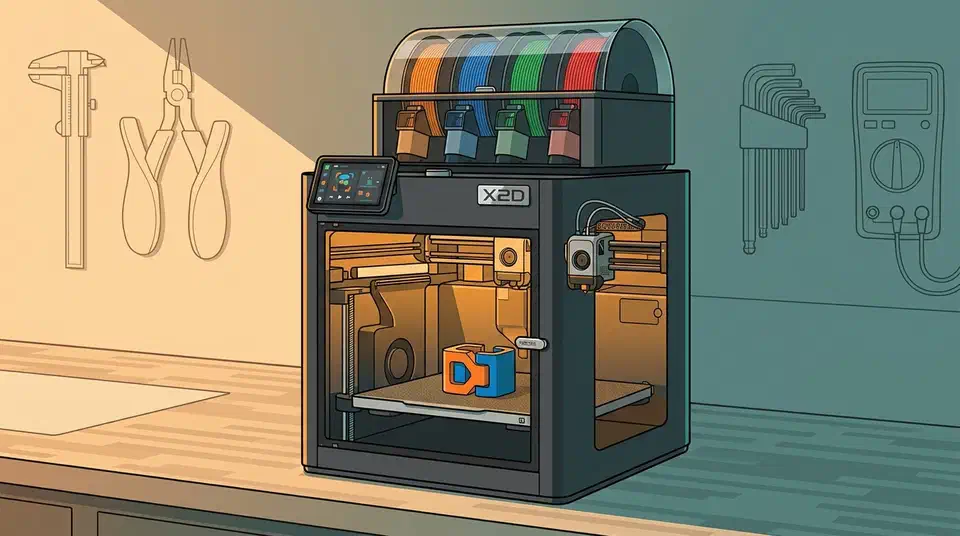
The Bambu X2D dual nozzle printer costs $649 and cuts purged filament from about 40 grams per colour change down to 10 or 12. Purge waste is the running cost that decides whether multicolour printing pays off. A second hot end also makes soluble supports practical at this price.
Key Takeaways
- The X2D lands at $649, or $899 with an AMS in the Combo.
- Two hot ends share one toolhead, and the idle one lifts clear.
- A colour change wastes about 11 grams instead of 40.
- Dissolvable supports finally make sense on a cheap printer.
- The second nozzle is slower and will not run flexible filament.
What the Bambu X2D dual nozzle setup buys you
Bambu Lab launched the X2D in 2026 at $649 for the bare printer and $899 for the Combo, which adds an AMS 2 Pro. The X2D launch write-up puts it directly in the X1 Carbon’s old slot, about $550 below where that machine started.
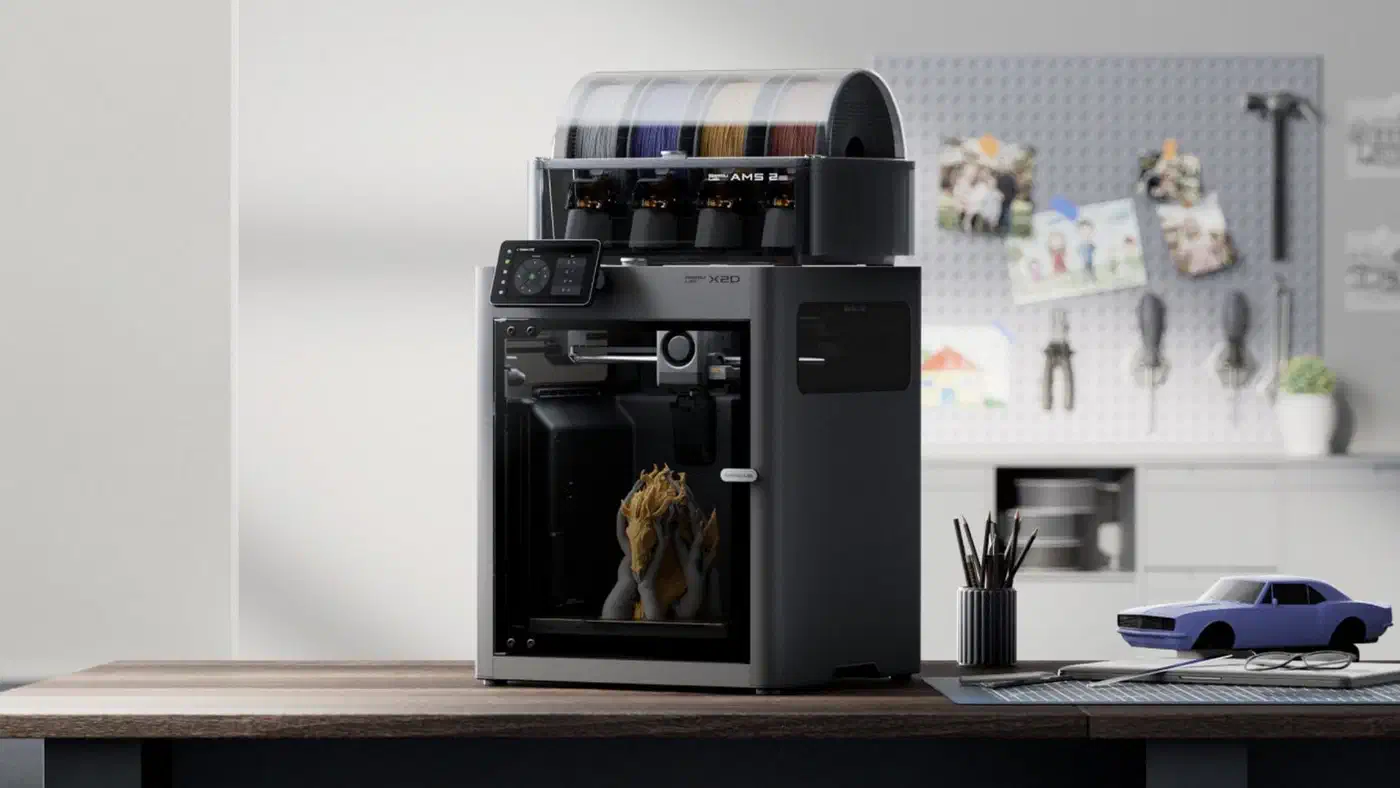
Both hot ends ride on one toolhead, and the two are built differently. The left nozzle is direct drive with the motor at the toolhead, handles the full material range to 300C, and prints at up to 500mm/s. The right nozzle is Bowden fed from a motor at the back of the printer, which keeps the toolhead light but caps that side at 200mm/s.
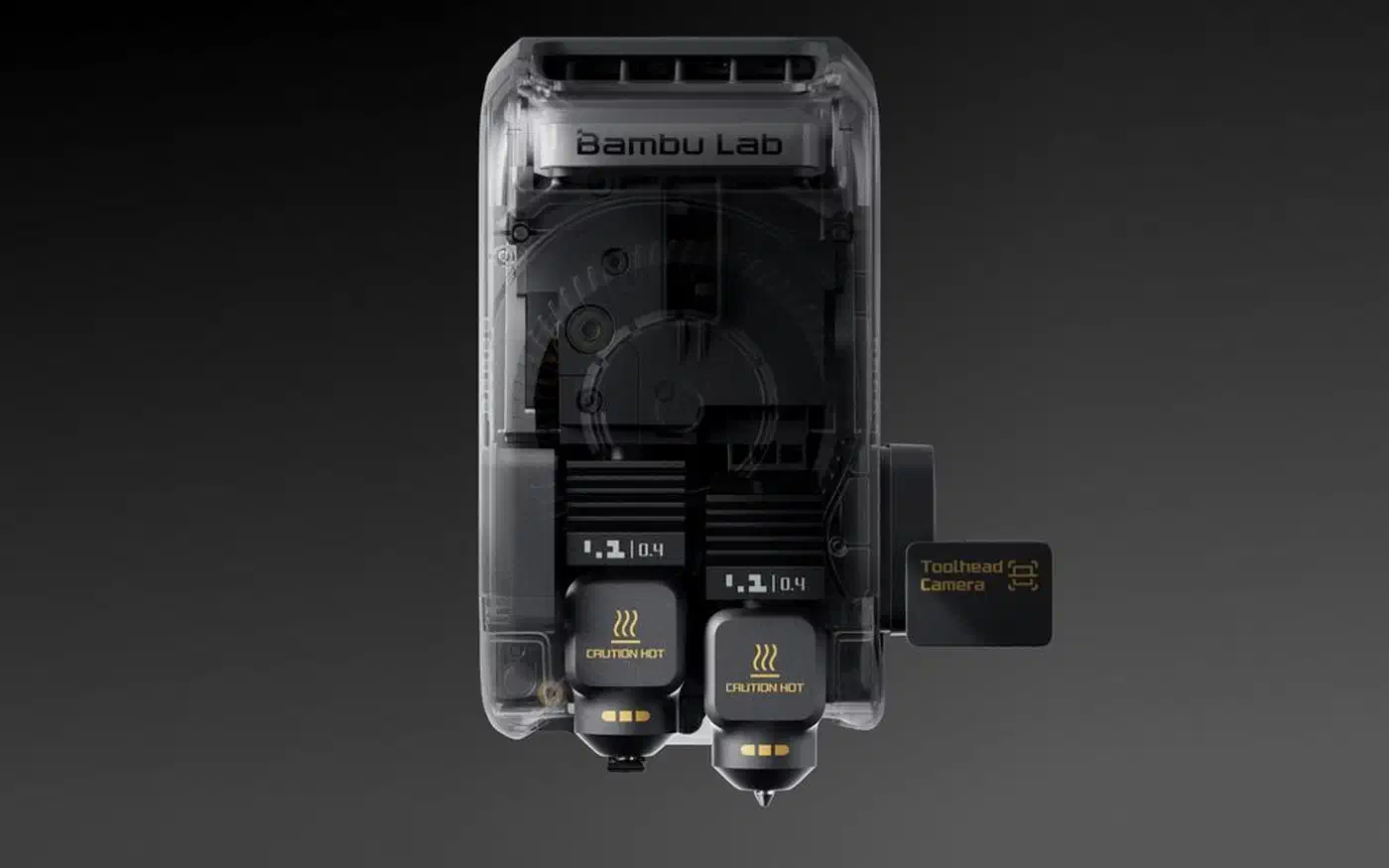
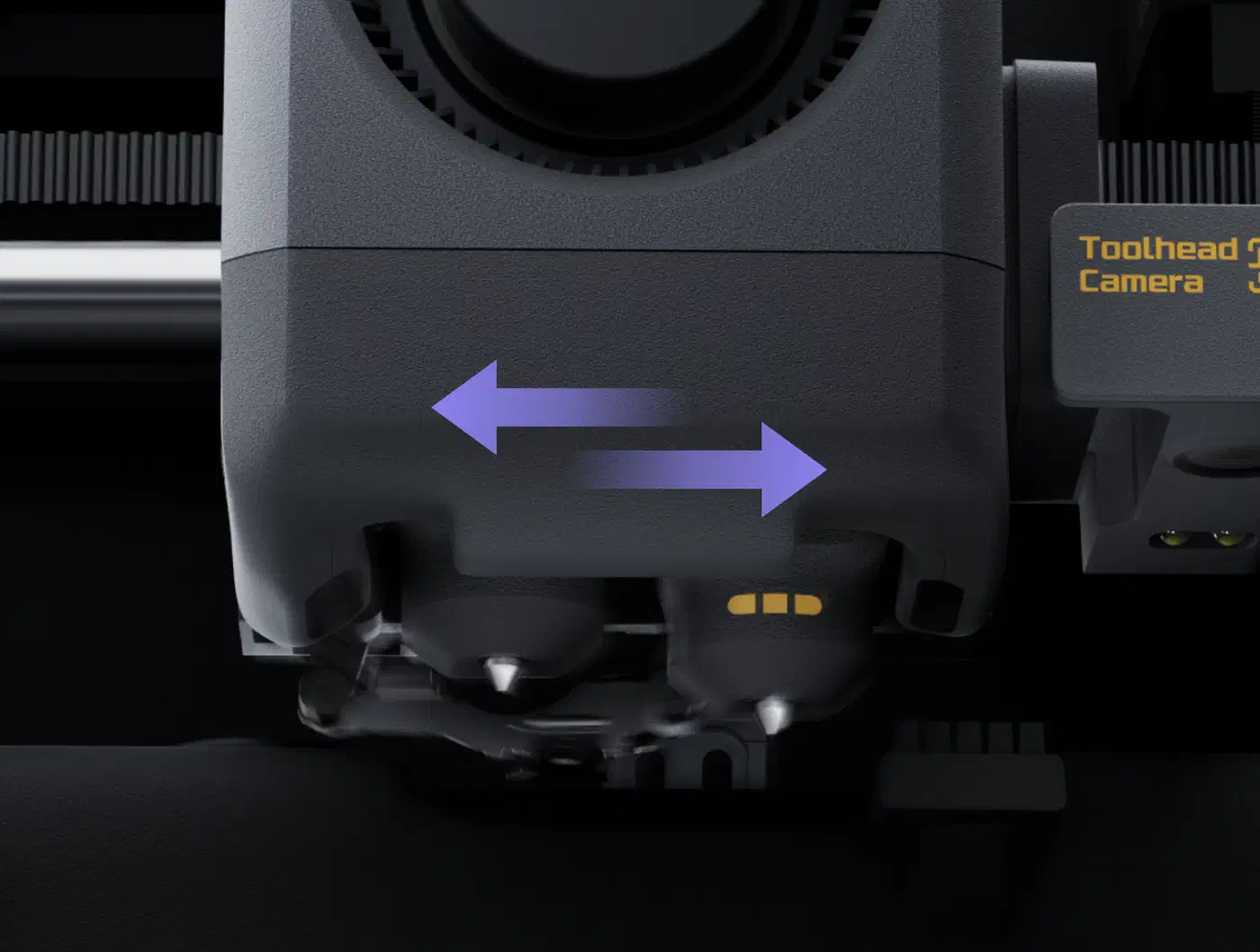
Switching happens with a gear-and-trigger lift inside the toolhead rather than a second motor. The idle nozzle rises off the print plane and a wiper cleans its tip before it comes back down. That is how Bambu keeps an unused nozzle from oozing onto your part.
Build volume is 256 x 256 x 260mm, dropping to 235.5 x 256 x 256mm in dual-nozzle mode because the two tips need an offset. The chamber heats actively to 65C, filtration runs three stages (a G3 pre-filter, an H12 HEPA layer and activated carbon), and the machine weighs 16.25 kg. If floor space counts for more than a second nozzle, the A2L’s 330mm bed buys roughly double that volume for less money.
The widely quoted 1000mm/s figure describes the toolhead’s mechanical ceiling, and real prints land within a few percent of X1 Carbon times.
A true toolchanger parks independent heads and picks one up; the X2D shares a single carriage and lifts one tip out of the way. You get most of the dual-material benefit without the extra motion hardware, and you inherit the shared-carriage limits.
How much filament does a colour change waste?
A single nozzle can only hold one material at a time. Before it prints the next colour clean, it has to push the old one out on every swap, and that flushed plastic goes into a purge tower or a waste chute.
Two nozzles change the arithmetic, because two materials sit loaded at once. The StackSheriff X2D review puts the drop at roughly 70%: two-colour parts that dumped about 40 grams per change now shed 10 to 12 grams.
Take a two-colour model with a dozen changes, and price the waste at $13/kg. That’s what the review’s $60/kg PVA figure implies for standard filament at four to five times cheaper.
| Setup | Purged per swap | Swaps | Total purged | Waste cost |
|---|---|---|---|---|
| Single nozzle plus AMS | 40 g | 12 | 480 g | $6.24 |
| X2D, two nozzles | 11 g | 12 | 132 g | $1.72 |
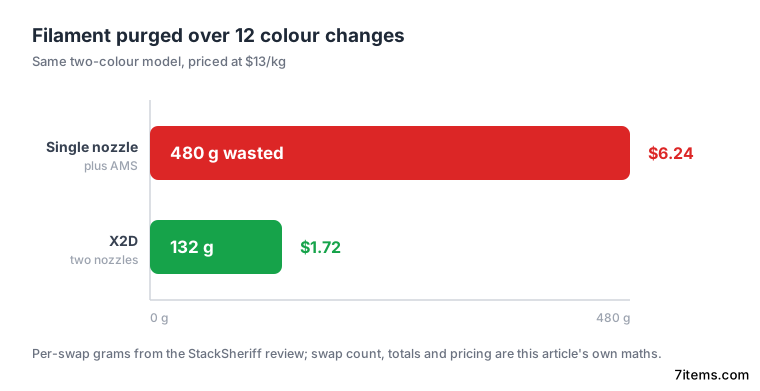
Roughly a third of a spool goes in the bin on the single-nozzle run, filament you paid for and never see.
The per-swap grams and the 70% reduction come from the review; the swap count, the totals and the currency conversion are my own. Filament prices move, so treat the dollar column as a shape rather than a quote. In one job the review logged, a 14-hour PA-CF jig with PVA supports finished with 22 grams of waste. The same part on an X1 Carbon with AMS swaps would have thrown away 80 grams or more.
Dual extrusion isn’t a gimmick at this price; it materially cuts purge waste and unlocks the soluble-support workflow that’s previously been exclusive to $3,000+ printers.
Soluble supports are the underrated half of dual extrusion
Support material is where the second nozzle changes what you can physically build. Load PVA or BVOH on the Bowden side, print the scaffold in it, then drop the finished part in water and let the scaffold disappear.
Internal channels that a knife will never get into, captured moving parts printed already assembled, and deep undercuts all become printable, because you never have to break the support out by hand.
The pairing has to make sense on temperature. PVA and BVOH sit comfortably alongside PLA and PETG on the primary nozzle. High-temperature engineering plastics are harder to pair. The X2D’s 300C nozzle ceiling rules out PA-CF and PC blends that want 310C or more anyway.
First-party PVA runs about $60/kg, four to five times standard PLA, so a support-heavy part costs more to print. Dissolving is also slow, since parts soak for hours. PVA absorbs moisture from the air faster than any other consumer filament, so an open spool degrades quickly. The money cost is real, and the time cost is bigger.
Where the X2D still gives ground
Two nozzles cover two materials, and no more. Past a second material you are back on an AMS feeding one hot end, and that hot end purges exactly as it always did. A six-colour model still wastes nearly as much filament as before.
Flexibles like TPU won’t run reliably through the Bowden side, and abrasives belong on the direct-drive nozzle. The 200mm/s cap comes from the mechanics, so no firmware setting will lift it. Symmetric dual extrusion, where either nozzle can do either job, still costs a lot more.
The lifter also adds a failure mode that single-nozzle machines do not have. Reports on r/BambuLab describe lifter misalignment during multi-material prints, where the parked nozzle drags across the part on a swap. The camera-based first-layer check catches some of it, but a mid-print misalignment is still on the table. Long-run data on how the mechanism holds up over hundreds of swaps does not exist yet.
The X2D follows the same locked-down path as the rest of the recent Bambu line: OrcaSlicer works, but new features reach Bambu Studio first, by six to twelve months in some cases. If open firmware is a requirement, this is not your printer.
Get the X2D if your work is two materials, or if soluble supports would change what you can make. Stick with an AMS-fed single-nozzle machine if you mostly print many-colour models, because two nozzles do not help there.