

Eight materials print at once on the Prusa CORE One INDX

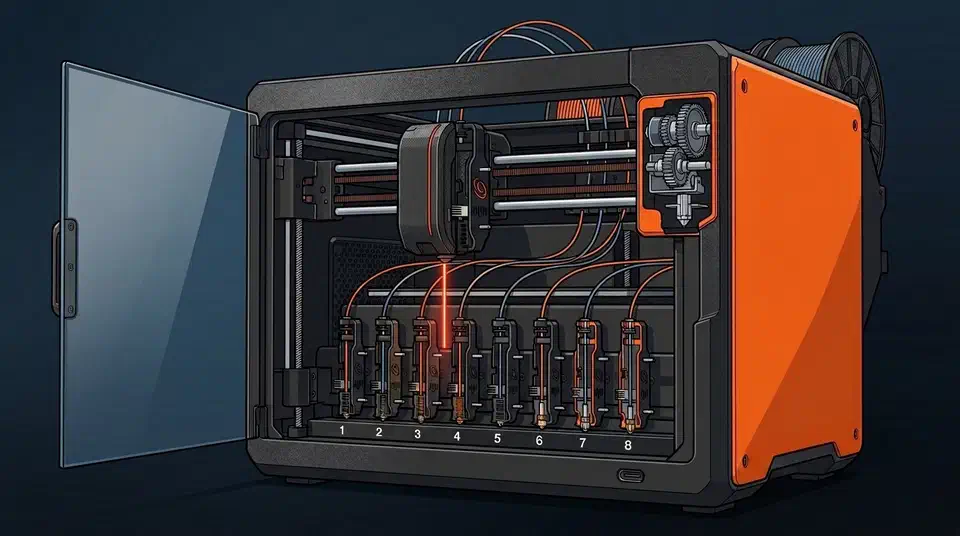
The Prusa CORE One INDX turns an ordinary CORE One into an eight-material toolchanger for 899 euros. One powered head picks up cheap passive tools, so every filament keeps its own nozzle and nothing gets purged between colours. The 8-tool kit costs less than a second CORE One+, which is the comparison every owner will make.
Key Takeaways
- One powered head picks up eight simple tools, each holding its own nozzle.
- Dedicated nozzles mean almost nothing is thrown away between colour changes.
- The 8-tool kit costs less than buying a second printer.
- The tool rack eats 15 mm of bed depth, so tall narrow prints suffer least.
- Two printers still beat one toolchanger for plain single-colour throughput.
What a passive toolhead is, in plain words
A normal toolchanger swaps the whole print head. Motor, heater, thermistor and wiring all ride on the gantry. Every extra tool means buying that whole stack again, which is why toolchangers have always been new machines rather than upgrades.
INDX splits the job in two. One Smart Head carries every expensive part and never leaves the gantry. The tools parked at the front hold nothing but a filament path and a nozzle. Bondtech and Prusa unveiled the design at Formnext as a CORE One exclusive, in 4-tool and 8-tool sizes.
With no wires, heaters or electronics in a tool, adding a fifth or an eighth material costs very little.
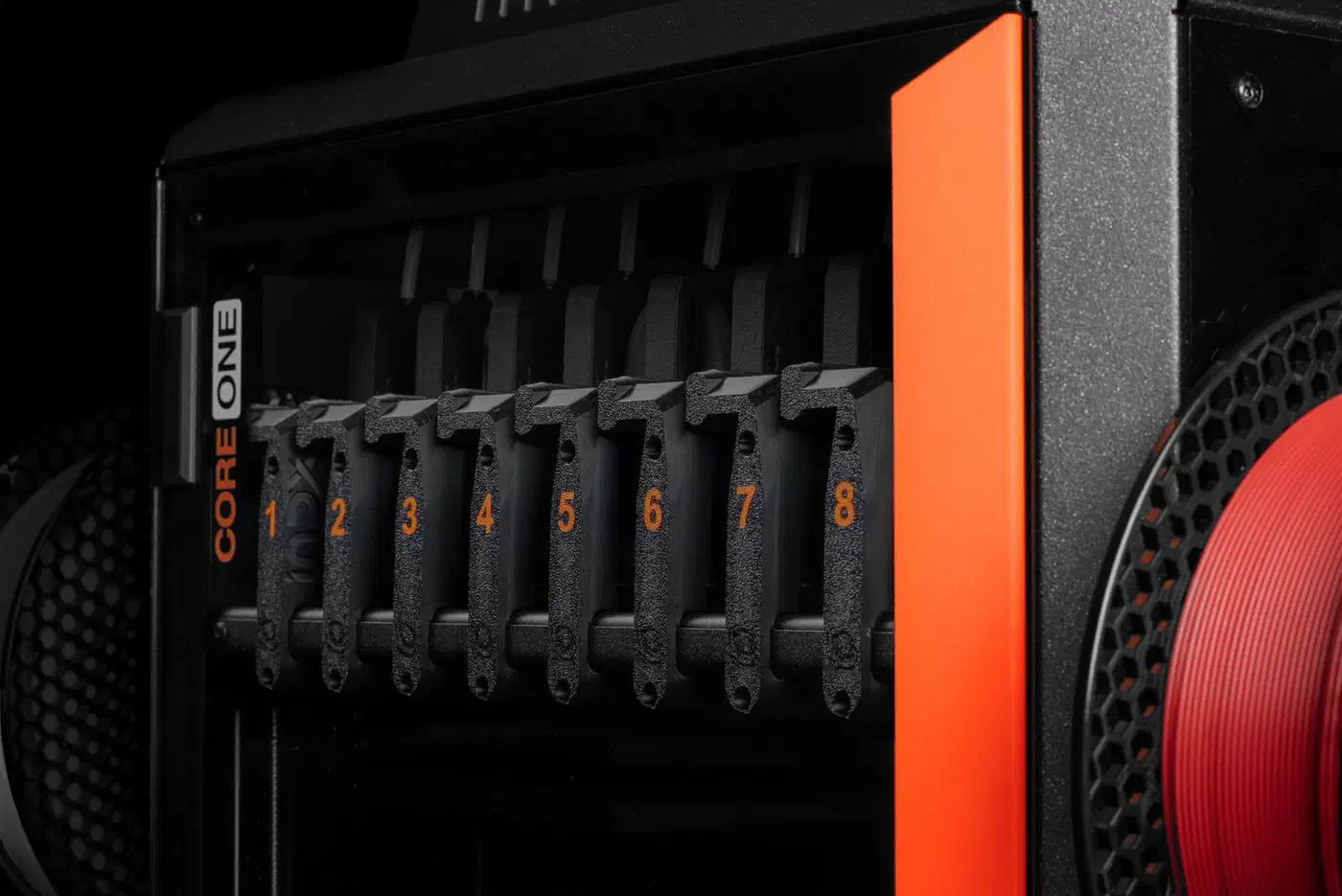
The Smart Head holds an induction coil that fires the moment it grabs a tool. The nozzle is almost weightless, so it hits printing temperature in seconds. VoxelMatters notes that the same low mass lets a parked nozzle cool just as fast, which keeps idle tools from oozing onto the part.
The extruder adapts on its own too. Bondtech’s Dynamic eXtruder uses a cam that reads back-pressure from the filament and grips harder when flow demands it. Rigid PLA and soft TPU both run without anyone touching a tension screw. One stepper motor drives the filament, works that cam, and releases the tool during a swap. A full swap takes as little as 12 seconds.
Printers with two switchable nozzles are a special case: they may look efficient and fast on paper (like “8 seconds per nozzle swap”), but only if you limit yourself to two materials.
What the Prusa CORE One INDX costs against a second printer
| Option | Price | Materials in one part | Effect on throughput | Extra floor space |
|---|---|---|---|---|
| INDX 4-tool kit | 669 euros | 4 | none | none |
| INDX 8-tool kit | 899 euros | 8 | none | none |
| Second CORE One+ kit | 1,049 euros | 1 | doubled | a whole machine |
Two printers finish two single-material jobs in the time one printer finishes one, and no toolchanger can match that. What two printers cannot do is build a single part out of eight materials, which one INDX can. So it comes down to which bottleneck you hit. If your queue is full of plain PLA brackets, buy the second machine. If it is full of parts needing soluble supports, the 8-tool kit is 150 euros cheaper and takes up no extra bench.
Prusa ran five multi-material printers through the same job and weighed what each threw away. On a model weighing 81.7 grams, the worst machine wasted 696.4 grams of filament. The INDX wasted 29 grams. On a rocket engine model the gap grew to nearly thirty to one.
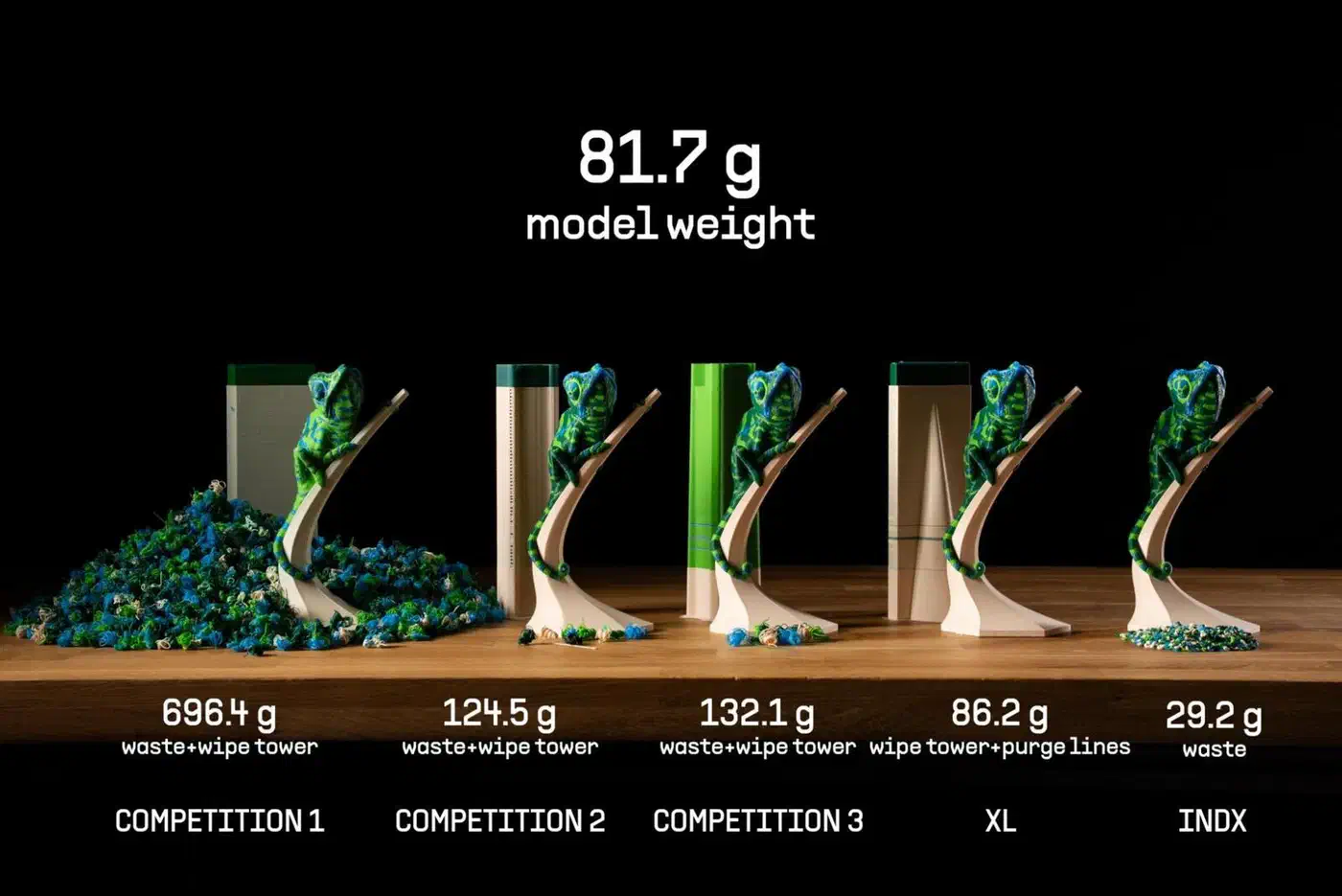
Across 90 colour swaps, an independent review by Filamino measured about 4 grams purged in total, roughly 44 milligrams per swap. A Bambu AMS on a comparable job produced 300 to 800 grams. At 20 to 30 euros a kilogram, a heavy colour habit pays back part of the kit in filament alone.
What the dock takes away from your build volume
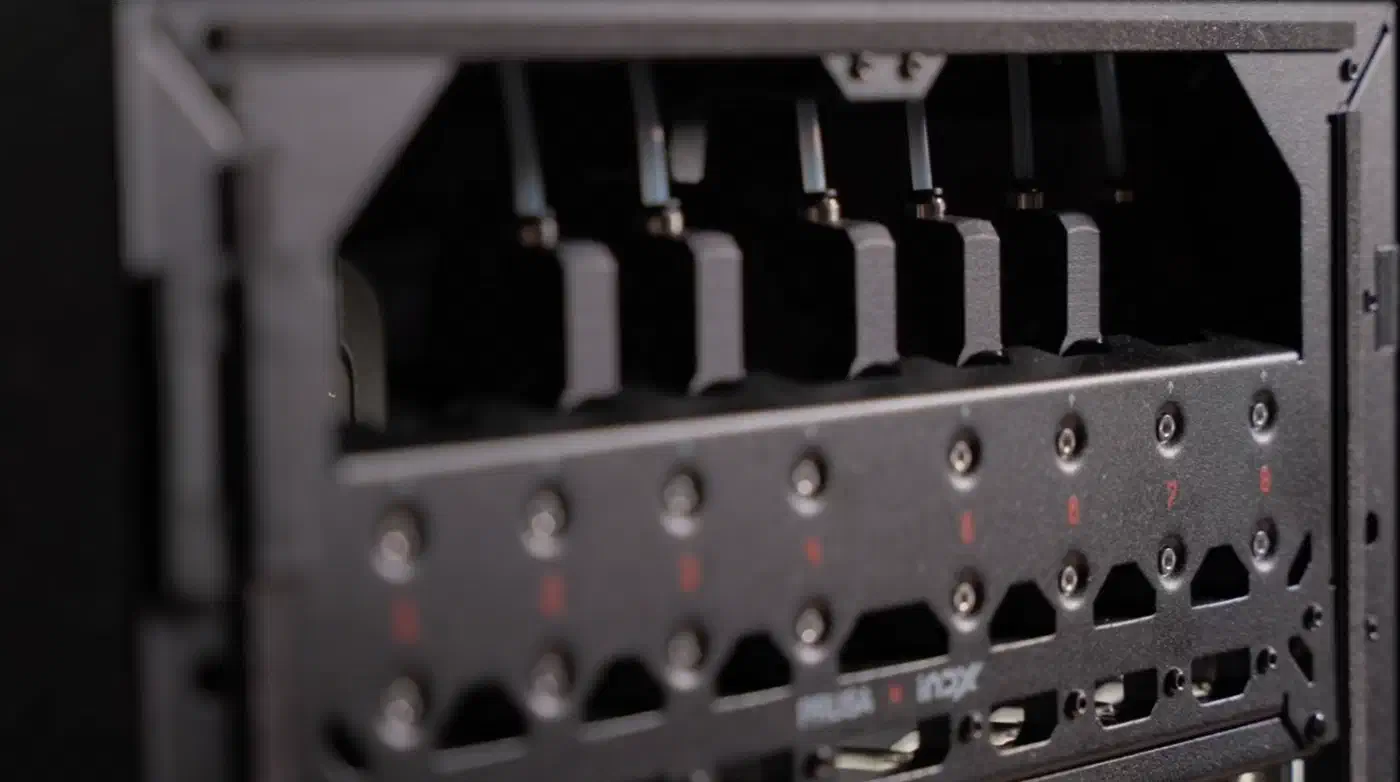
The rack sits along the front of the chamber at 35 mm spacing and permanently claims a slice of the bed.
A CORE One+ with INDX fitted prints 248 x 205 x 270 mm instead of the stock 250 x 220 x 270 mm. You lose 2 mm across and 15 mm front to back. Height is untouched.
Tall narrow models barely notice, since 2 mm of width rarely decides anything. A wide flat plate can become two plates once you lose 15 mm of depth.
The kit replaces the whole Nextruder with the Smart Head, and owners report the step-by-step guide takes five or six hours. Calibration is less work. An inductive sensor measures every toolhead at the start of each print, so swapping nozzle sizes between jobs needs no manual setup.
The kit fits the CORE One and the CORE One+, and it leans on the “+” chamber vent control to hold chamber temperature steady during multi-material prints. Owners of an original CORE One need the Gen 2 conversion first. A kit for the larger CORE One L is planned but has not shipped.
Who should wait, and who should order now
Order now if multi-material is your normal week rather than an occasional novelty. Soluble supports, parts that mix rigid and flexible filament, mixed nozzle sizes and many-colour models all pay the kit back quickly. The time saved counts as much as the filament.
Wait if colour is a treat you print a few times a year. A filament switcher like the MMU3 gets you five materials for far less money.
Wait too if you own a CORE One L, since that kit is still unannounced. Check whether your machine needs the Gen 2 conversion before you budget for INDX alone.
Check these against your own workflow before you buy:
- Does losing 15 mm of bed depth break any plate you print regularly?
- Can you live with 12 seconds per swap on a model with hundreds of changes?
- Are your filaments dry enough that priming pellets stay as small as advertised, at roughly 0.013 to 0.015 grams each?
Toolchanging used to mean buying a new machine, and Bondtech and Prusa have priced it as an upgrade to one you already own. Bondtech is also releasing the design to Voron builders and modders, so it will not stay exclusive to one printer for long.