

30 minutes at 100°C nearly doubles HT-PLA Pro's heat limit

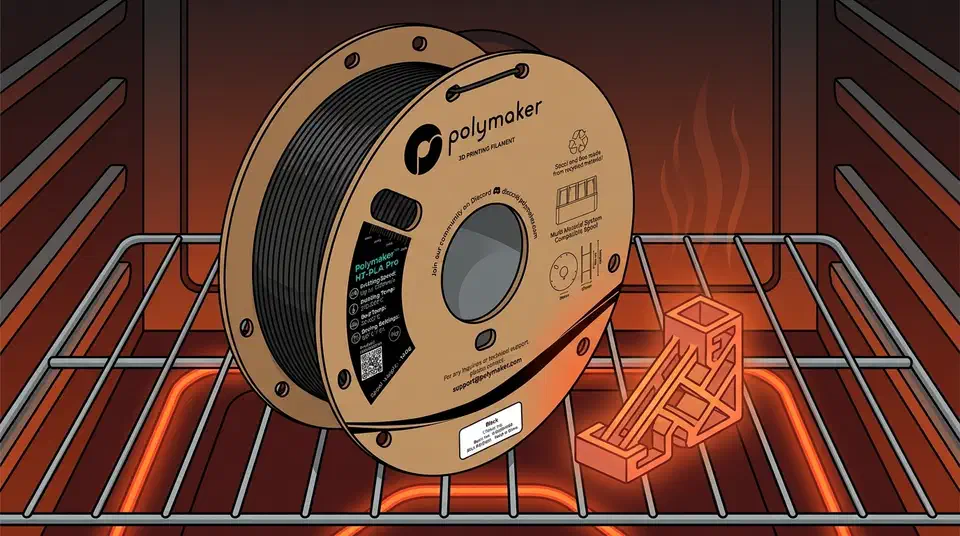
HT-PLA Pro annealing raises a part’s load-bearing heat limit from 56.3°C to 107.6°C after just 30 minutes at 100°C. The much-quoted “won’t sag up to 150°C” is an unloaded softening point, far short of what a loaded part can take. That short oven step unlocks the heat the filament promises.
Key Takeaways
- A 30-minute anneal at 100°C lifts HT-PLA Pro’s load-bearing heat rating from 56.3°C to 107.6°C.
- The “won’t sag to 150°C” claim is an unloaded number, not a limit for parts under load.
- HT-PLA Pro takes more than double the impact of regular HT-PLA.
- Annealing can warp a print, so heat-soak a test part before a full batch.
- It still prints on plain PLA settings, so the heat gain costs only oven time.
What does annealing HT-PLA Pro change?
Annealing is a short heat soak that lets the plastic finish crystallizing. For HT-PLA Pro, that step is the line between a part that softens in warm air and one that holds its shape under load.
The core figure comes from Polymaker’s own HT-PLA Pro datasheet . A 30-minute anneal at 100°C lifts the heat deflection temperature (HDT at 0.45 MPa) from 56.3°C to 107.6°C. HDT is the temperature at which a part carrying a light load starts to bend.
As printed, 56.3°C is barely above a hot car interior on a summer day. Annealed, 107.6°C clears the temperature of boiling water. The heat and time give the polymer chains room to crystallize more fully, so the gain sticks.
The datasheet lists that 107.6°C figure at the lighter 0.45 MPa test load only. It does not publish a number for the heavier 1.8 MPa load, so size safety margins around the load you expect.
Why “won’t sag up to 150°C” isn’t a heat limit
The headline marketing number and the number a functional part needs are two different measurements. Mixing them up leads makers to over-trust the plastic.
The 150°C figure is a Vicat softening point. Off the plate it reads 148.3°C, rising to 150.5°C after annealing, and both are tested with no external load beyond the part’s own weight. That tells you the shape holds on a shelf in a warm room. It says nothing about a bracket carrying weight.
Heat deflection temperature is the number to trust for a part that bears force, because it is measured under a defined load.
| Measure | What it tests | As printed | Annealed |
|---|---|---|---|
| Vicat softening | Shape held with no load | 148.3°C | 150.5°C |
| HDT at 0.45 MPa | Shape held under a light load | 56.3°C | 107.6°C |
A part trusted to the 150°C marketing figure can deform under load at barely a third of that heat. Hackaday’s write-up on HT-PLA’s marketing makes the same point. The headline heat claim is an unloaded softening point, and real heat-under-load performance shows up only after annealing.
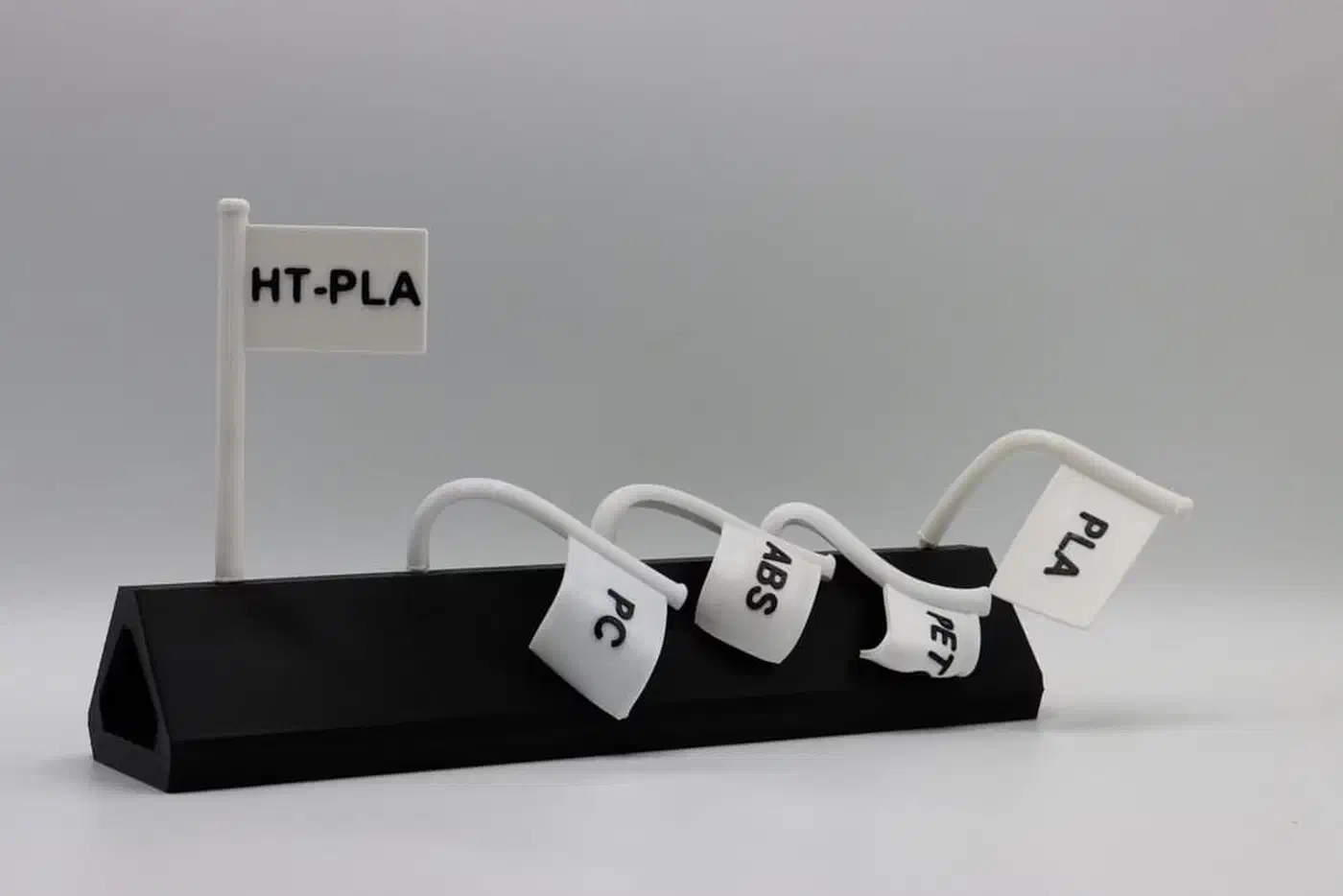
the short version is that this is mechanically like PLA and can take the heat
How much tougher is HT-PLA Pro than regular HT-PLA?
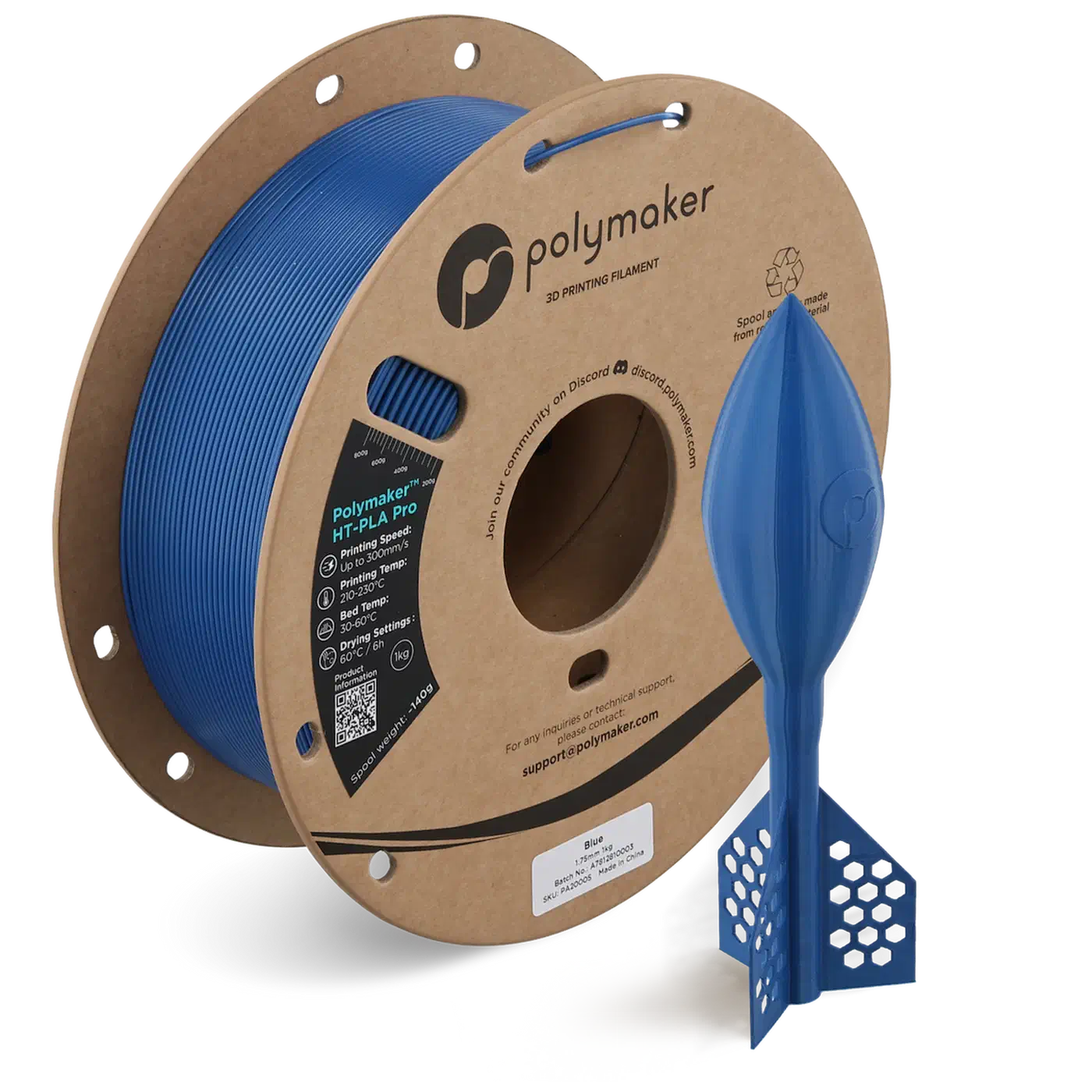
The “Pro” in the name covers more than heat. It also brings a big jump in impact and layer strength, which counts for parts that get dropped or stressed across layers.
Impact strength more than doubles, so HT-PLA Pro shrugs off a sharp knock that would crack the plain grade. Z-axis adhesion climbs about 30% too, and layer lines are exactly where PLA prints tend to split, so that gain is the one you feel when a part is dropped.
| Property | HT-PLA Pro | Regular HT-PLA |
|---|---|---|
| Impact strength | 9.94 kJ/m² | 4.94 kJ/m² |
| Z-axis interlayer adhesion | 26.8 MPa | 20.8 MPa |
| Vicat softening, unloaded | up to 150.5°C | up to 150°C |
Regular HT-PLA earns the same 150°C unloaded rating. It recommends the same 30-minute 80 to 100°C anneal, 100°C preferred, per the HT-PLA datasheet . So pick HT-PLA Pro when the part sees impact or layer stress on top of heat. Plain HT-PLA is fine when heat stability alone is the goal.
How do you anneal HT-PLA Pro without warping it?
Annealing buys the heat gain, but it also risks warping and shrinkage.
Both grades print on ordinary PLA settings, which is why the heat gain costs only oven time. Polymaker suggests a nozzle around 230°C, the high end for PLA, with print speeds up to 300 mm/s and no enclosure needed.
| Setting | Value |
|---|---|
| Nozzle temperature | around 230°C |
| Build plate | 25 to 65°C |
| Print speed | up to 300 mm/s |
| Anneal | 30 min at 100°C |
Expect a dimensional change of 0.3 to 0.6% after the soak, with a slight difference between the XY and Z axes. Design tight-fit parts with that shift in mind. Large or thick parts warp most, so anneal a test part before you commit a whole batch.
How to anneal HT-PLA Pro for load-bearing heat
Pick a uniform heat source
Use a forced-air drying oven for even heat. A household oven can overheat the element-facing side and soften it, so wrap the part in aluminum foil to spread the heat. A water or oil bath works too, as long as the part never touches the hot bottom of the container.
Preheat to 100°C
Bring the oven to 100°C and wait until it holds that temperature. Only then does the part go in.
Keep the part on the bed if it fits
Place the whole plate in the oven, bed at the bottom and part facing up, so the flat plate anchors the part against distortion. If you must take it off the plate, leave the supports on and keep its original print orientation.
Soak by wall thickness
Hold the part by how thick its walls are: 30 to 60 minutes under 4 mm, 1 to 2 hours at 6 mm, 2 to 4 hours at 8 mm, and 3 to 6 hours at 10 mm. Thicker cores need the core itself to reach heat, not just the surface.
Ease large or thick parts up to temperature
Bulky parts warp the most. Hold them at 60°C until the core is uniform, then ramp quickly to 100°C. A programmable oven makes this hands-off and cuts the chance of permanent deformation.
Cool, then measure
Let the part cool in the oven before you pull it out. Then check the fit, and expect that 0.3 to 0.6% change between the XY and Z axes.
Annealed HT-PLA Pro suits the warm spots the datasheet names: a sunlit windowsill bracket, or a mount placed near heat-emitting machinery. For those jobs, the 30-minute soak turns a marketing number into heat the part can carry.