

6K 3D without glasses arrives on Samsung's Odyssey G90XH


The Samsung Odyssey G90XH is the first 6K monitor with glasses-free 3D. Split a 6,144-pixel-wide panel between two eyes and each eye gets about 3,072 pixels. The optics are proven, so the size of the 3D game library is what should decide the purchase.
Key Takeaways
- The Odyssey G90XH is a 32-inch 6K screen that shows 3D without glasses.
- Splitting the picture between two eyes leaves each eye about half the width.
- A camera watches your eyes, so only one person sees the effect.
- Samsung counts more than 60 3D-ready games and promises 120 by the end of 2026.
- A plain Odyssey G8 gives you the same 6K panel without the 3D layer.
What Samsung announced, and which claim is a first
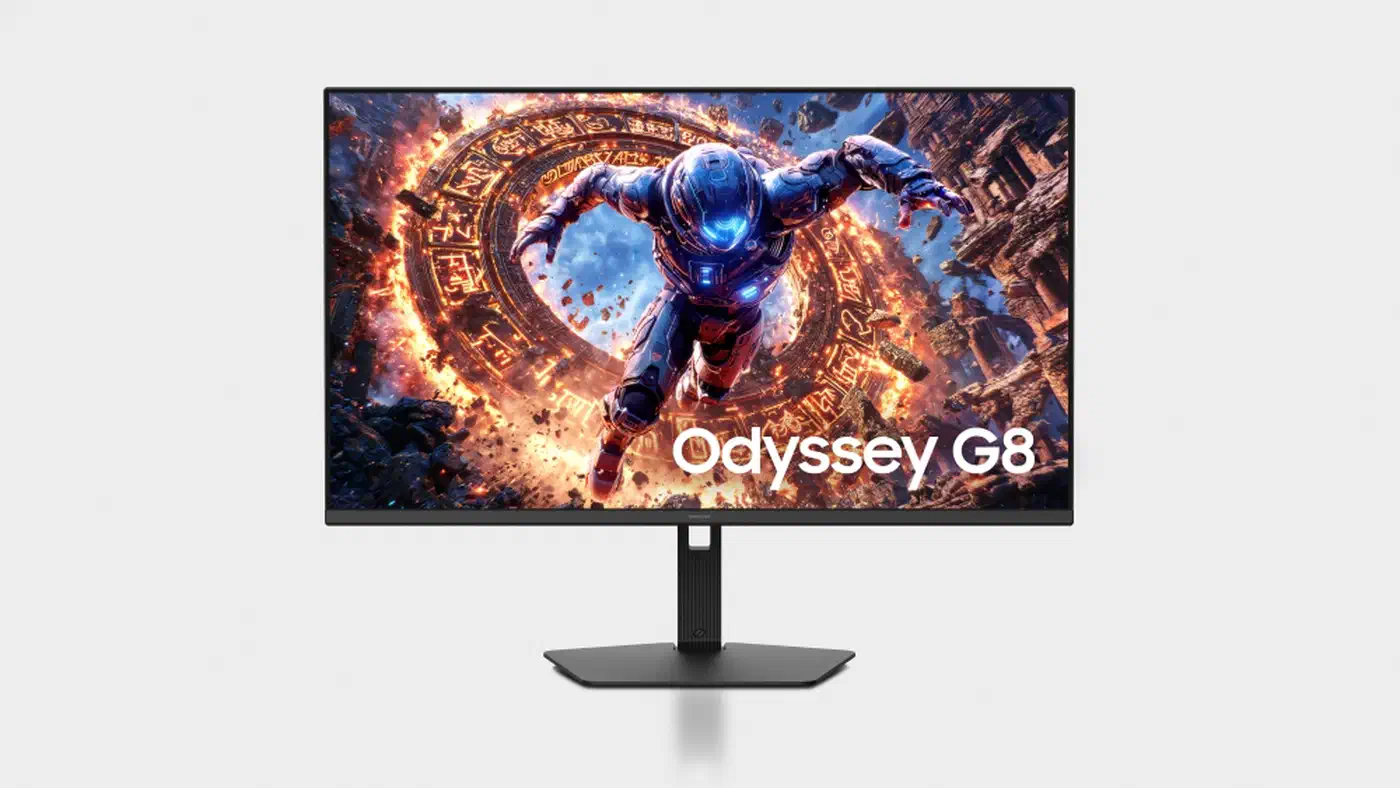
Two world-first claims arrived together, and they belong to two different monitors. The Samsung newsroom announcement gives the 32-inch Odyssey 3D, model G90XH, the world’s first 6K glasses-free 3D display. The separate 32-inch Odyssey G8 takes the industry-first 6K gaming monitor title, and it has no 3D at all.
Both use the same panel on paper: a 6,144 by 3,456 IPS screen running at 165Hz, with a Dual Mode that reaches 330Hz at 3K. The G90XH adds a glasses-free 3D layer, eye tracking and 2D to 3D conversion on top of that. Everything else about the two 32-inch models is identical.
| Model | Size | Resolution | Refresh rate | Glasses-free 3D |
|---|---|---|---|---|
| Odyssey 3D G90XH | 32 in | 6K, 6,144 x 3,456 | 165Hz, 330Hz at 3K | Yes |
| Odyssey G8 G80HS | 32 in | 6K, 6,144 x 3,456 | 165Hz, 330Hz at 3K | No |
| Odyssey G8 G80HF | 27 in | 5K, 5,120 x 2,880 | 180Hz, 360Hz at QHD | No |
| Odyssey OLED G8 G80SH | 32 in | 4K, 3,840 x 2,160 | 240Hz | No |
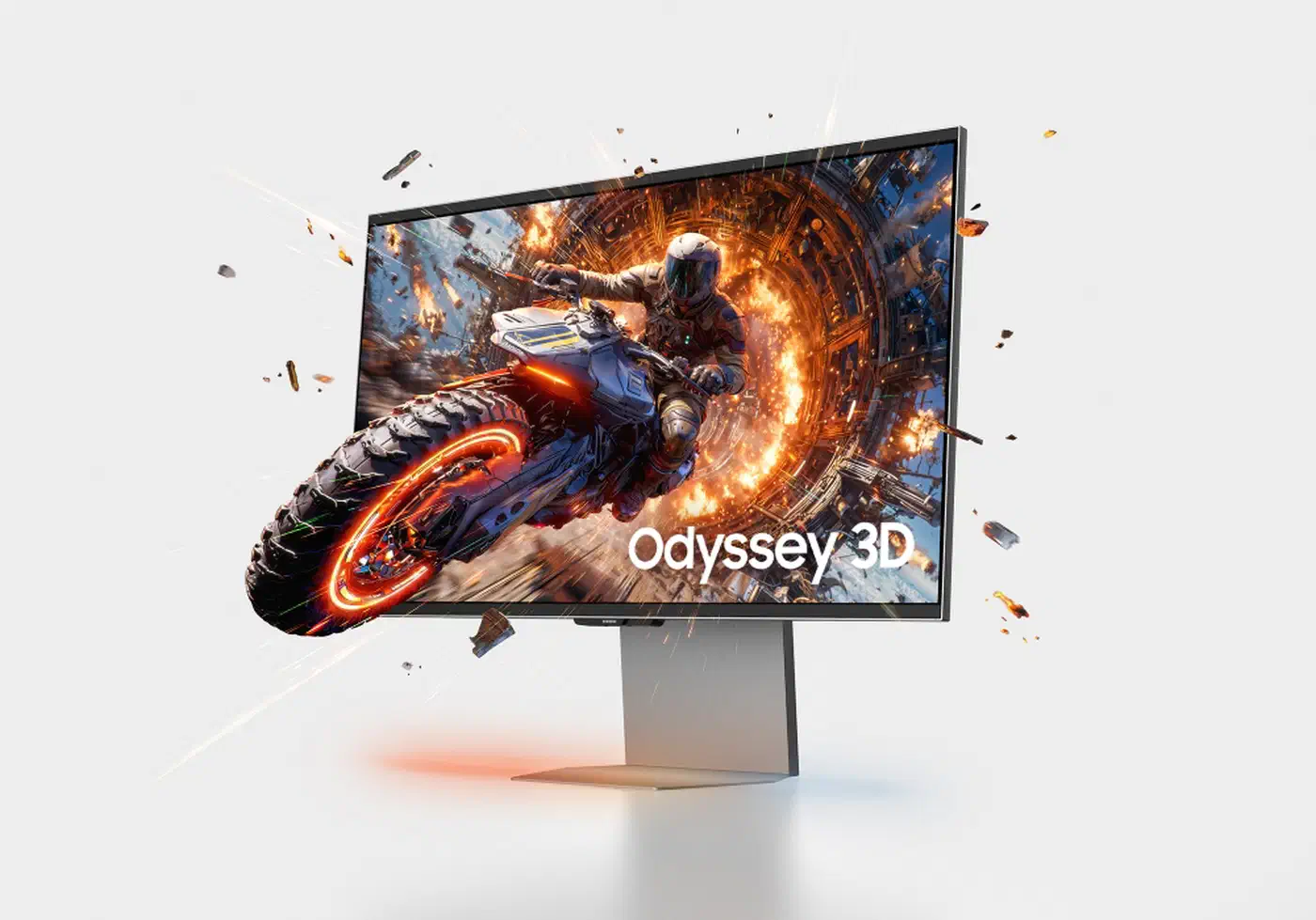
Samsung is treating 3D as a gaming feature only. Its ViewFinity creator monitors shipped alongside these without it.
Price and ship date for the G90XH are still unpublished, though the non-3D models already have both. Tom’s Hardware reports $1,599.99 for the 32-inch 6K G8 and $949.99 for the 27-inch 5K version. The previous 27-inch Odyssey 3D, the G90XF, arrived around $2,000, which sets a rough floor.
How does glasses-free 3D work on a monitor?
A sheet of lenticular lenses sits on the front of the panel. Each tiny cylinder bends the pixel columns underneath it in slightly different directions, so your left eye and right eye receive different columns. Cameras in the bezel track where your eyes actually are, and the software remaps which columns feed which eye as you shift in your chair.
The split costs horizontal pixels. A 6,144-pixel-wide panel serving two views hands each eye roughly 3,072 pixels across, while the 3,456 vertical pixels stay intact. Samsung does not print that figure anywhere, so treat it as our arithmetic.
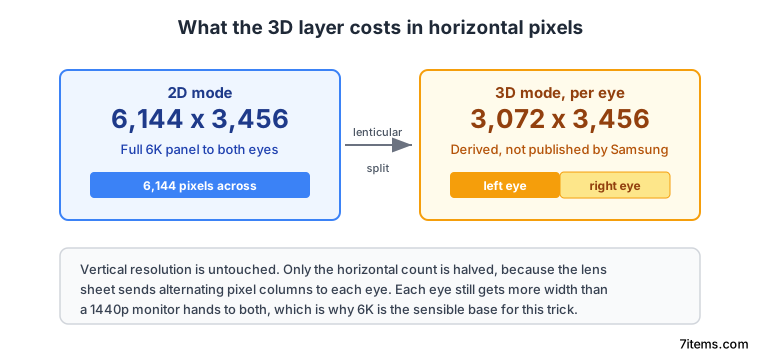
On the older 4K G90XF, the effective picture drops from 3,840 by 2,160 to 1,920 by 2,160 per eye once 3D turns on. The 6K panel is therefore the minimum that keeps a 3D image looking like a modern desktop.
Eye tracking is the fragile half of the system. It locks onto one face, so the effect works for a single viewer sitting still and facing forward. A second person standing beside you sees a smeared image, which software cannot correct.
Games reach the display through Samsung’s Odyssey 3D Hub app, and a title has to support that path explicitly. Everything else runs in ordinary 2D.
Glasses-free 3D has failed before, so what changed
Consumer 3D has a long record of being launched and then withdrawn. 3D televisions ran from about 2010 to 2016 before every major brand dropped them, Nintendo shipped stereoscopic handhelds and then stopped, and early autostereoscopic sets from other vendors never found buyers at all.
Eye tracking has since become cheap and accurate enough to follow a head in real time, and panel density has caught up too. After the split, each eye on the G90XH still sees more horizontal pixels than a 1440p monitor delivers to both. A 32-inch 6K panel packs 216 pixels per inch , about double what 4K manages at the same size.
Content is the part that has not changed. A display feature without a steady supply of software dies regardless of how good the optics are. Notebookcheck reports that Samsung’s Odyssey 3D Hub library holds more than 60 supported titles, with more than 120 targeted by the end of 2026. Named launch titles for the new panel include The First Berserker: Khazan, Lies of P: Overture and Stellar Blade.
Christian de Looper reviewed the earlier G90XF for Reviewed :
The 3D effect on the Samsung Odyssey 3D G90XF is very cool, but it’s limited in availability right now. Unless you’re that perfect buyer, it’s worth going for a better 4K monitor that doesn’t feature 3D.
The lenticular layer is a physical sheet that sits in front of your desktop whether 3D is on or off. Whether that costs anything in plain 2D sharpness is a question for a reviewer with the panel on a bench.
What to check before buying the Samsung Odyssey G90XH
Five things decide whether this monitor is worth the premium over a plain 6K screen.
- Per-eye resolution in 3D mode. Get it from a review with real measurements.
- Shipped titles. Count the games you can play in 3D today, and treat a roadmap number as a plan.
- Refresh rate while 3D is active. Headline refresh figures usually apply to 2D, so ask what the panel does with both views running.
- Whether 3D switches off completely. Confirm that 2D mode looks as sharp as the non-3D G8 sitting next to it in the lineup.
- The gap to the G80HS. The plain 6K G8 gives you the same panel and the same Dual Mode, so a large 3D premium with none of your games on the list points back to it.
One item the spec sheet rarely spells out is the pipe that feeds all those pixels. A 6K panel at 165Hz in full color needs the newest cable tier, and HDMI 2.2’s 96Gbps ceiling is what carries it without compression.
For most people the 6K panel is the real upgrade here, and the 3D is a bonus that either has your games or does not. Check the list first. And if the pixels matter more than the 3D, the same count also comes stretched sideways: Dell spreads 6K across a 52-inch ultrawide built to swallow a three-screen desk.