

550Hz on a QHD Mini LED screen arrives with the 27P2A Ultra

The TCL 27P2A Ultra is a 27-inch gaming monitor that runs QHD at a native 550Hz on a Mini LED panel, then doubles to 1040Hz by dropping to 720p. That is the fastest refresh rate announced for a Mini LED screen. TCL has not shared its dimming-zone count.
Key Takeaways
- It runs a full QHD picture at 550Hz.
- It hits 1040Hz only by dropping to 720p.
- Mini LED rarely goes this fast; OLED usually does.
- TCL hid the dimming-zone count, so contrast is a question mark.
- It launches in China first, with no price and no ship date.
What is the TCL 27P2A Ultra?
TCL calls the 27P2A Ultra a “Mini LED esports” monitor. It is a 27-inch screen with a native 2560x1440 (QHD) resolution and a 550Hz refresh rate, per TFTCentral’s write-up of the launch. A dual-mode button then doubles the refresh to 1040Hz, which is expected to run at 720p like other 1000Hz-plus screens, per Tom’s Hardware.
The panel is TCL CSOT’s own “HFS Shoot” design, a high-speed IPS-type LCD. It carries a 1ms grey-to-grey response spec and a 0.1ms MPRT spec, and that second number points to a blur-reduction mode. TCL brands the strobing tuning “Tmoc Super Dynamic Sharpness,” while the Mini LED backlight uses a proprietary “Wanzone Partition” system.
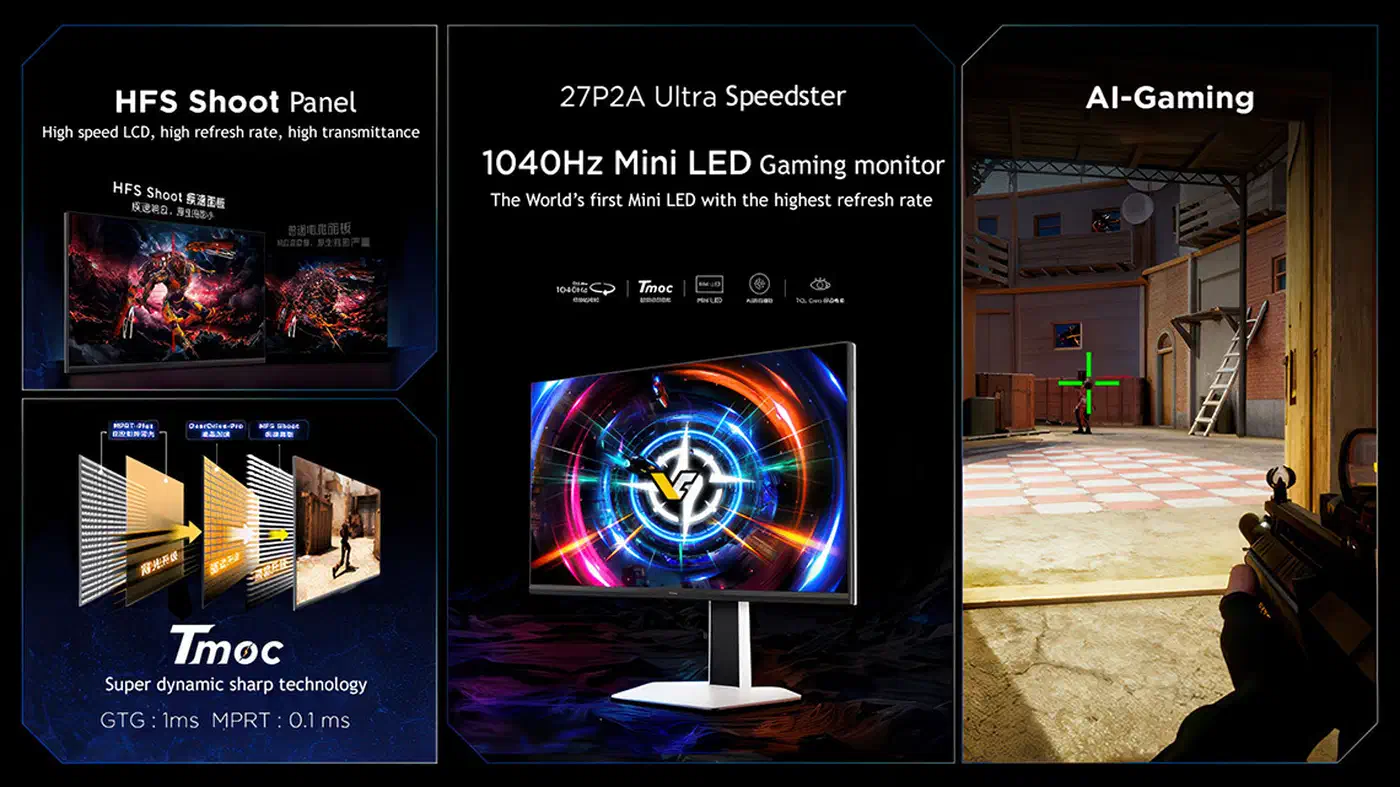
TCL also lists a set of AI gaming features: dark-area enhancement, faster recovery after flash effects, and dynamic crosshairs. They run in software on top of the panel.
TCL did not publish the number of dimming zones, the peak brightness, or whether HDR is supported. The model is listed as “coming soon” with no confirmed price, and it launches in China first.
How does a Mini LED panel reach 550Hz?
The speed comes from the LCD layer, not the backlight. Mini LED is a backlight technology: it packs thousands of tiny LEDs behind a normal LCD panel. The refresh rate depends on how fast that LCD layer can switch.
Here the switching speed comes from TCL CSOT’s HFS panel. HFS is an evolution of FFS (Fringe Field Switching), and TCL says it reaches over 2000:1 contrast, versus about 1000:1 on older FFS panels.
Dual-mode is a straight trade of resolution for speed. The panel drives every QHD pixel at 550Hz. Hitting 1040Hz means switching to a 720p pixel grid, which is far fewer pixels to refresh each cycle.
The 0.1ms MPRT spec signals backlight strobing, where the backlight blinks between frames to cut motion blur. That is separate from the 1ms grey-to-grey pixel response.
The spec sheet does not say whether a Mini LED backlight can dim and brighten its zones fast enough to track a 550Hz image. It may simply switch local dimming off at top speed, and TCL has not said either way.
Why a 550Hz Mini LED breaks the OLED speed pattern
For years, Mini LED has been the panel people buy for OLED-like brightness without burn-in risk. The trade was refresh rate, which OLED usually won. A 550Hz native, 1040Hz dual-mode Mini LED flips that trade.
It is the first Mini LED gaming monitor to pass 1000Hz, per Notebookcheck. Samsung and HKC already passed 1000Hz on other panel types, per Tom’s Hardware.
TCL has published the panel’s speed but has not shown that the backlight control keeps up at 550Hz. OLED avoids the problem because each pixel makes its own light.
The dimming zones TCL did not mention
On any Mini LED panel, the local dimming zone count governs contrast, blooming, and the halo around bright objects. TCL published none of that for the 27P2A Ultra, which leaves the most important Mini LED spec blank.
TCL was specific elsewhere in the same launch: its 27C3A Pro Mini LED lists 2304 dimming zones and 2200 nits of peak brightness.
A high zone count and a very high refresh rate can also work against each other. Local dimming needs the backlight to respond zone by zone, and at 550Hz there is very little time per frame for that to happen.
An esports panel tuned for speed may run few zones, or none at top refresh, which would give up the contrast people buy Mini LED for.
How the 27P2A Ultra fits TCL’s 2026 lineup
TCL launched a family of screens, and the 27P2A Ultra is the fastest of them, next to two more balanced siblings.
| Model | Panel | Resolution | Refresh (native / dual) | Dimming zones | Price |
|---|---|---|---|---|---|
| 27P2A Ultra | Mini LED, HFS IPS-type | QHD (2560x1440) | 550Hz / 1040Hz at 720p | Not disclosed | Not confirmed |
| 27C3A Pro | Mini LED, HFS IPS-type | 4K (3840x2160) | 165Hz / 320Hz at 1080p | 2304 | CNY 3199 |
| 32X3A | OLED+, WOLED | 4K (3840x2160) | 240Hz / 480Hz at 1080p | Not applicable | CNY 5999 |
The flagship is the TCL 32X3A, a 31.5-inch 4K “OLED+” panel that peaks at 1300 nits with 10-bit color and a Bang and Olufsen audio system. The mainstream Mini LED is the 27C3A Pro, a 27-inch 4K screen with a 2304-zone backlight, which works out to roughly £346. A larger 32C2A Pro adds a 4K “Fast HVA” VA-type panel at 160Hz with the same 2304-zone backlight for CNY 3999.
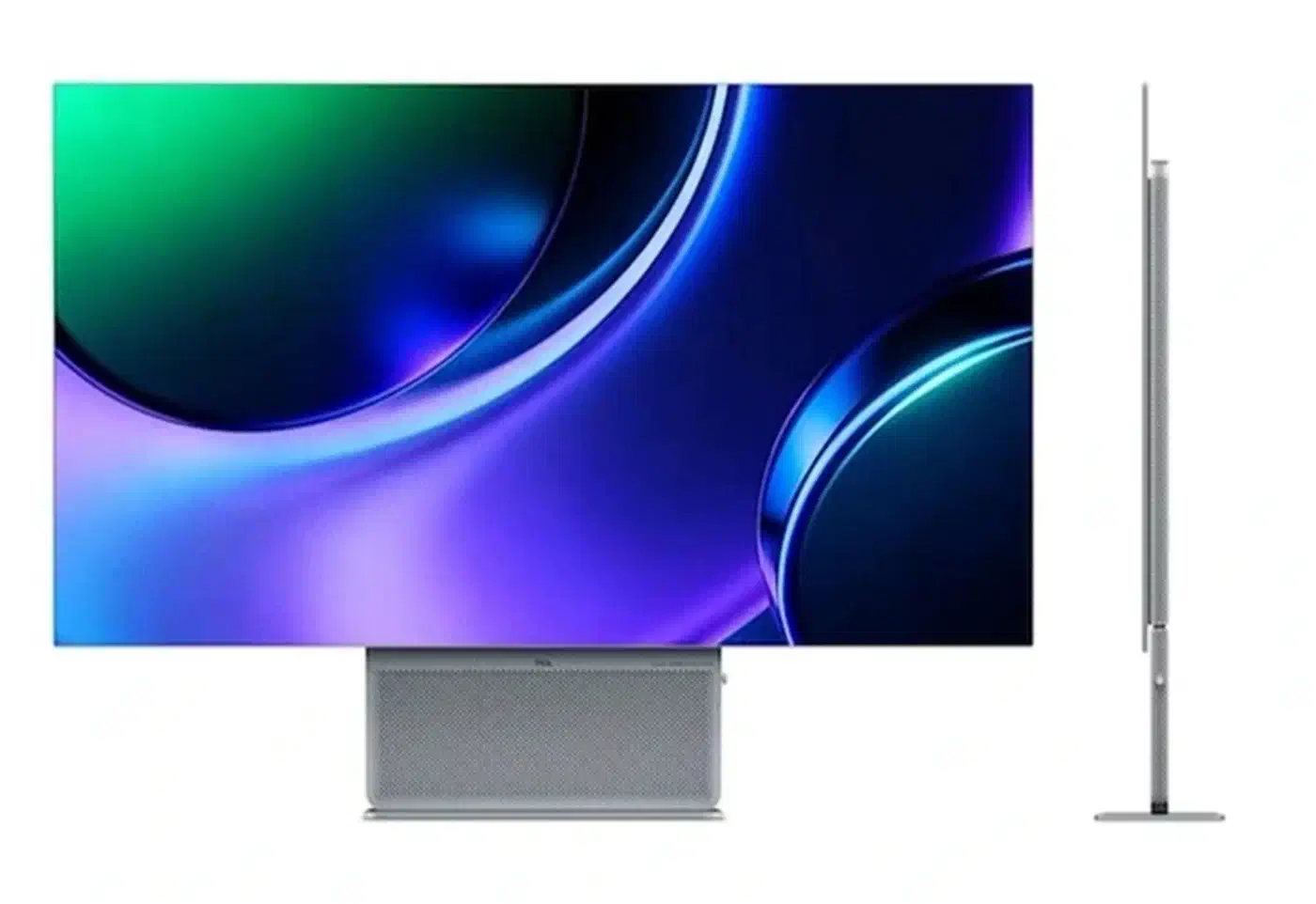
Against that family, the 27P2A Ultra is the speed halo. It drops to QHD and chases refresh rate for competitive play, with its zone count still unpublished.
When can you buy the 27P2A Ultra?
Not yet. The 27P2A Ultra is listed as “coming soon” rather than on sale, unlike some siblings from the same event that opened pre-sales. Pricing was not confirmed either.
The launch is China-first, and TCL has said nothing firm about Western markets.
Until an independent review of a shipping unit lands, the 550Hz and 1040Hz figures are announced specs that no one has measured.