

The X2D's 65°C chamber is what finally makes ABS behave

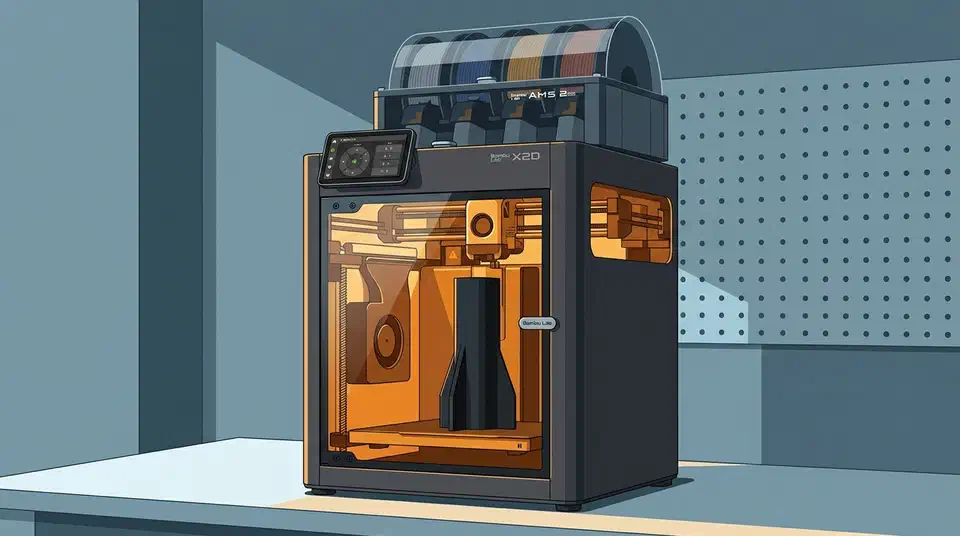
The Bambu X2D heated chamber has its own heater and holds 65°C, well above what a passive box reaches on bed heat alone. That one change is what makes ABS and polycarbonate hold their layers. Warping comes from uneven cooling, and chamber temperature is the one setting that touches that cause directly.
Key Takeaways
- The X2D has a dedicated chamber heater, so the air is warmed on purpose.
- Parts warp because they cool unevenly, which no amount of bed grip solves.
- ABS, ASA and polycarbonate gain the most; PLA and PETG want cool air.
- The printer swaps between recycled warm air and fresh outside air on its own.
- A hot chamber puts out more fumes, so filtration runs in three stages.
Why parts warp
A printed part shrinks as it cools, and it cools from the outside in. The layers near the plate finish contracting while the layers above them are still soft and hot. Those cooled layers are now slightly too short for the part sitting on top of them, so the whole thing pulls its own corners off the plate.
Glue sticks, brims and textured plates all fight that pull, and all of them treat the symptom. The corner lifts because the part is fighting itself. A stronger grip on the plate just moves the stress somewhere else, usually into a crack halfway up a tall wall.
An enclosure that keeps the whole part near the same temperature removes the cause. If the bottom layers never get the chance to cool and contract ahead of the top ones, there is no internal tug-of-war to lose. That is the entire argument for a heated chamber, and it works on the cooling rate, which is where the stress starts.
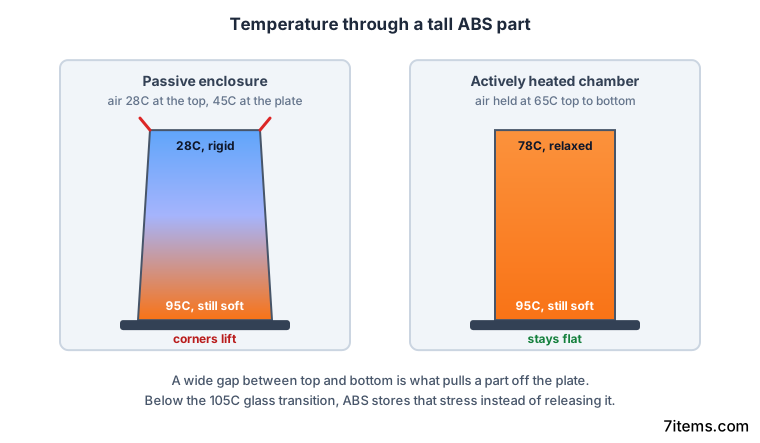
Passive enclosures get partway there. They trap whatever heat the bed throws off, which on a tall print means a warm bottom and a cool top. Anton Mansson’s X2D hardware breakdown puts the difference plainly. Active heating holds a steady temperature through the whole print, and that is what governs layer adhesion in ABS, ASA and nylon.
What chamber temperature does each material need?
Below its glass transition, a plastic is rigid and locked into whatever shape it has. Above it, the plastic is soft enough to relieve stress as it builds. So the useful question is how far the chamber sits below that line.
| Material | Glass transition | Chamber wanted | Warping without one | Verdict |
|---|---|---|---|---|
| PLA | 60-65C | none, cool air | very low | a hot chamber hurts it |
| PETG | 80-82C | none, cool air | low | no benefit |
| ABS | 105°C | 50-65C | severe | genuine case for 65°C |
| ASA | 100°C | 50-65C | severe | genuine case for 65°C |
| Polycarbonate | 147°C | 65°C and up | severe | 65°C helps, more would help further |
| Nylon | 70-80C | 40-60C | high | moisture is the bigger fight |
| Polypropylene | below room temp | 65°C does little | extreme | chamber is the wrong lever |
Those figures come from 3D Solved’s filament comparison . ABS at 105°C and ASA at 100°C sit far enough above the chamber that the part stays solid, but warm enough that the shrinkage never gets a head start. That gap does the work, and polycarbonate at 147°C would happily take more chamber heat than the machine offers. Nylon is the odd one: a moderate chamber helps, but wet filament ruins a nylon print long before cooling rate does, so drying nylon first matters more than any chamber setting. With carbon-fiber grades the stakes climb, since humidity even flips the winner between PPA-CF and PA6-CF, and the same soak erases PA6-CF’s strength lead over PA12-CF.
Polypropylene is semi-crystalline and its glass transition sits below room temperature, so its shrinkage comes from crystallising as it cools. MatterHackers’ polypropylene guide points at controlled cooling and the right bed surface instead. A 65°C chamber does not fix PP.
PLA softens at 60-65C, which is the chamber setpoint, so a heated chamber does it active harm. Hold PLA in that air long enough and the filament goes soft inside the melt path before it ever reaches the nozzle, and you get heat creep and jams. “Warmer is always better” fails here. To make a PLA-family part hold real heat, the fix is annealing HT-PLA Pro after the print, not warming the chamber during it.
How the X2D heated chamber picks hot air or fresh air
The chamber runs two modes. Heat Mode uses the dedicated heater to hold the chamber at up to 65°C for ABS, ASA and polycarbonate. Cool Mode pulls fresh outside air into the chamber for PLA and PETG. People used to do the same thing by propping the door open with a screwdriver.
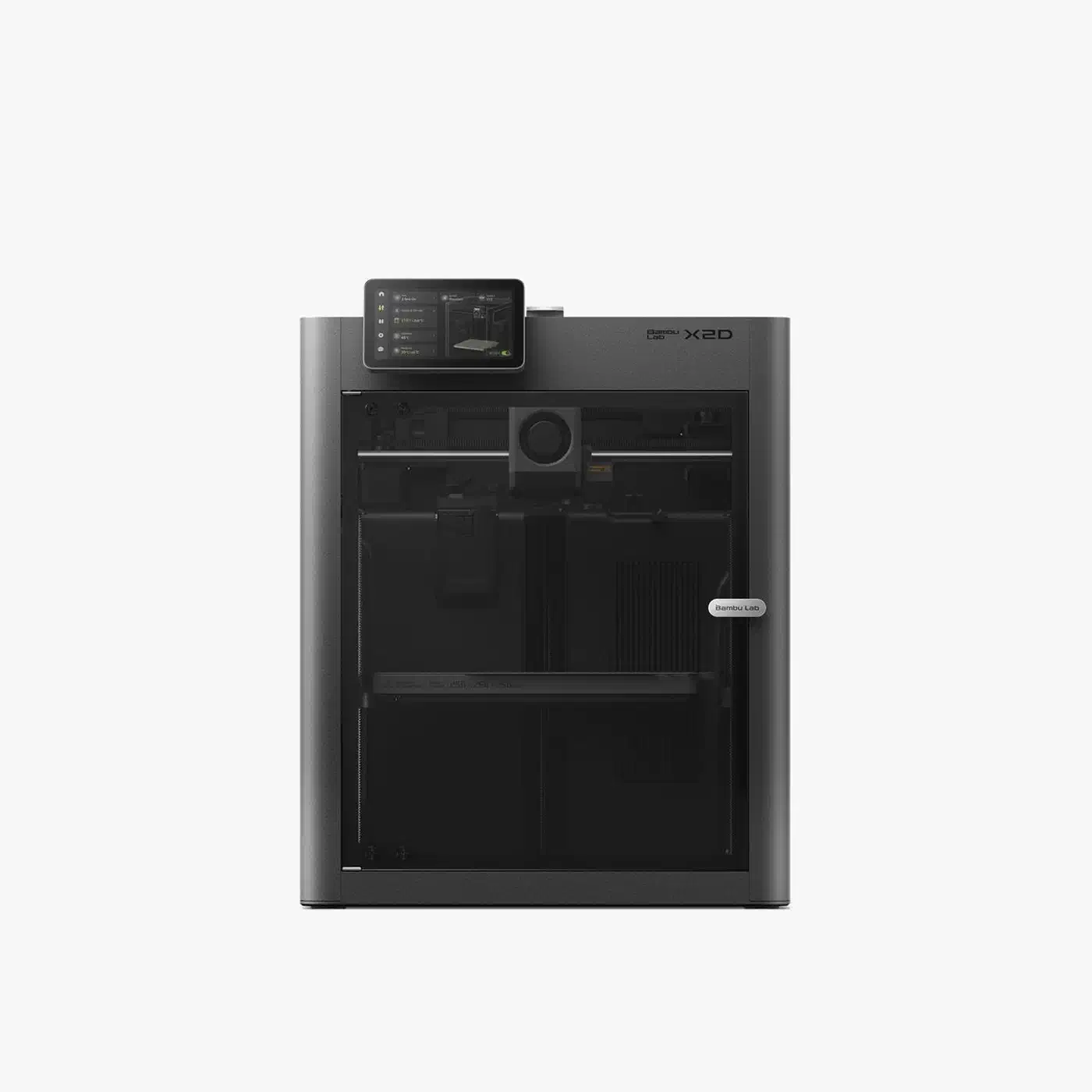
The X2D specification writeup at Makers101 confirms the switch is automatic. You pick the filament and the machine picks the air.
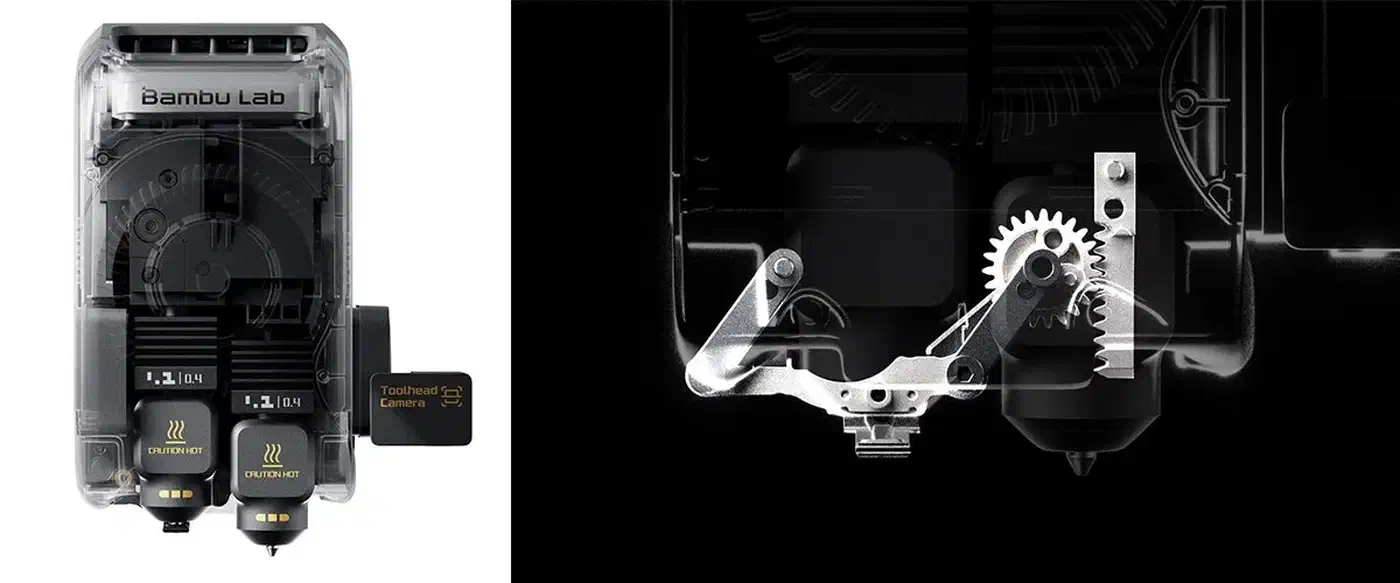
The nozzle tops out at 300°C and the plate at 120°C, which covers most engineering filaments. Mansson notes the 300°C ceiling came in below the rumoured 350°C, so the very high-temperature materials like PEEK stay out of reach. That ceiling applies to both tips, since the X2D’s dual-nozzle toolhead carries two hot ends at once.
Higher chamber temperature also means more emissions, so the X2D runs three stages: a G3 pre-filter, an H12 HEPA element, and activated carbon. The Printer Hub review still recommends not treating that filter as a substitute for ventilating the room when you print ABS or ASA.
Nobody states whether the 65°C figure is read at a chamber sensor or at the part surface, and the difference on a tall print is not trivial. There is also no published warm-up time from cold. On a short print that decides whether the chamber does any work, or only gets hot after the job is done.
When a heated chamber is not worth paying for
If your spool shelf is PLA and PETG, an active chamber buys you nothing. Both materials want the fresh-air mode, which an open-frame machine like Bambu’s budget A2L gives you for free. You would be paying for a heater you switch off.
Occasional ABS at small footprints is the borderline case. Warping scales with the length of the cooled layer, so a 40mm bracket in a passive enclosure in a draught-free room usually comes out fine. The chamber earns its money on large flat parts, where a 200mm bottom layer has room to build up real force.
Large ABS, ASA or polycarbonate work is where the chamber becomes the reason to buy the machine. Peak draw on the X2D is around 1600W, most of it heating the plate and the chamber. A 20-hour print holding 65°C shows up as a real line on the electricity bill. And if the part lives outside, ASA beats ABS outdoors under UV, even though the two print almost the same.
Buy the chamber for the material you print most of.