

Nozzle swapping replaces the purge tower on Creality's K3

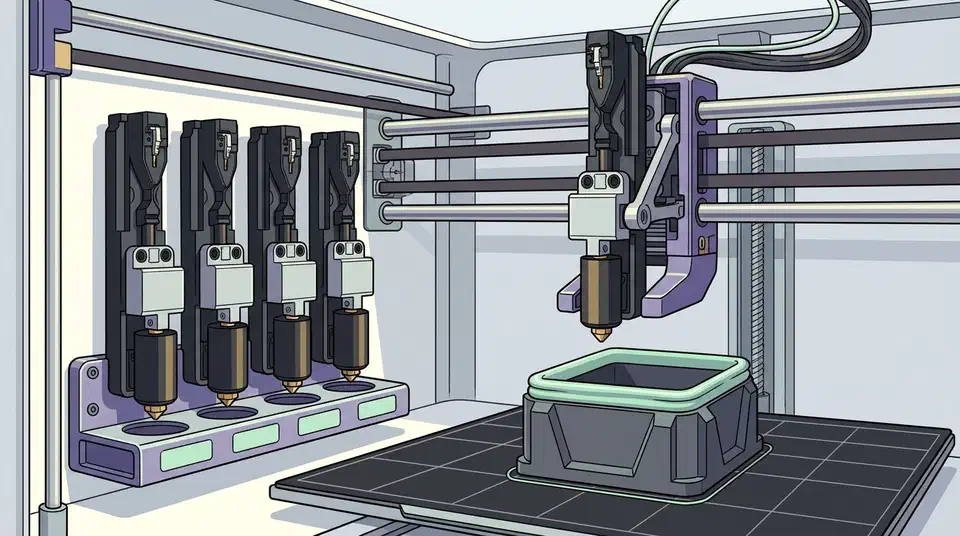
Creality KliTek replaces the purge tower with a nozzle swap, and the K3 carries it first in 2026. Each assembly weighs a fifth of a full toolhead and clicks in within about five seconds. The 80A TPU claim explains the design better than the colour pitch does.
Key Takeaways
- KliTek swaps the whole nozzle, so nothing gets purged between colours.
- The K3 is the first machine to carry it, arriving late in 2026.
- Nozzle-swap systems live or die on how repeatably they re-seat the nozzle.
- Creality claims stable 80A TPU printing at 3 mm³/s, where most printers manage about 1.
- The older K2 line still does colour the old way, purging on every swap.
What Creality KliTek changes on the K3
Creality unveiled KliTek as a quick-swap nozzle system for multicolour and multi-material FDM. In Creality’s own announcement , the company describes keeping the changing part minimal. It carries the nozzle, the hotend and the filament tube, and nothing else. That bundle weighs about one fifth of a full toolhead.
The first machine to carry it is the K3, due in the third quarter of 2026. Makers101’s coverage of the launch puts a nozzle swap at roughly five seconds. A full colour or material change runs under fifteen. Four heads ship on the base machine, one for each CMYK colour.
Each assembly carries its own PTC heater, so it can warm up while another head is printing. That preheat is what keeps a swap down to seconds instead of minutes, since the printer never has to wait for a cold hotend to come up to temperature. Bambu solves the same problem with induction heating instead.
The current K2 line works the older way. It feeds several filaments through one nozzle from CFS units. Every colour change therefore flushes the melt zone and drops the old material in a purge tower. Slice Lab’s K3 guide frames the removal of that purge step as KliTek’s central argument, since each material keeps a nozzle of its own.
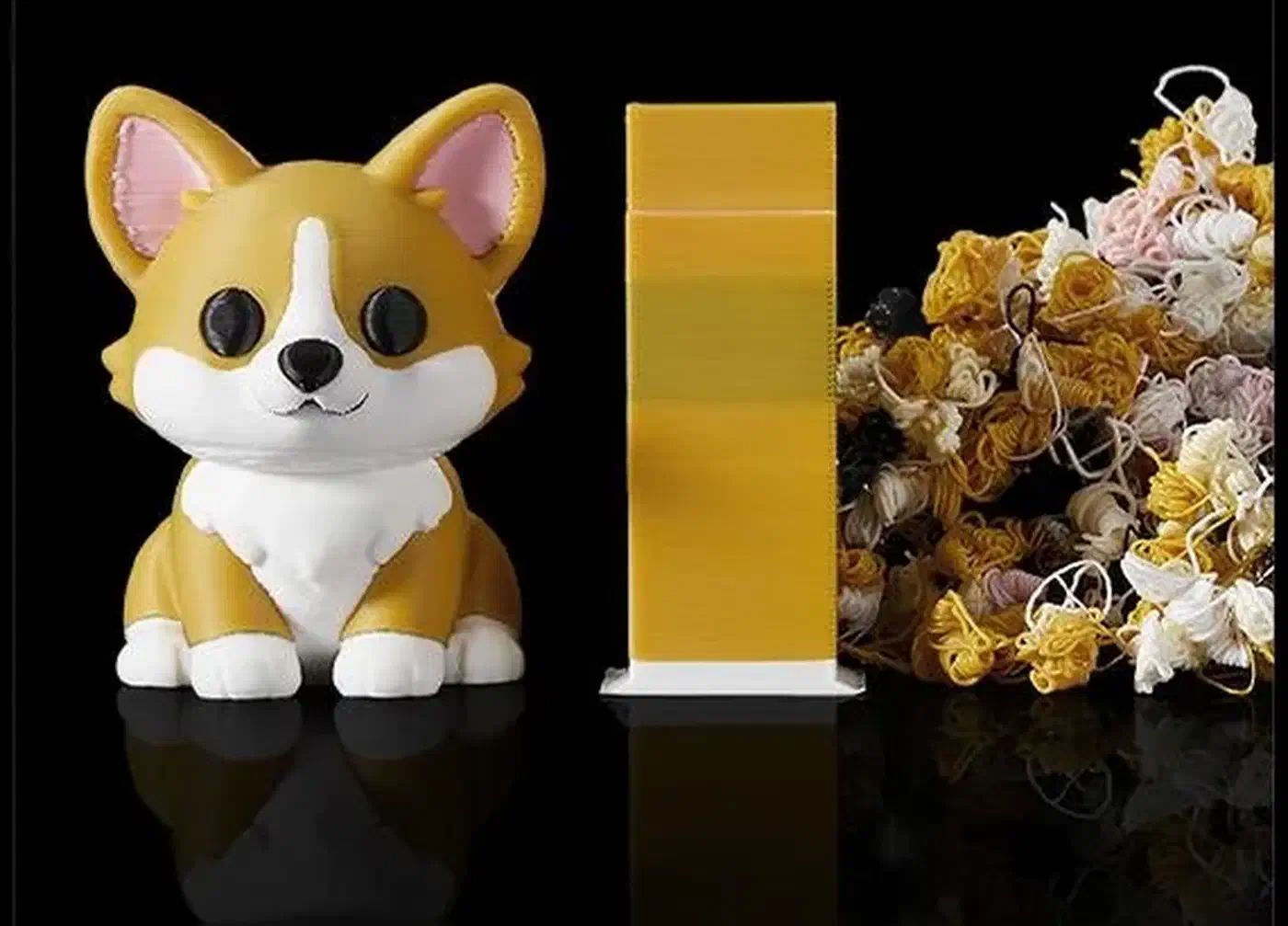
Creality has priced the consumable at roughly 14 dollars per nozzle assembly, against about 67 for a rival toolhead. The K3 itself has no announced price.
Why nozzle-swap systems drift out of alignment
Every nozzle that clicks into place has to land in the same X, Y and Z position as the one it replaced. The tolerance is a fraction of a layer height, which at 0.2 mm layers leaves very little room to be wrong.
When a nozzle lands off-centre, the print shows it before any error message does. Walls double up along a colour boundary, and seams appear where two heads should have met cleanly. A nozzle sitting slightly too high leaves a first layer that never bonded, and one sitting too low ploughs through what is already down.
Three things push a swap mechanism off its mark over time:
- Seating tolerance. The coupling has to locate the assembly the same way on every cycle, jams included.
- Thermal expansion. Parts at 260 degrees sit in different places than the same parts cold. Each head also heats on its own schedule.
- Wear. Latches, cones and contact faces all lose material after hundreds of insertions, and the drift creeps in slowly.
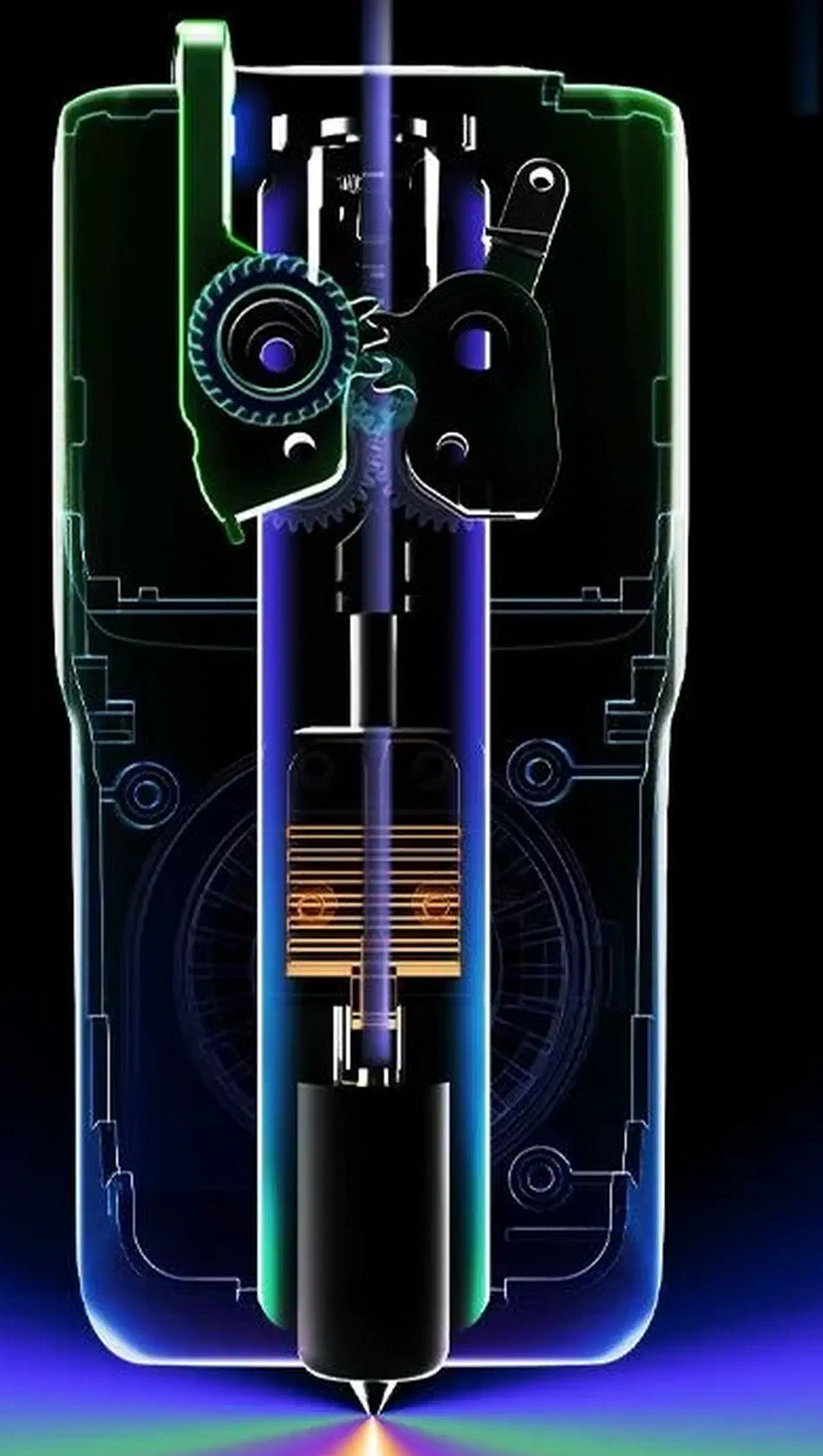
Creality’s answer is to measure constantly. The K3 uses an eddy-current sensor to find each nozzle’s centre and set the offset, with no mechanical probe touching the bed. Creality’s own figures put the repositioning accuracy under 25 microns and cite 12 sensors doing the work. The company also says it tested the swap to 80,000 cycles.
Those are vendor numbers, and nobody outside Creality has confirmed them. A full toolchanger has an easier job here. It moves a whole toolhead and stores a calibrated offset per tool that rarely changes. KliTek re-establishes the offset far more often, so its sensing has to keep working long after the mechanism has worn in.
Creality’s first-gen answer to a Bambu feature usually exposes the problems the second iteration quietly solves. Bet on KliTek v2, not v1.
Soft TPU is the reason this architecture exists
The specification points at flexible filament even though the marketing leads with colour. Flexibles are the one job a single-nozzle multi-material system cannot do, and KliTek is built around them.
Soft TPU buckles under pushing force in a long tube, coiling up instead of advancing. Creality calls Bowden setups out of the question for it. It also lingers in a shared melt zone. The next material then drags soft residue into a print meant to be rigid.
A dedicated nozzle per material removes both problems at once. Nothing else has to pass through that hotend, so there’s no residue to flush and no compromise profile to run. Creality pairs that with a dual-drive feeder it calls S-Drive. A rear unit pushes while the front unit pulls, and the company says the synchronised pair moves TPU like a caterpillar.
Creality says the system holds a stable 3 mm³/s on 80A TPU, where most printers slow to about 1 mm³/s. On harder 95A stock it claims 15 mm³/s, against 2 to 3 elsewhere.
The payoff is print-in-place parts that mix hardnesses in a single job. That covers a rigid housing with a moulded soft seal, a tool handle with the grip already on it, or a wheel with its tyre. Judge KliTek on parts like those rather than on colour swatches. Colour is the one thing the older architecture already does well enough.
KliTek against the other two answers to the same problem
Three vendors have taken three routes to multi-material printing: purge and waste filament, swap the nozzle, or swap the entire tool.
| System | Approach | Purge waste | Swap speed | Alignment risk |
|---|---|---|---|---|
| Creality KliTek | Nozzle assembly swap, PTC preheat | None between materials | About 5 s per nozzle | Highest, re-seated constantly |
| Bambu Vortek | Hotend swap, induction heating | Reduced, not removed | About 8 s | Moderate |
| Full toolchanger | Whole toolhead parked and picked | None between materials | Slower, more mass to move | Lowest, offsets stored per tool |
Prusa’s INDX takes the third route, and the grams it stops flushing between colours add up faster than the price gap suggests. It is also the only one of the three sold as an eight-material upgrade to a printer you already own.
KliTek is the cheapest of the three to build. A nozzle assembly is small, and a PTC element costs far less than an induction coil. The trade is that the smallest, most frequently swapped part carries the whole alignment burden.
No upgrade path to K2 machines has been announced. A retrofit would need firmware, motion control and toolhead hardware those printers lack. Independent print samples in 80A TPU don’t exist yet, so every flow-rate figure above traces back to the vendor.
The sensible move is to wait for first-batch alignment reports before ordering. Slice Lab reaches the same conclusion from the pricing side, calling the K3 worth watching and not worth a blind pre-order. If your reason for wanting one is colour, an existing purge-based machine already does that today. If your reason is soft TPU, KliTek is the first consumer system that treats it as a headline feature.