

A 3200KV outrunner drives the FCX18 LC80 from the box

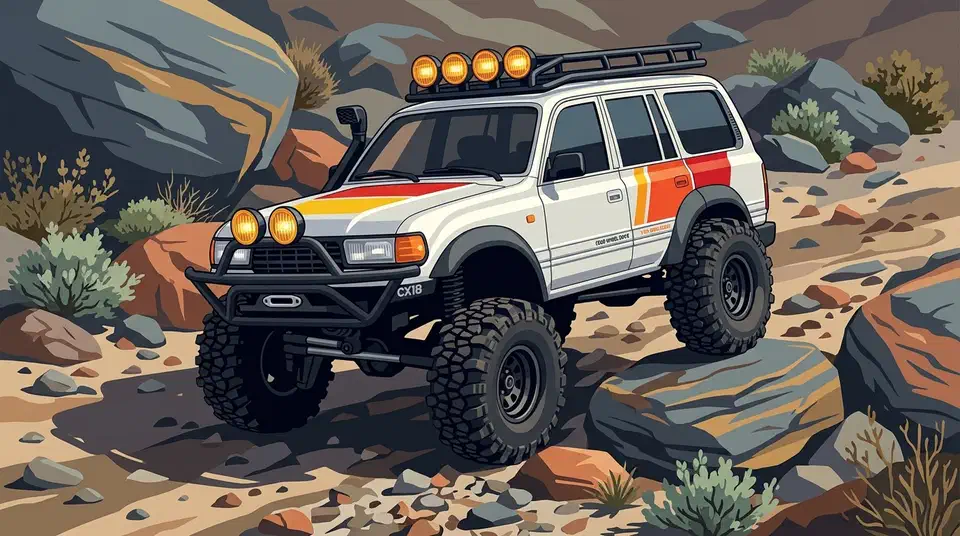
FCX18 LC80 brushless power now arrives fully wired from the factory. The FMS FCX18S LC80 Tri-Color V2 Mod RTR ships with a 3200KV outrunner motor, its own separate ESC and receiver, and a drag brake. A 1/18 crawler gets outrunner torque with no aftermarket conversion, and the truck runs straight out of the box.
Key Takeaways
- It comes brushless from the factory, so no conversion is needed.
- A 3200KV outrunner pulls hard at low speed instead of chasing top rpm.
- The kit uses a separate ESC and receiver, not a combined stock board.
- A two-speed gearbox and metal portal axles back up the power.
- The transmitter dip-switches cannot tune the brushless system.
What is a 3200KV outrunner brushless motor?
An outrunner spins its outer shell around a fixed inner stator. An inrunner does the opposite: the can stays still and only the shaft turns. Because the rotating mass sits further from the center, an outrunner favors torque at low rpm. That is the useful trait for a rock crawler.
KV means revolutions per volt with no load. So a 3200KV motor turns 3200 rpm for every volt you feed it before any load bites. By brushless standards that is a modest number. On a small crawler pack it reads as a high-pull, low-speed setup built for grip over top speed.
Crawling asks two things of a motor: controllable pull just off zero throttle, and steady heat when a wheel loads up against a rock. An outrunner’s power curve fits that shape well. Brushless design also drops the brushes and commutator that wear and heat-soak inside a small brushed can, so the motor holds its character through a longer trail session.
FMS builds all of this into the truck at the factory. The FairRC FCX18S LC80 Tri-Color V2 Mod RTR product page describes a 3200KV outrunner brushless motor with stronger torque and precise control, paired with an independent brushless ESC. The motor type, more than the word “brushless,” is what changes how this crawler drives.
What the FCX18 LC80 brushless RTR ships with
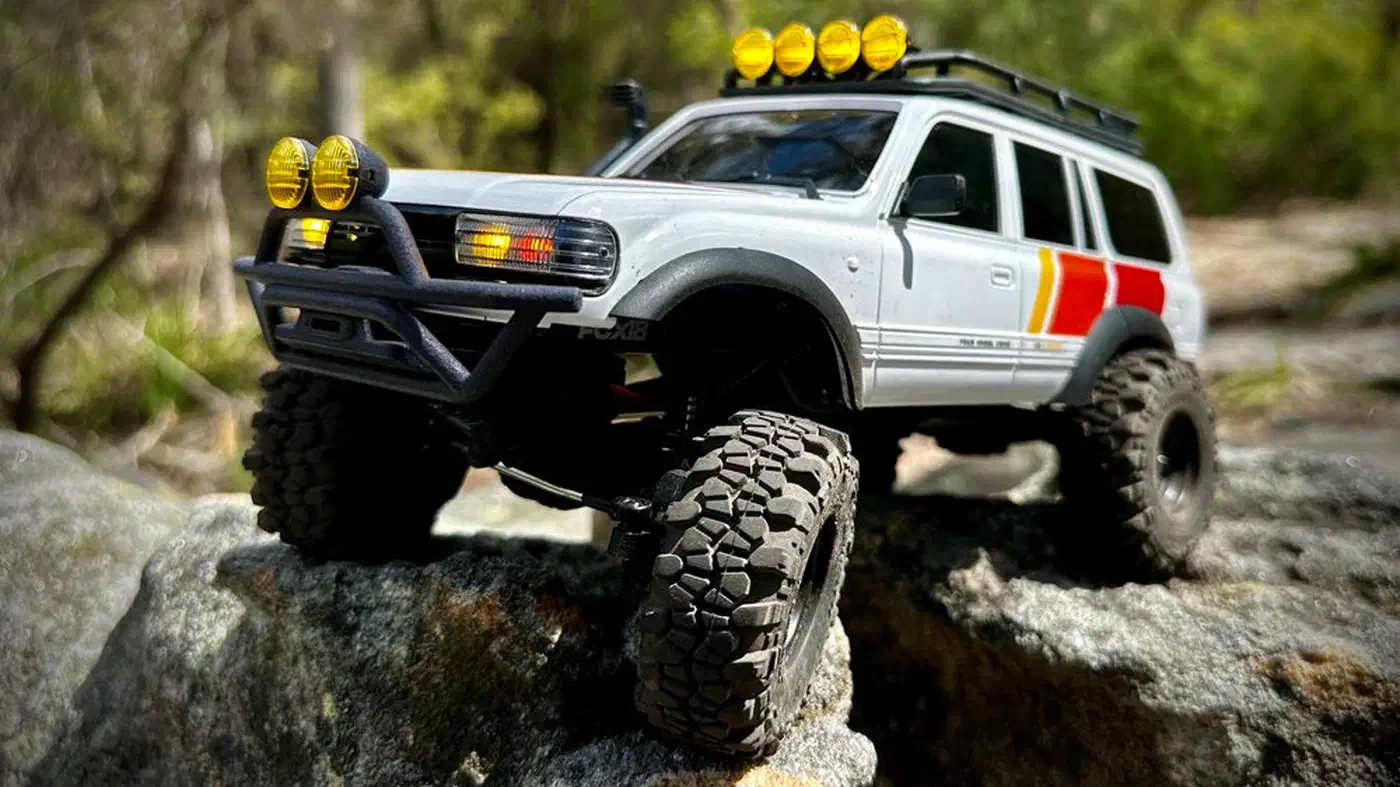
The Tri-Color V2 Mod is the modded version of the FMS FCX18S LC80 S. It keeps the scale body of the original and swaps in the brushless drivetrain.
- Power: a 3200KV outrunner brushless motor, an independent brushless ESC, and a separate receiver, rather than a combined 2-in-1 board.
- Drivetrain: a high-strength metal-beam chassis, a 2-speed transmission, metal-gear portal axles, 4-link suspension, metal steering and chassis links, metal shock absorbers, and 24 metal bearings.
- Control: a metal-gear steering servo, the BATRAZZI Remote Control V6 with dip-switches, and a drag brake for descents.
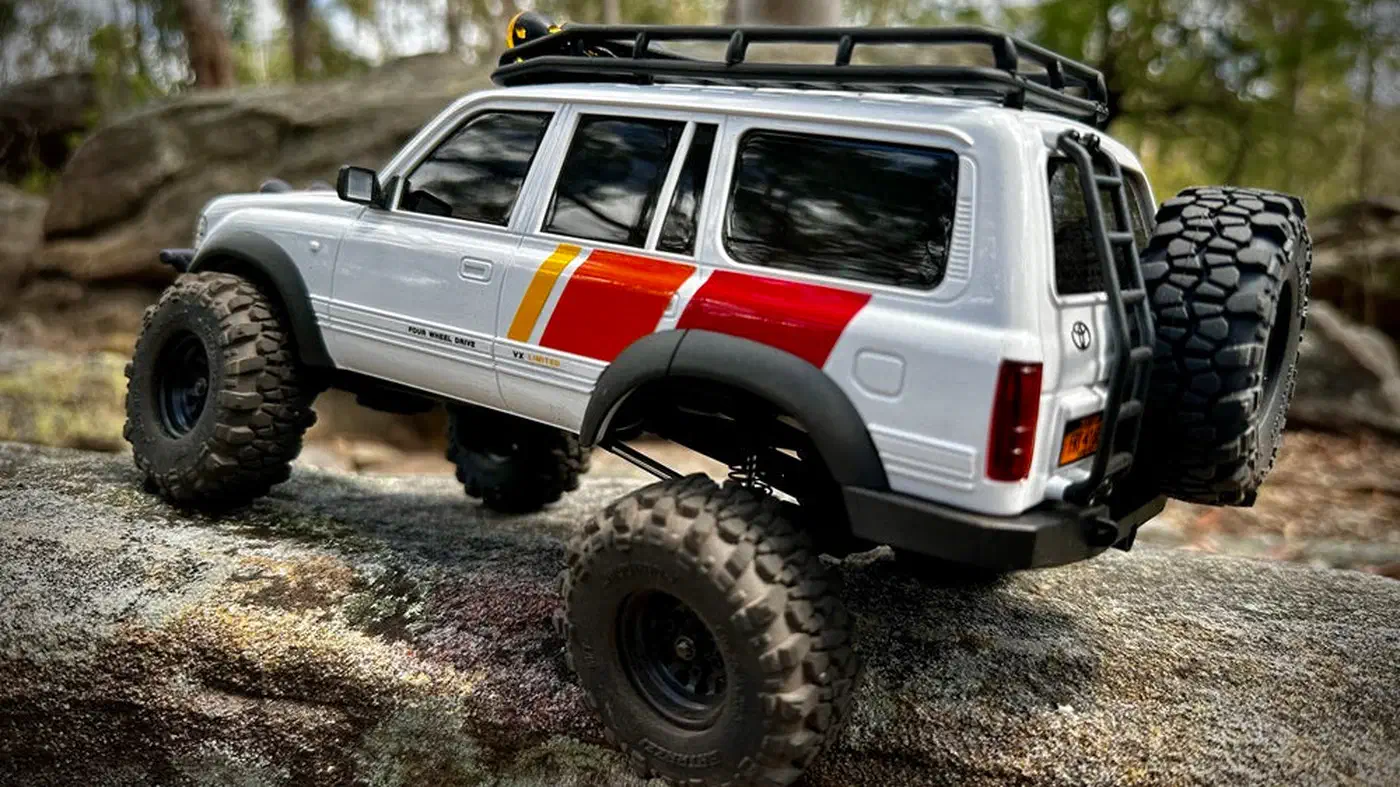
- Body: an injection-molded hard plastic Land Cruiser 80 shell with a radiator grille, working searchlights, a snorkel, an openable hood, and a roof rack.
- Mod extras: tri-color livery stickers honoring Ivan Stewart’s paint scheme, BATRAZZI steelie wheels with brass weights, BATRAZZI Mud Pro-X super-soft tires, a 3D-printed rhino bumper with light buckets (not installed), and a spare sticker pack.
Headlights and spotlights switch on their own channels, and the turn and reverse lights fire automatically as the truck steers and backs up. You supply 4 AAA batteries for the transmitter and nothing else.
Why factory brushless beats a DIY conversion here
A brushless conversion is real work. You source a motor, then a matching ESC, often a mount, and sometimes a receiver. Then you wire it, bind it, and hope the gearing suits the new power. The factory route skips every step of that and arrives running.
Parts that ship together are already matched. FMS picked the motor, ESC, and gearing to work as a set, so there is no guessing whether the can clears the chassis or the ESC can carry the current. The separate ESC and receiver layout is exactly what a careful conversion ends up building anyway, so the RTR starts where a home build would finish.
FairRC notes that the transmitter dip-switches cannot adjust any parameters for this car’s brushless system, so throttle curve and drag-brake tuning are not on the radio.
That is the real trade-off. A conversion lets you pick your own KV and your own ESC brand, while the factory truck locks you to what FMS fitted. Buy the RTR to save time, or convert a brushed truck to control the parts list yourself. On the smaller Axial SCX24, a hand-picked part like the Micro Komodo brushless motor is exactly that kind of build-it-yourself swap.
How the FCX18 compares with the FCX24 and FCX24M
FMS sells three small crawler families that sit close together, which makes the first pick confusing. The FCX18 is the 1/18 line. It runs physically larger than the 1/24 FCX24 and the more micro FCX24M, so it carries more body presence and leaves room for a bigger outrunner can. All three share the FMS crawler kit that counts on rocks: portal axles and multi-link suspension, with a two-speed box on the FCX18S.
The editorial guide at Scale & Motion frames the pick as a question of character.
Choose FCX18 if you want a small-scale crawler with more visual presence, stronger scale-body character and a more substantial trail-truck feel.
| Platform | Scale | Best for |
|---|---|---|
| FCX18 | 1/18 | Outdoor trail presence, scale photography, a planted feel |
| FCX24 | 1/24 | Compact versatility and the deepest parts shelf |
| FCX24M | Micro 1/24 | The smallest realistic stance in tight spaces |
Still, the scale number alone does not decide how a crawler feels. Body, wheelbase, tires, and weight placement shift the character as much as the label does.
Is the FCX18 LC80 brushless RTR worth buying?
For most first-time and returning drivers, yes. You get brushless smoothness and heat headroom without learning to solder or bind a fresh receiver. A scale-trail driver wins too, since a licensed Land Cruiser 80 body, a two-speed box, and metal portal axles all arrive in one purchase.
Two groups should think twice. If you already own a brushed FCX18 and enjoy building, a BATRAZZI FOC brushless kit or Furitek kit converts the truck you have for less than a second RTR. And if radio-side tuning is important to you, remember the dip-switches do not reach the brushless system on this model.
FMS does not publish the ESC’s current rating, nor whether it runs field-oriented control, so the smoothness claim rests on the motor type and owner reports rather than a published spec figure. Buy this truck for the outrunner torque and the ready-to-run wiring, and treat the finer ESC numbers as untested.