

Five stacked blue layers push Penta Tandem to 1,300 nits


Penta Tandem QD-OLED is Samsung Display’s new name for a monitor panel that stacks five blue emitting layers instead of four. That extra layer lifts peak brightness to 1,300 nits. The name arrived in 2026, but the five-layer panel has shipped since 2025. So a 2026 badge can hide an older panel.
Key Takeaways
- Penta Tandem just means Samsung moved the blue OLED stack from four layers to five.
- The name is new, but the five-layer panel has shipped since 2025.
- The extra layer lifts monitor peak brightness to 1,300 nits.
- That 1,300-nit figure is measured on a small bright patch, not the whole screen.
- A 2026 Penta Tandem monitor may reuse the exact panel a 2025 model already had.
What is Penta Tandem QD-OLED?
Penta Tandem is a brand name Samsung Display uses for QD-OLED panels built on a five-layer blue stack plus its newer EL 3.0 emitter material. The word “tandem” means stacking several OLED emitting layers on top of each other. The whole industry uses it. LG already ships Tandem WOLED and Tandem OLED. Penta Tandem is Samsung’s move from a four-layer stack to a five-layer one.
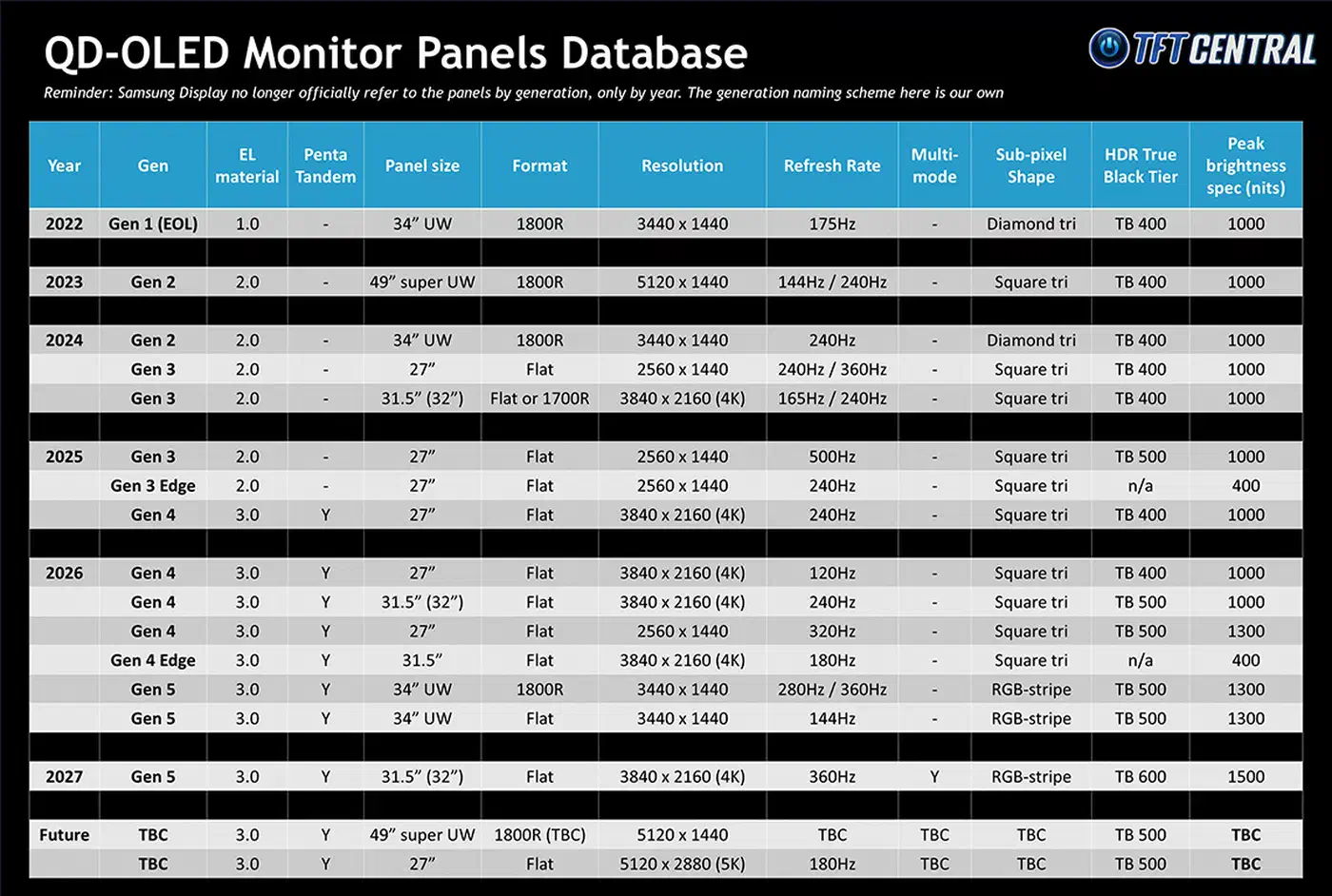
Samsung Display introduced the Penta Tandem branding in 2026. Yet the TFTCentral QD-OLED FAQ shows the same five-layer stack and EL 3.0 material already sat inside a 2025 panel, a 27-inch 4K model. So the name is a marketing layer over an engineering change; the panel design itself is not new.
Samsung Display makes every QD-OLED monitor panel on the market. MSI, Asus, Gigabyte, AOC and Samsung Electronics all buy from it. So a Penta Tandem panel shows up under many brands at once. A monitor maker’s own “generation” label often points at its own product line rather than the panel inside. That is why the same panel can appear in two model years under two different names.
Penta Tandem, therefore, is just Samsung’s way of referring to it as the firm moves to a 5-layer stack.
Why a fifth blue layer raises brightness
QD-OLED starts with a blue OLED base layer. That blue light drives quantum dots, which then produce the red and green you see. Blue is the hardest color to make both bright and long-lived, so it sets the ceiling for the whole panel. Stacking one more blue emitting layer adds more light output for the same drive current.
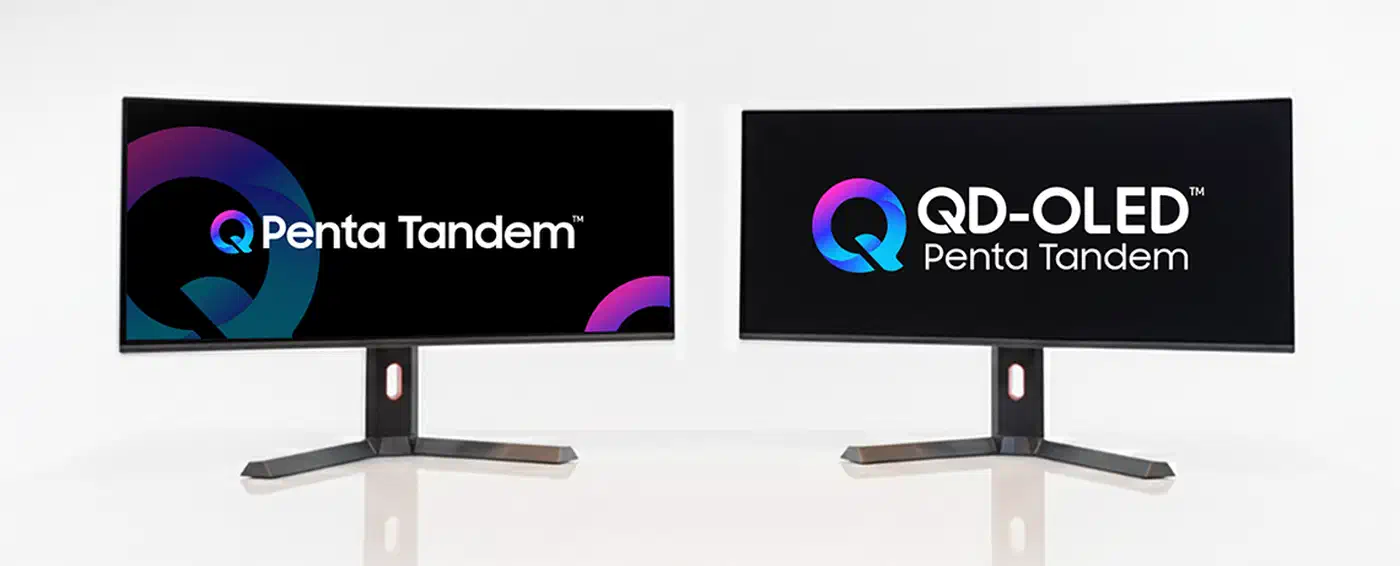
Samsung Display turns that extra output into two headline claims: the five-stack raises luminous efficiency by 1.3x and roughly doubles lifespan against the four-layer design. Both are manufacturer figures with no independent testing behind them yet, so treat them as claims rather than verified results.
A more efficient panel runs each pixel less hard to hit the same brightness. Less strain per pixel means slower wear. That is the mechanism behind the doubled-lifespan number, even if the exact multiplier stays unverified.
For a real buyer, the VideoCardz report on MSI’s panels names the concrete payoff. MSI says its MPG 272URX QD-OLED used the five-layer approach to claw back brightness that a higher pixel density had cost it. The extra layer buys back light that a denser, sharper panel would otherwise lose.
What does 1,300 nits mean here?
The 1,300-nit figure is a peak, measured on a small bright patch, not across the full screen. Displays quote OLED peak brightness at a 3% on-pixel ratio. That means a bright square covering 3% of a mostly dark screen. On-pixel ratio names how much of the panel is lit during the test. A full white document or spreadsheet drops far below that peak.
Read against the old ceiling, the gain is real but small. Earlier QD-OLED monitors sat near a 1,000-nit barrier. Tom’s Hardware frames 1,300 nits as a small step past it. Call it a modest step up from 1,000 nits.
One number that circulates with Penta Tandem does not apply to monitors at all. The 4,500-nit figure is a TV peak. Monitors top out at 1,300 nits, and the two should never be quoted together as if a desktop screen reaches 4,500. For any QD-OLED brightness spec, always read the number with its measurement window. A 3% peak tells you nothing about a full-screen white page. One certification, DisplayHDR True Black 1400 , now pins that full-screen figure down instead of leaving it to the peak.
Same panel, new badge
This is where the badge can cost you money. MSI says it began fitting the five-layer panels in early 2025, before the Penta Tandem name existed. It then grouped six QD-OLED models under the Penta Tandem umbrella for 2026. Several of those are older monitors or close relatives, not fresh reveals. A 2026 sticker does not promise a 2026 panel.
| Model | Size / resolution | Refresh | First announced |
|---|---|---|---|
| MAG 341CQP QD-OLED X28 | 34-inch ultrawide | 175Hz | 2024 |
| MPG 272URX QD-OLED | 27-inch 4K | 240Hz | early 2025 |
| MAG 272UP QD-OLED X24 | 27-inch 4K | 240Hz | mid 2025 |
| MPG 341CQR QD-OLED X36 | 34-inch ultrawide | 360Hz | 2025 lineup |
| MPG 322UR QD-OLED X24 | 32-inch 4K | 240Hz | new for 2026 |
| MAG 321UP QD-OLED X24 | 32-inch 4K | 240Hz | new for 2026 |
Only two of the six are genuinely new 32-inch designs. So the safe buyer rule is to ignore the year on the box. Match a monitor’s size, resolution and refresh rate against TFTCentral’s panel database to pin down the real panel generation. The spec table mixes generations, so not every one of the six carries the newest five-layer panel. Verify per model before you assume.
Should you buy a Penta Tandem monitor in 2026?
Penta Tandem is a genuine panel improvement, but an incremental one. For most buyers, the coatings do more in 2026 than the nit count does, and those are worth understanding before you spend.
Samsung Display now offers two panel coatings that monitor makers can pick per model:
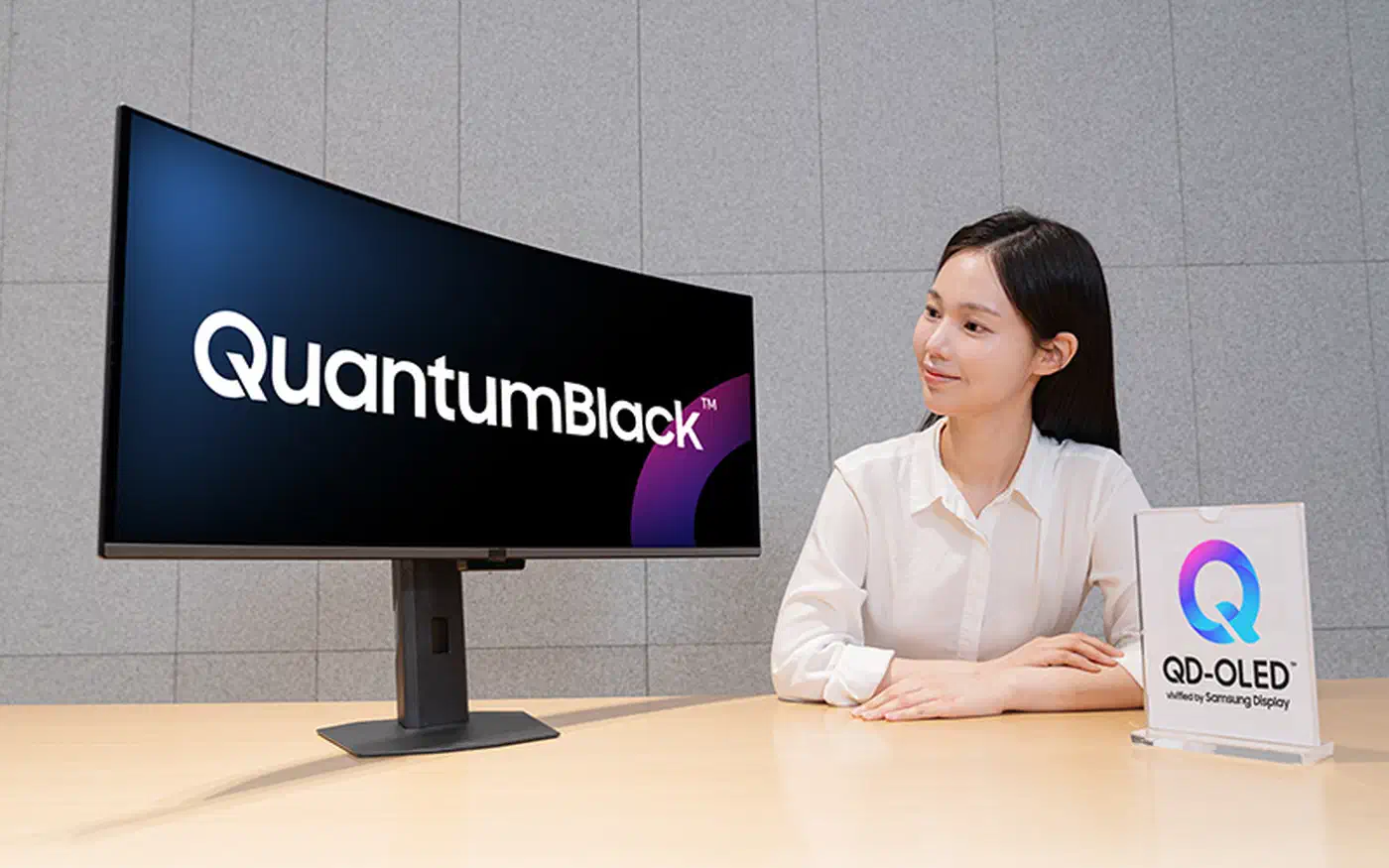
- QuantumBlack film hardens the panel from 2H to 3H, raising scratch resistance by about 2.5x, and it cuts the purple tint that ambient light throws onto a bare QD-OLED. Samsung Display’s own name is QuantumBlack, but each brand rebadges it: DarkArmor on MSI, BlackShield on Asus, ObsidianShield on Gigabyte.
- AGLR coating is a factory anti-glare, low-reflection finish for setups with harsh lighting, aimed more at pro use than gaming.
Both come from TFTCentral’s coating breakdown . A harder, less reflective screen changes daily use more than 300 extra nits on a 3% patch ever will.
So the right move depends on what you own now. Say you already own a 2025 five-layer panel, such as a 27-inch 4K QD-OLED. A 2026 Penta Tandem model of the same size and spec is likely the same glass, so the name alone is no reason to upgrade. Moving up from an older 1,000-nit QD-OLED is a different case. If you chase brighter HDR highlights, the higher small-window peaks are a fair reason to buy. Either way, do not pay a premium for the Penta Tandem badge on its own. Confirm the panel generation and the coating first, then decide.