

True Black 1400 holds 700 nits across a full OLED screen

DisplayHDR True Black 1400 is VESA’s top OLED badge. The number that decides your desktop experience is 700 nits across a full white screen. The 1400-nit peak printed on the box only shows up on small highlights. Read straight from the test table, sustained full-screen output climbs 2.8x from the bottom tier to this one, while the black level never moves.
Key Takeaways
- True Black 1400 wants 700 nits across the whole screen, held steady.
- Peak brightness hits 1400 nits, but only on small bright highlights.
- Every True Black tier shares the same deep black, 0.0005 nits.
- The first certified product is a laptop, the Lenovo Yoga Pro 16, with no monitor yet.
- Tandem OLED is the tech that lets panels stay this bright.
What is DisplayHDR True Black 1400?
DisplayHDR True Black 1400 is the highest tier in VESA’s True Black certification for OLED screens. Three numbers define it: at least 1400 cd/m² peak brightness, black levels as low as 0.0005 cd/m², and at least 700 cd/m² across the full screen. The VESA announcement put it at the top of the ladder.
Nits and cd/m² are the same unit. One nit equals one candela per square meter, so 700 cd/m² is simply 700 nits.
The True Black program covers emissive panels only, meaning OLED and QD-OLED. Regular DisplayHDR tiers like 400, 600 and 1000 cover LED-backlit LCD instead. The split exists because of black level. An OLED pixel switches itself off and reaches 0.0005 nits, while an LCD leaks backlight and cannot get there. So a “DisplayHDR 1000” LCD and a “True Black 1400” OLED come from two separate programs.
The tier also sits on the DisplayHDR CTS 1.2 test framework , released in 2024, which added checks for color accuracy, static contrast and shadow detail. The 1400 tier was layered on top of that framework. As TechPowerUp frames it , the target is professional HDR content creation and grading rather than gaming.
Why 700 nits full screen beats 1400 peak
Peak brightness and full-screen brightness measure two different things, and buyers usually watch the wrong one. Peak is a short burst on a small patch, like a sun glint or an explosion. The 1400-nit figure comes from an 8% center patch, so it says nothing about a full white window.
Full-screen brightness is the sustained figure. It is what a white browser page, a spreadsheet, or a bright HDR sky asks the panel to hold. For True Black 1400 that number is 700 nits, and the panel has to sustain it.
OLED panels fight this with automatic brightness limiting, often shortened to ABL. The panel dims a large bright area to protect itself and manage power draw. Consequently the full-screen number sits far below peak on almost every OLED. That gap is exactly what the badge now pins down.
Peak decides how punchy a small highlight looks. Full screen decides whether a mostly white scene stays bright or fades to gray. The True Black 1400 tier holds 700 nits on both its full-screen flash test and its full-screen long-duration test, so the brightness has to last through the whole run.
The True Black tier ladder from 400 to 1400
Every figure below comes straight from the CTS 1.2 summary table for the True Black tiers.
| True Black tier | Peak (8% patch) | Full-screen flash | Full-screen sustained | Black level |
|---|---|---|---|---|
| 400 | 400 cd/m² | 250 cd/m² | 250 cd/m² | 0.0005 cd/m² |
| 500 | 500 cd/m² | 300 cd/m² | 300 cd/m² | 0.0005 cd/m² |
| 600 | 600 cd/m² | 350 cd/m² | 350 cd/m² | 0.0005 cd/m² |
| 1000 | 1000 cd/m² | 500 cd/m² | 500 cd/m² | 0.0005 cd/m² |
| 1400 | 1400 cd/m² | 700 cd/m² | 700 cd/m² | 0.0005 cd/m² |
Across the ladder from True Black 400 to True Black 1400, sustained output rises 2.8x while the black floor holds flat.
The summary table names the long-duration test but does not publish the hold time, so the exact minutes a panel must sustain 700 nits stay unstated in the public spec.
What stays the same across every True Black tier
Climbing the ladder mostly buys brightness, because the other floors barely move. Black level is a shared 0.0005 cd/m² on every True Black tier, from 400 up to 1400. A True Black 500 panel is not “less black” than a True Black 1400 one.
Color coverage holds steady too. Every tier needs 99% of BT.709 and a 10-bit input signal. DCI-P3 coverage sits at 90% on the lower tiers and 95% on the top ones, a small step up.
Color accuracy tightens only at the very top. The average delta-ITP error cap drops from 8 to 6 on the 1000 and 1400 tiers, so the highest rungs promise slightly cleaner color.
Which displays carry True Black 1400 today?
The first certified product is a laptop, and no desktop monitor qualifies yet. Lenovo launched the Yoga Pro 16, billed as the world’s first notebook certified to True Black 1400, with 1400 cd/m² peak and black levels below 0.0005 cd/m². Samsung Display supplies the panels behind it and plans to show True Black 1400 alongside lower tiers at later 2026 exhibitions. They first appeared at Bilibili World 2026 in Shanghai.

In the TechPowerUp comment thread , readers point out that desktop OLED monitors have not even reached True Black 1000, and that laptop panels are the only ones passing above True Black 500. The badge exists, but the desktop hardware that meets it has not reached shelves.
The enabling change is Tandem OLED. Stacking two emissive layers lets a panel hit far higher sustained brightness while keeping the deep OLED black. That architecture is why laptop panels cleared this bar first.
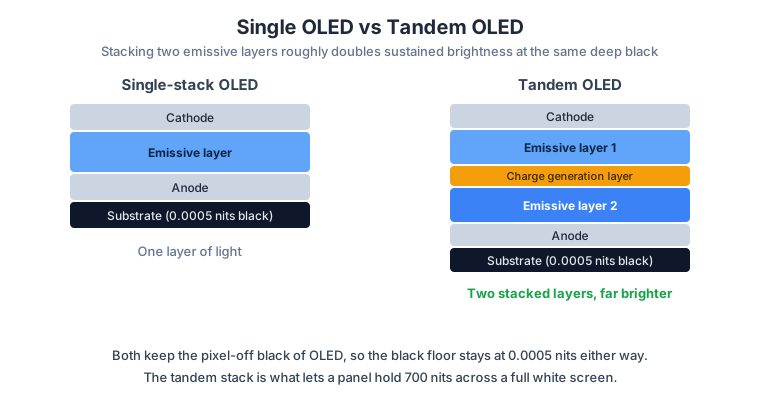
Longevity is the cost. Holding a full white screen at 700 nits is exactly the workload that stresses OLED and invites burn-in. That is why the tier is aimed at short HDR bursts, since a bright spreadsheet running all day would wear the panel down fastest.
In my experience, a certification announcement and a monitor you can buy are a year or more apart. Earlier DisplayHDR tiers followed the same path, landing on laptop panels first while desktop screens trailed well behind. So I would not wait on the badge alone when buying an OLED monitor. Judge the panel you can order today, and treat True Black 1400 as a signpost for where desktop screens are heading, since you cannot shop for it yet.