

Mini LED holds 1,400 nits full screen where OLED dims

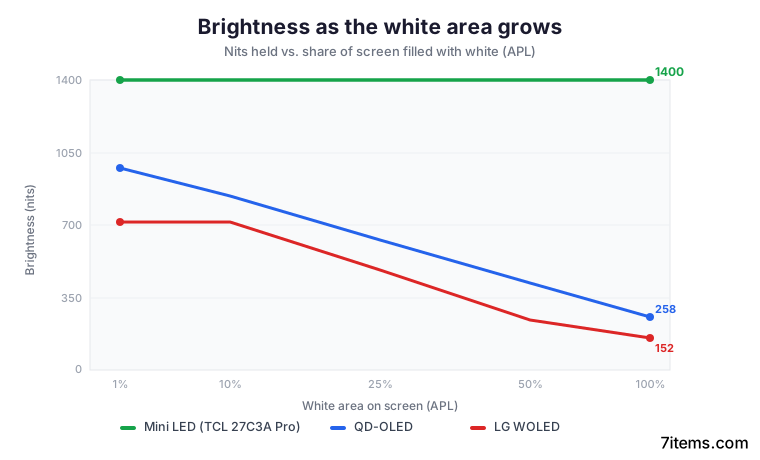
Mini LED full screen brightness stays high when white fills the whole panel, which is exactly where OLED dims. TCL’s 27C3A Pro holds 1,400 nits across a full white screen, while a measured WOLED drops from 717 nits to 152 nits. A backlight runs no auto brightness limiter, so it holds output steady.
Key Takeaways
- Mini LED keeps full brightness when white fills the screen; OLED cannot.
- TCL’s 27C3A Pro holds 1,400 nits full screen against a 2,200-nit peak.
- One measured OLED screen sank to 152 nits on a full white page.
- VESA asks LCD panels for 900 steady nits where OLED needs only 700.
- Mini LED buys that brightness with halos around bright objects.
Why peak brightness numbers do not compare
OLED and mini LED often quote similar peak numbers on a spec sheet. Those numbers hide how each panel behaves once the bright area grows. An OLED peak is measured on a tiny white window, usually 1% to 5% of the screen, where the panel pours its whole power budget into a few pixels. A mini LED backlight works the other way. A separate light source sits behind the panel, so it puts out the same brightness whatever the content shows.
A nit figure without its window size tells you nothing useful. What counts is how bright a screen stays when most of it is white.
The gap shows up in everyday scenes: a white document filling the screen, a bright HDR sky, a snow level in a game, a spreadsheet in a sunlit room. It stays hidden on dark scenes, small highlights, and any desktop running at a normal 120 nits.
Mini LED full screen brightness on TCL’s 2026 monitors
TCL’s 2026 mini LED gaming monitors were shown at a company presentation and reported by TFTCentral . The 27C3A Pro is a 27-inch 4K IPS-type screen at 165Hz, with a dual mode that runs 1080p at 320Hz.
Its mini LED backlight is quoted at 2,200 nits peak XDR brightness and 1,400 nits full screen, spread across 2,304 local dimming zones. A Quantum Dot coating pushes colour to 99% sRGB and 99% DCI-P3, with 10-bit depth and a 1ms G2G response spec.
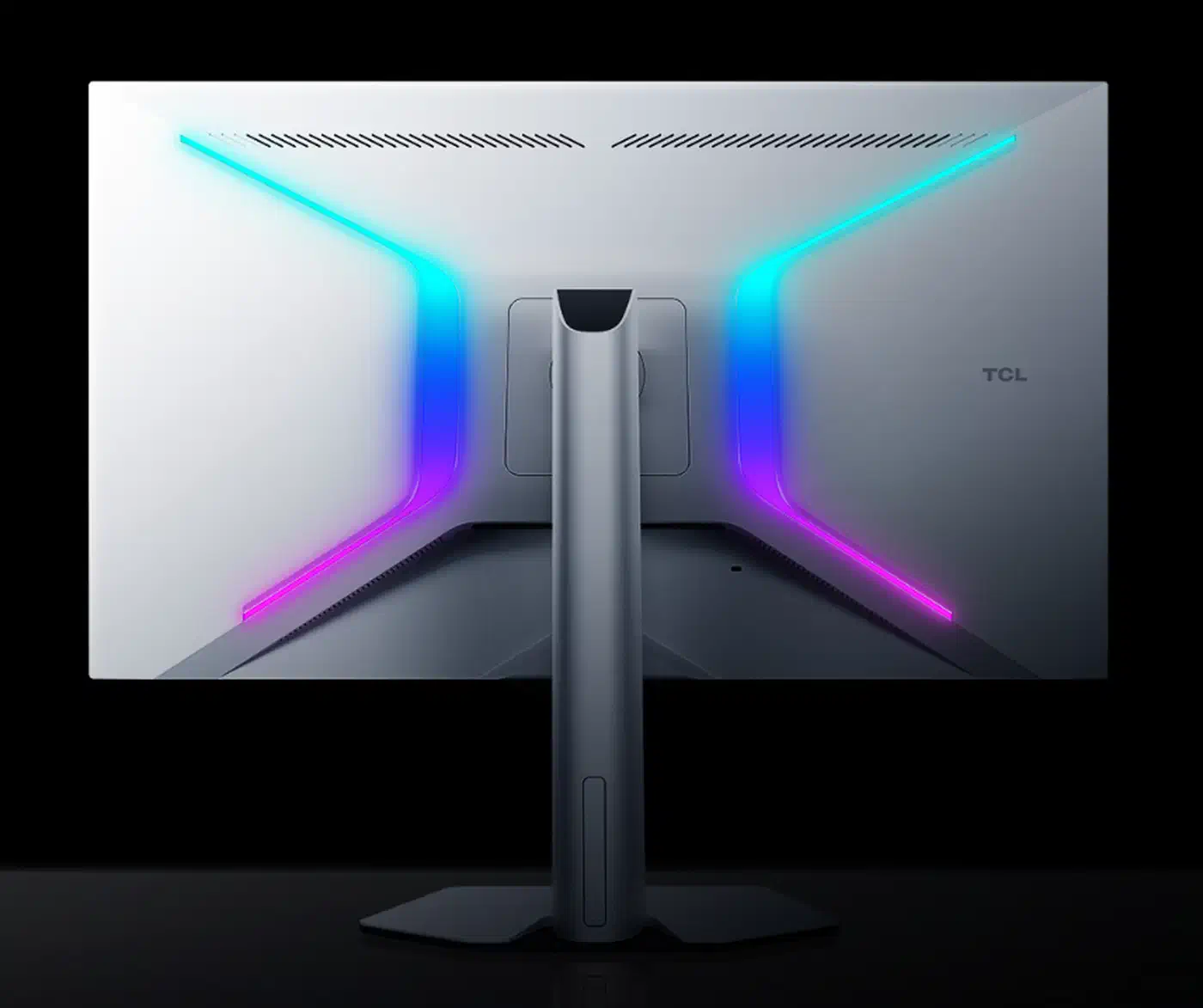
The 31.5-inch TCL 32C2A Pro carries the same 2,304-zone backlight and 2,200-nit peak, this time on a Fast HVA panel at 160Hz. TCL’s 27P2A Ultra uses the same Wanzone Partition backlight but has not published a zone count, so it stays out of the table below.
One caveat: these are announced specifications from a product slide, not independent lab measurements. Treat the 1,400-nit full-screen figure as a manufacturer claim until a reviewer tests a retail unit.
What the OLED curve looks like next to it
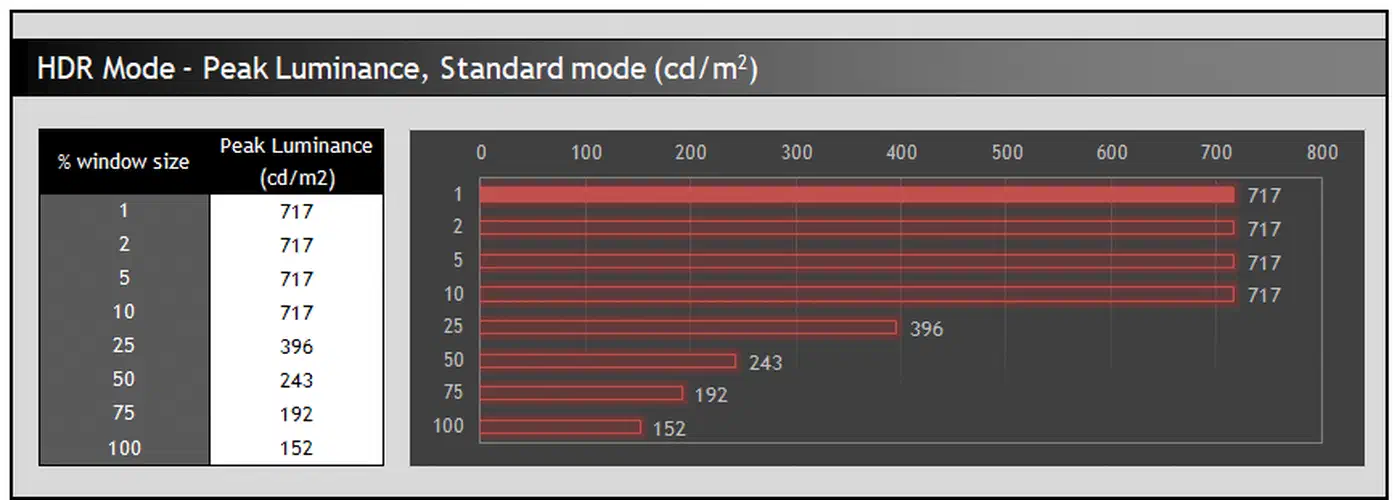
Put a measured OLED next to that claim and the gap is wide. TFTCentral’s OLED dimming guide shows an LG WOLED holding 717 nits at 1%, 2%, 5% and 10% white windows. Then the bright area grows and the number falls. At 100% APL, a full white screen, the same panel reaches only 152 nits.
A QD-OLED does a little better at both ends. It peaks around 950 to 1,000 nits in a 1% to 2% window and lands at 258 nits full screen. Both panels fall the same way, because the cause is the same.
That cause is the auto brightness limiter , or ABL. There is no menu setting to switch it off. It is a power ceiling built into how OLED works.
There is no way to disable ABL at all, even using a service menu of an OLED screen: it’s an inherent technical and power limitation.
So a 1,400-nit full-screen mini LED out-brightens a “1,000 nit” OLED by roughly five times once the screen fills with white. The comparison flips the moment the content goes mostly dark.
| Technology | Peak brightness (window) | Full-screen brightness | Black level |
|---|---|---|---|
| TCL 27C3A Pro mini LED | 2,200 nits (announced XDR peak) | 1,400 nits (announced) | Zone dimming, some blooming |
| LG WOLED (measured) | 717 nits (1-10% window) | 152 nits (100% APL) | Perfect per-pixel black |
| QD-OLED (measured) | 950-1,000 nits (1-2% window) | 258 nits (100% APL) | Perfect per-pixel black |
What VESA’s own criteria reveal
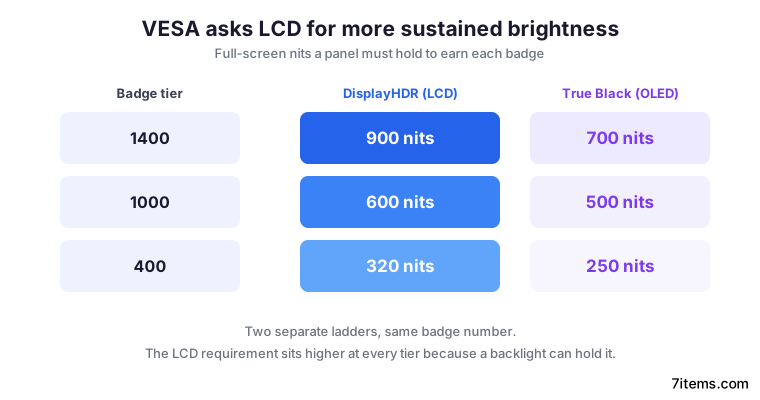
An independent standards body has already priced this gap into its badges. The VESA DisplayHDR criteria run two parallel ladders: DisplayHDR for LCD, and DisplayHDR True Black for self-emissive panels like OLED. Both climb through 400, 500, 600, 1000 and 1400.
Look at the sustained full-screen test at the top tier. To earn the 1400 badge, an LCD must hold 900 nits across a full screen for a long duration. A True Black display must hold only 700. The same split runs down the ladder: 600 against 500 at the 1000 tier, and 320 against 250 at the 400 tier.
The standard measures two different things on purpose: a quick full-screen flash, like an explosion in a film, and the steady brightness a screen holds long term. A True Black badge and a DisplayHDR badge at the same number do not promise the same sustained brightness.
What mini LED gives up in return
Mini LED does not win everything. 2,304 zones is a lot, yet it is still tens of thousands of pixels sharing each zone. So a bright object on a dark background gets a halo, where the zone lights more area than the object fills. White subtitles on a night scene are the classic example.
OLED has no such problem. It switches each pixel off on its own, so its blacks and its edge contrast stay perfect whatever the content. Response time and motion clarity still favour OLED in fast games too, whatever the backlight does.
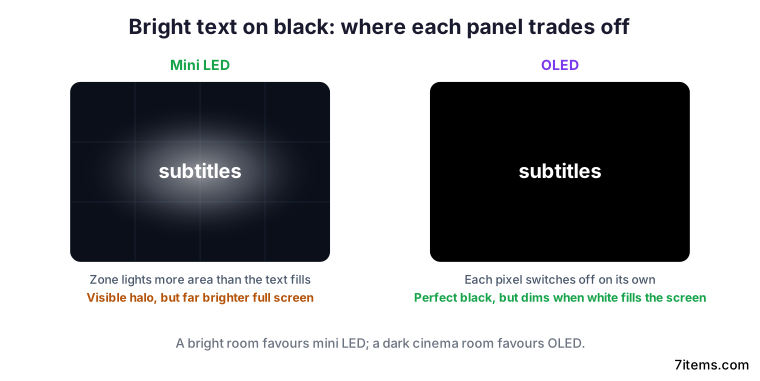
A bright room with large bright areas points to mini LED. A dark room and cinema content point to OLED.