

INDX, KliTek and AMS all print color a different way

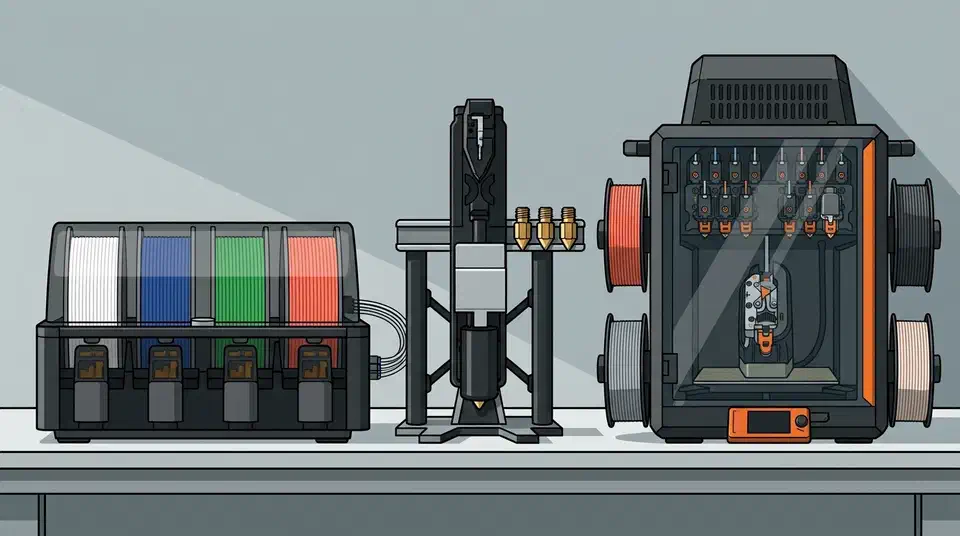
INDX, KliTek and AMS use three different mechanisms, and each one is bad at something different. A purge feeder flushes roughly 8 grams of filament every colour change. Nozzle swapping skips the flush, at the price of re-seating metal thousands of times. Toolchangers waste almost nothing and cost the most.
Key Takeaways
- Three very different multi-material systems now sell in the same price band.
- Purge feeders are cheap and simple, but throw plastic away on every swap.
- Nozzle swapping skips the purge and gambles on perfect re-seating instead.
- Toolchangers waste almost nothing and carry the most parts to service.
- Count the colour changes in a typical print, then pick the mechanism.
The three architectures, in one paragraph each
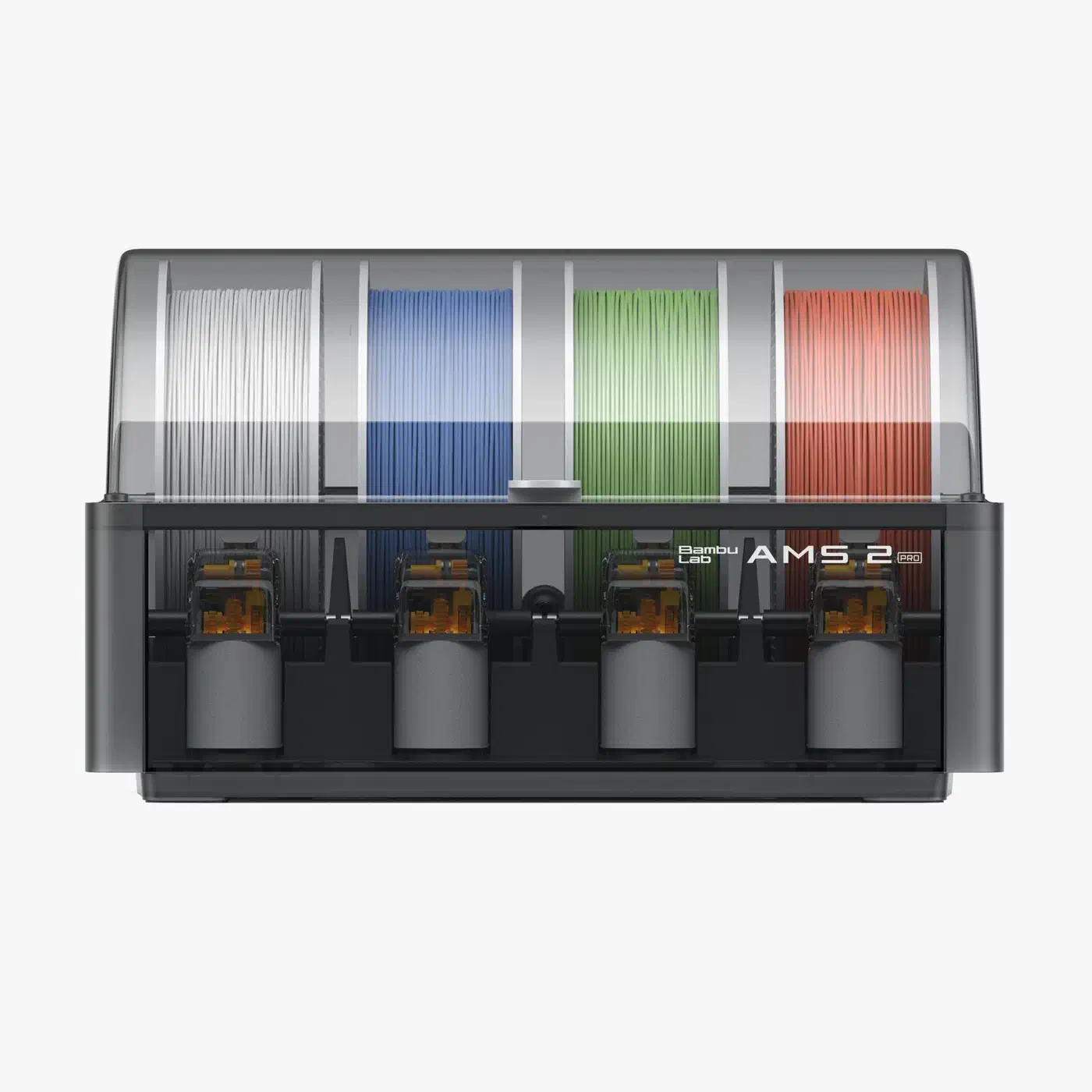
A purge-and-swap feeder keeps one nozzle and feeds many spools into it. Bambu Lab’s AMS is the best known example, and Creality’s CFS works the same way. Molten plastic cannot be un-melted, so the old colour has to be pushed out before the new one prints cleanly. The AMS also dries its spools, but only the HT version reaches nylon’s 75°C drying floor.
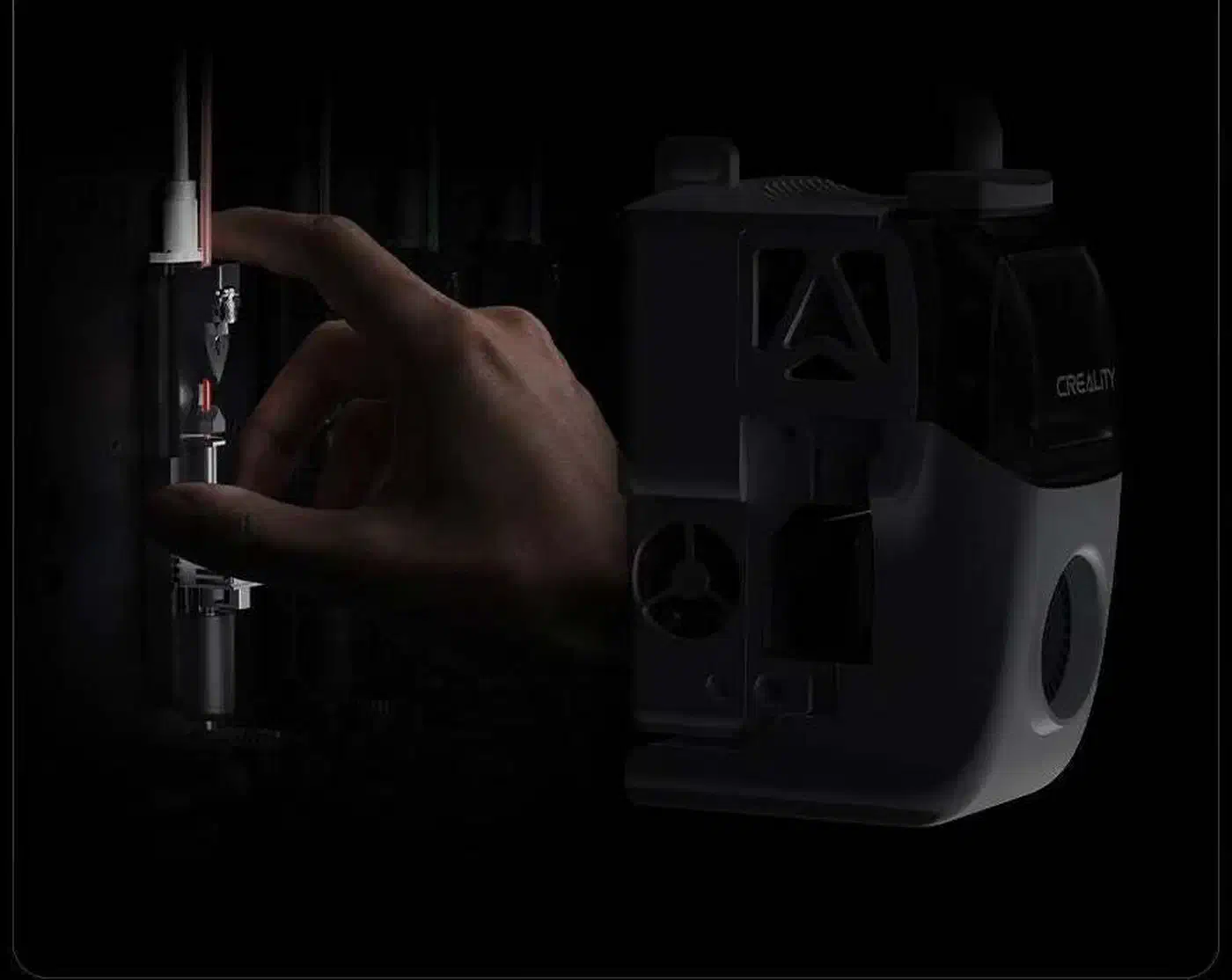
A quick-swap nozzle system changes the nozzle instead of flushing it. Creality’s KliTek parks four nozzles at the back of the chamber and docks onto whichever one it needs. The melt zone is never shared, so there is nothing to purge.
A passive toolhead system goes one step further. Bondtech’s INDX , sold as a conversion kit for the Prusa CORE One, uses one active head. That head picks up as many as eight featherweight tools. The tools carry no electronics and no heater block, because the smart head induction-heats the nozzle itself.
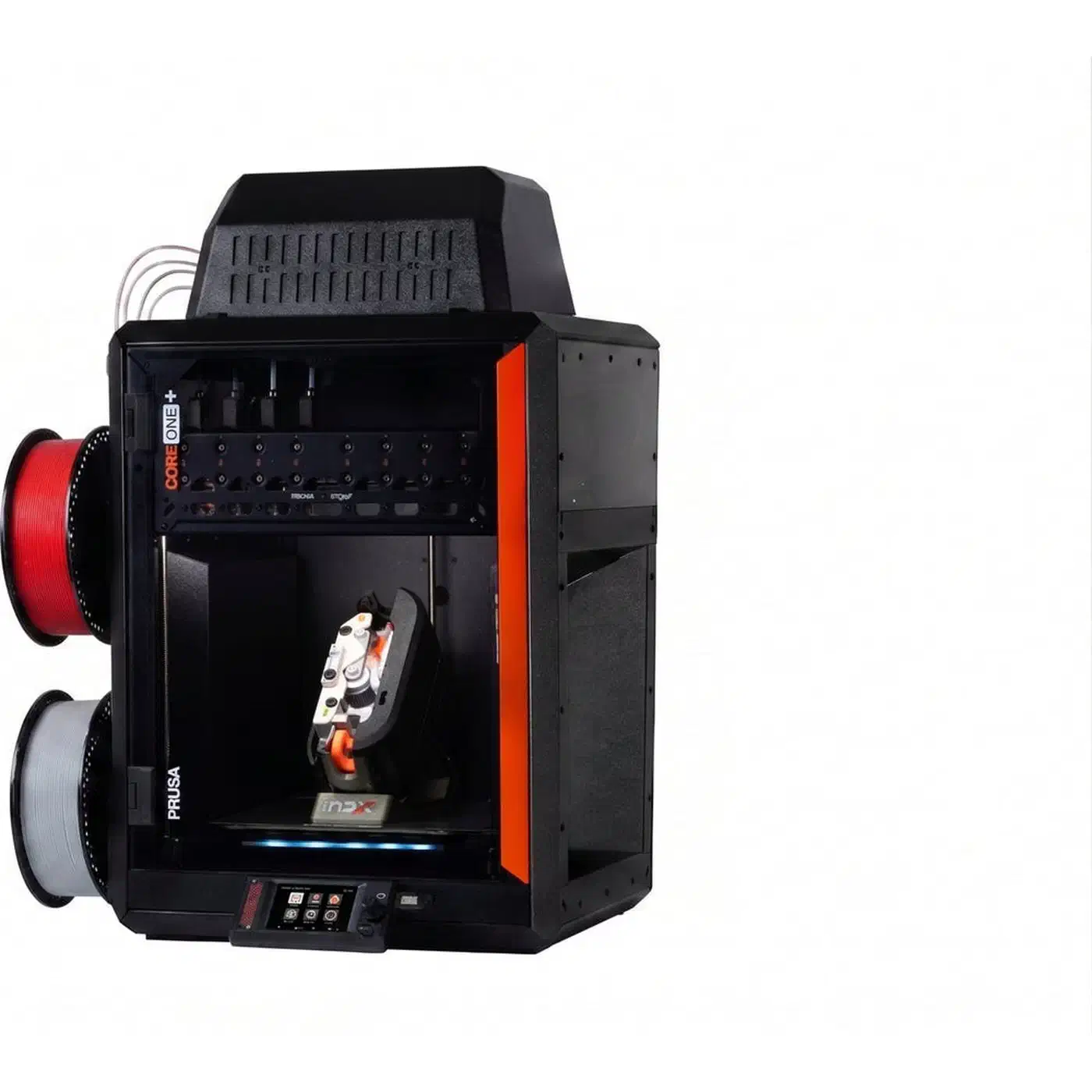
All three shipped inside the same twelve months and land in roughly the same money. The 8-tool INDX kit is $999 and the 4-tool kit $749, per Prusa’s order announcement . The Snapmaker U1 toolchanger is $999 complete. A P2S with an AMS sits under that, and Creality has not priced the K3 yet.
How-To Geek’s three-brand comparison lands on ease of use for Bambu Lab, price for Creality and repairability for Prusa, with no overall winner. The mechanism predicts the weakness far better than the badge does.
Which multi-material system wastes the least filament?
Purge feeders lose the most, and the loss is structural. A Bambu X1C or P1S flushes about 8 grams per swap by default. Tuned settings pull that down to 4 or 5 grams, and aggressive ones push it past 12. Those figures come from a worked purge-waste analysis of real multi-colour jobs.
On a 15 gram keychain with 8 colour changes, purge accounts for 81% of the plastic you buy. On a 100 gram phone case with 20 changes it is 62%. On an 800 gram helmet with 15 changes it falls to 13%, because the part is huge and the swaps are few.
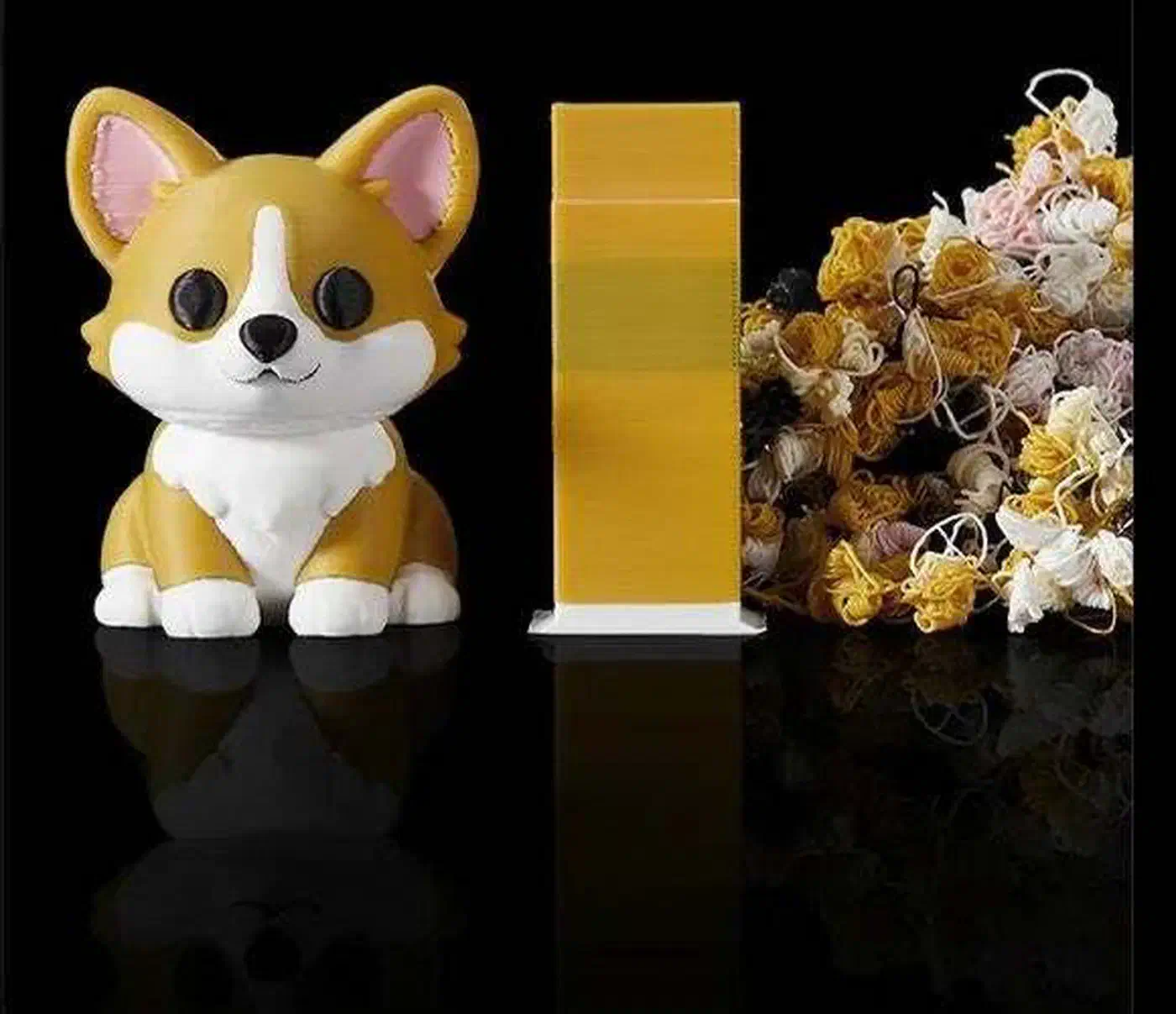
Toolchangers sit at the other end. Prusa puts INDX purge at 0.013 grams per material swap, with a whole multi-material print producing 20 to 30 grams of waste in total. Nothing is flushed, so only ooze and a short prime remain, which makes the claim plausible.
Nozzle swapping should land in the same low band, and Creality says it does. Its lab cites one model needing 278 grams on a single-nozzle printer against 39 grams on KliTek, an 80% cut. Again, that is a manufacturer number with no independent test behind it yet.
| Architecture | Waste per colour change | Source of the figure |
|---|---|---|
| Purge feeder (AMS, CFS) | ~8 g default, 4-12 g tuned | Measured by third parties |
| Nozzle swap (KliTek) | Ooze plus a small prime tower | Vendor claim, untested |
| Toolchanger (INDX, Snapmaker U1) | 0.013 g claimed | Vendor claim, mechanism plausible |
On a part heavier than 100 grams with under 10 colour changes, a purge feeder throws away less than a euro of plastic. Above 30 changes on small parts, you are buying more filament for the bin than for the model. The plastic in the bin also carries a carbon cost, which a lower-footprint spool like recycled PETG trims even though it does not cut the gram count.
Speed, alignment risk and what breaks
A purge feeder spends roughly 30 to 45 seconds per swap once cutting, retracting, feeding and flushing are counted. Older single-filament setups reach 90 seconds. Forty swaps therefore add 20 to 30 minutes of dead time to a print.
Mechanical swaps are much quicker. Snapmaker advertises 5-second tool changes on the U1, though independent reviewers measured 10 to 12 seconds in practice. INDX lands near 12 seconds including the reheat. Creality claims under 5 seconds for a bare nozzle swap and under 15 seconds for a full material change on KliTek.
Any mechanical system beats any purge system on time, at every swap count.
Alignment risk runs the other way. A single-nozzle purge feeder never moves its hot end, so there is nothing to misalign. Nozzle swappers have to seat the same metal interface thousands of times per print, and Creality quotes 25 microns of repositioning accuracy after each change. On a toolchanger the per-tool offsets need calibrating, but each tool stays assembled.
Part count decides what you end up servicing. One nozzle and a feeder gives you the least that can go wrong. Four docked nozzles add four couplings and a docking mechanism on top of that, while eight passive tools plus a smart head multiply almost every part by eight. The INDX kit alone packs a docking rail, an induction coil and a self-adjusting extruder.
Repair costs differ sharply between the two mechanical systems. Creality quotes about $14 per nozzle assembly against roughly $67 for a full toolhead, a 4.5x difference. The swap itself needs two screws and one USB-C cable. A clogged single nozzle on a purge feeder is cheaper still. A worn dock on a toolchanger is the expensive failure, because it is structural rather than consumable.
Colour-change times are measured consistently for the U1 only, and spare part prices are published for KliTek only. Nobody has yet run one test model across all three architectures with the waste weighed. Long-run coupling and dock wear data does not exist at all.
Which architecture fits which kind of printing
Occasional colour models suit a purge feeder. If you print a two-tone bracket every few weeks, the purge costs pennies. The machine also has the fewest parts to service, and it sits inside printers you can buy for well under a thousand.
Flexible and multi-hardness parts push you toward dedicated nozzles. A shared melt zone is exactly the problem with TPU, which buckles under push force and jams. Creality’s S-Drive pushes filament from behind so it moves through the tube like a caterpillar. The company claims 80A TPU support at 3 mm³/s flow, where most consumer printers manage 1 mm³/s. Bambu’s Vortek on the H2C handles flexibles too, but only one TPU per print job.
Toolchangers earn their keep on production multi-material work. Waste of 20 to 30 grams across a whole job changes the economics of running a printer daily. Eight independent tools also let soluble supports, abrasives and colours coexist without cross-contamination. You pay for that in upfront cost and in parts to maintain. Engineering plastics ask for one more thing first: ABS and polycarbonate warp without an actively heated chamber , whatever the tool count is. Carbon-fiber nylons add a moisture trap of their own, where wet filament reshuffles PPA-CF and PA6-CF and swings PA6-CF behind PA12-CF before any tool ever moves. Regulated parts raise the bar higher still, since a flame-retardant rail nylon must clear fire-safety certification before it can ride on a train at all. And for a part headed outdoors, ASA’s UV resistance matters more than the tool count, because ABS goes brittle in sunlight.
Mixed hobby use has a duller answer: keep the machine you own and budget for the plastic it wastes. The Next Layer’s 2026 roundup notes that Creality is building a toolchanger of its own. Anycubic, meanwhile, is prototyping a low-cost printer that minimises purge.
Count the colour changes in a print you actually make, then multiply by 8 grams and by 40 seconds. If both answers make you wince, buy the mechanism that skips the purge. If neither does, a purge feeder is the simpler machine and it will serve you fine.