

Portal axles bolt onto any 1/10 rig with the Reefs XP199

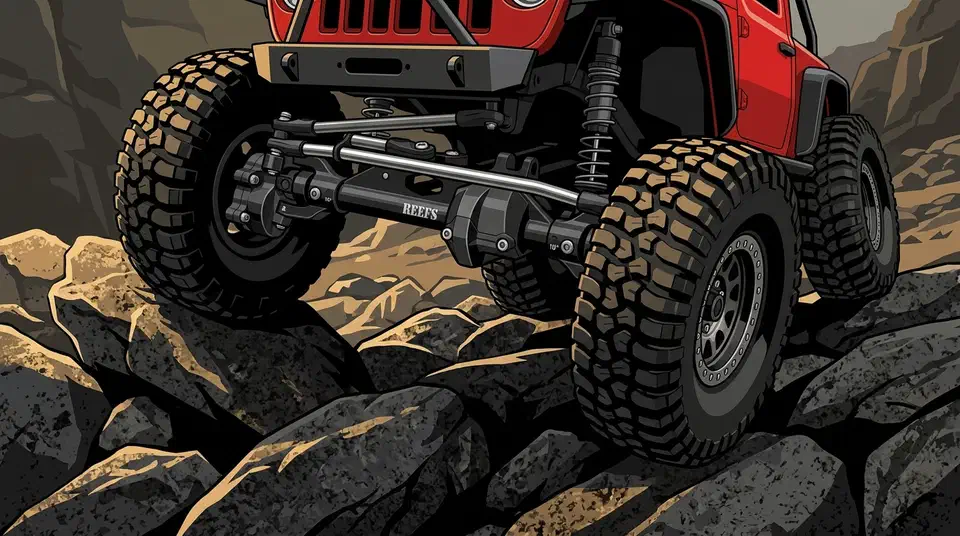
The Reefs XP199 portal axle now sells on its own, so you can bolt portals onto a 1/10 crawler you already own instead of buying a whole new truck. The fully assembled aluminum and hardened-steel front axle steers up to 60 degrees and adds a second gear reduction at each wheel, and it lists for $399.
Key Takeaways
- Reefs now sells the XP199 portal front axle by itself, not just on the XP10.
- Portal boxes lift the axle over rocks and gear each wheel down again.
- The axle steers up to 60 degrees, close to what factory portal crawlers reach.
- It arrives fully assembled in hardened steel and aluminum for $399.
- At 199mm hex-to-hex it fits most 1/10 builds, though links may need re-drilling.
What is a portal axle, and what does it do?
A portal axle adds a small gearbox at each wheel hub. That gearbox sits between the axle tube and the wheel center, so the tube rides higher than the wheel. On a crawler, that raised tube is the whole point.
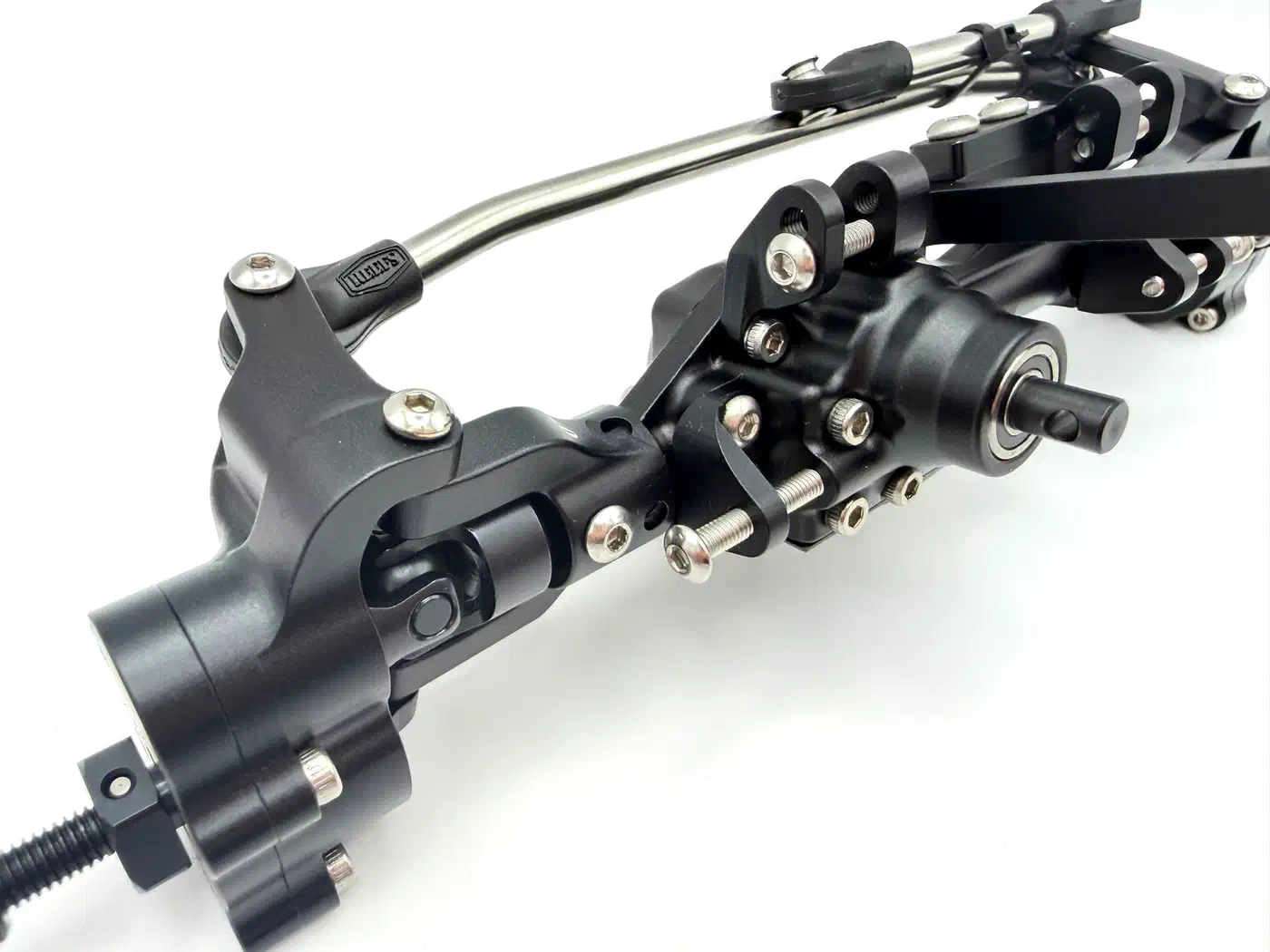
The lift is free ground clearance. Your lowest hard part moves up and away from the rocks, so the axle stops hanging up on ledges the tires could otherwise climb. A standard straight axle drags its center pumpkin over everything; a portal axle tucks that pumpkin out of the way.
The gears inside the box also do a second job. They add another reduction stage right at the wheel, on top of the ring and pinion in the diff. More reduction means more torque and slower wheel speed, which is exactly what you want when you’re picking a line over rocks.
Still, portals are not free in every sense. You hang extra weight and more moving parts at each corner, and that unsprung mass changes how the suspension behaves. For a crawler, most builders take that trade gladly.
What the Reefs XP199 portal axle gives you on paper
The headline number is steering: the Reefs XP199 front axle set , covered by Big Squid RC, is rated up to 60 degrees of steering angle, backed by high-clearance C-hubs and a low-profile diff cover to protect the ground clearance you just gained.
The gearing is two stages. The ring and pinion is 8T/30T, and the portal gears are 18T/31T. That second pair sets the extra wheel-end reduction, so it decides how much the axle slows and torques up your drivetrain.
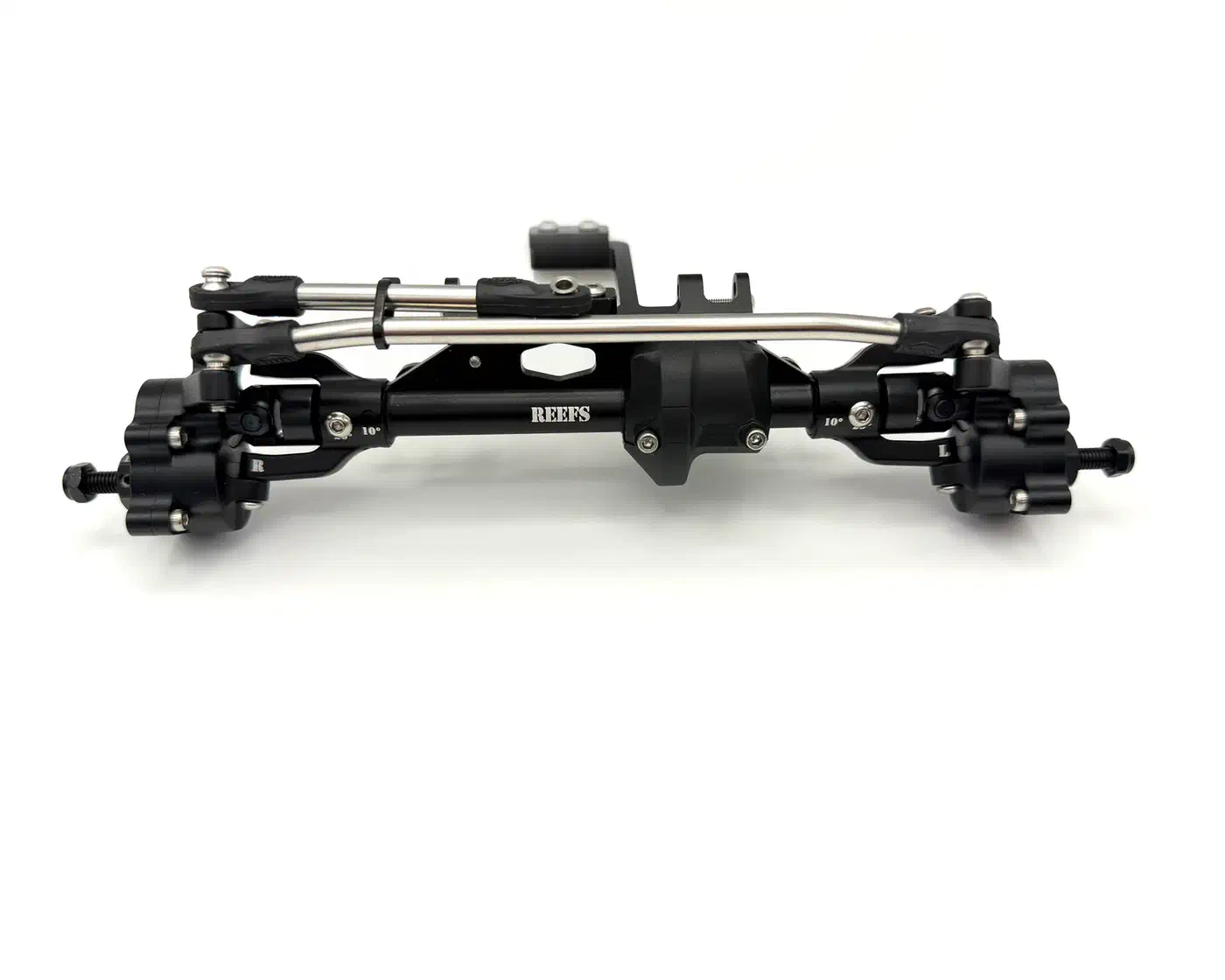
Width decides fitment. At 199mm hex-to-hex, the axle drops into the space most 1/10 crawlers expect, though the exact link and mount points still need checking.
The build is hardened steel where it counts. Reefs uses 5mm pinned axle shafts, keyed steel spools, hardened steel universals, and 6mm portal stub shafts with M5 threads. The C-hubs offer 0, 10, and 20 degree caster adjustment, and the servo mounts behind the axle with a skid plate. It ships fully assembled in black anodized aluminum as part #REEFS298 for $399.
How the portal gearing changes your crawler’s drive ratio
The 18T/31T portal gears drive this upgrade, and they retune your whole drivetrain, not the front hubs alone. Each portal box multiplies the final drive ratio by its own gear pair. So the moment you fit the axle, the effective reduction climbs.
A lower effective ratio means the same motor turns bigger tires more slowly and with more grunt. That suits rock work, where crawl speed and control beat top speed. The extra lift also lets larger tires clear obstacles without the axle tube dragging.
There is a cost to that torque, though. If you keep the same motor and pinion, expect a slower top end and a torquier crawl. Plan a motor or pinion change if you want some of that speed back.
Only the front axle is portal here, so your front and rear ratios no longer match unless you add a matching rear. On a slow technical line that mismatch is minor, but check it before you build.
Is the standalone XP199 worth it over buying a portal crawler?
The answer depends on what you already own. Buying the axle lets you keep a chassis, electronics, and body you like, and upgrade only the front end. If your rig is already dialed, that is a clean way to add portals without starting over.
The Redcat Vertex-10W , also reported by Big Squid RC, makes the opposite case: it ships on portal axles from the box and is rated at 58 degrees of steering, close to the XP199’s 60. It arrives tuned and balanced, with no fitment guesswork.
| Option | What you get | Steering | Price |
|---|---|---|---|
| XP199 front axle | one assembled portal front axle | 60° | $399 |
| Vertex-10W Slider | pre-built roller, you add electronics | 58° | $399.99 |
| Vertex-10W RTR | complete ready-to-run crawler | 58° | $529.99 |
The axle wins when your existing rig is already good and you only want portals up front. A new crawler wins when you would otherwise rebuild half the truck to make the axle fit.
Reefs sells the front axle separately, but a matching rear was not confirmed. So for now, grafting portals onto both ends may still leave you an axle short.
What to check before you bolt the XP199 to your build
A few go/no-go checks decide whether this axle fits your truck. Run them before you spend, because most are cheaper to answer than to fix later.
Confirm your chassis expects a 199mm hex-to-hex front axle. A mismatch here means new mounts or a different rig.
Next, check that the axle’s link mounting points line up with your chassis. If they don’t, plan to re-drill or fabricate links to get the geometry right, and budget time for this even on a close match.
Finally, size up the servo and the suspension. Verify the behind-the-axle servo mount clears your steering servo, and that the servo has enough torque to push 60-degree portal steering under load. Then account for the added corner weight and retune your shocks and springs to suit. Decide up front, too, whether you are happy running portals only at the front or would rather wait for a matching rear.
For a builder with a rig they already trust, the XP199 turns a full rebuild into a front-end swap. That is the real appeal of selling a portal axle on its own, and it is why the $399 spend reads as an upgrade rather than a fresh start.