

Redcat's Vertex-10W adds 24mm of track for steadier lines

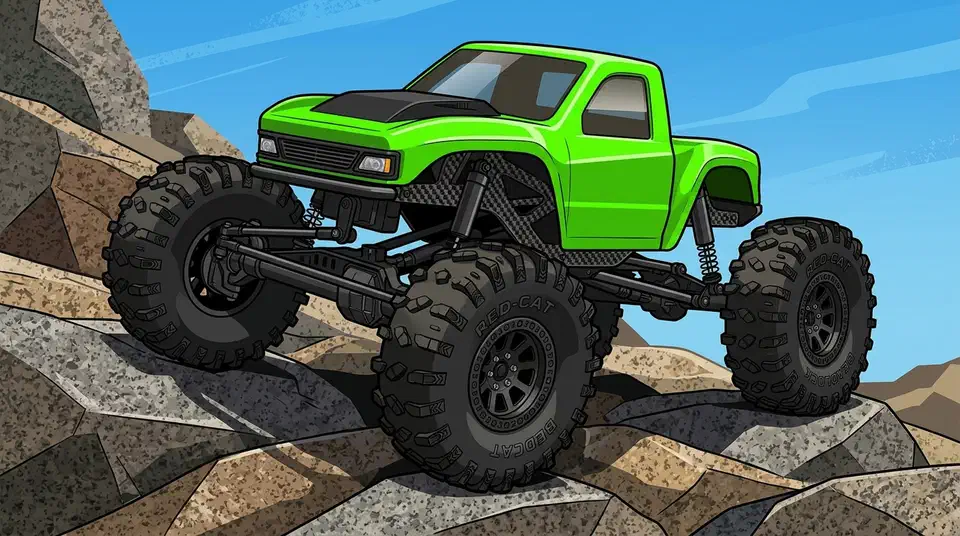
The Redcat Vertex-10W is the wide-track version of the 1/10 Vertex-10 crawler, and it runs 24mm wider than the standard rig, 12mm on each side. That wider stance, plus a longer 330mm wheelbase and 74mm of clearance, resists tipping on off-camber rock. It keeps the same 58-degree steering and trades tight-gate agility for a planted feel.
Key Takeaways
- The Vertex-10W sits 24mm wider than the standard Vertex-10, 12mm per side.
- The wider stance fights tip-over on side-hills but fits through narrow gates less easily.
- Both rigs share one carbon chassis, portal axles, and 58-degree steering.
- The 10W also stretches the wheelbase to 330mm and lifts clearance to 74mm.
- The ready-to-run version drives on a brushless motor and 2.2 inch beadlocks.
What is the Redcat Vertex-10W?
The Redcat Vertex-10W is the wide-track member of Redcat’s 1/10 Vertex-10 crawler family. It shares the platform but adds 12mm of width on each side, 24mm in total.
Redcat pitches the Vertex-10 range as performance-first with trail-truck DNA rather than a scale-looks build.
You can buy the 10W two ways. One is a ready-to-run (RTR) rig that drives out of the box once you add a battery. The other is a pre-built slider chassis kit that leaves electronics, wheels, tires, and body to you.
Redcat unveiled the Vertex-10W in the Big Squid RC Vertex-10W announcement , one day before the standard Vertex-10 announcement . Both models arrived together as the first two rigs in a four-option lineup.
What does 24mm of extra track width buy a crawler?
Track width is the distance between the left and right tire contact patches. Widen it and you move the point where the rig tips over. A wider track lets the crawler lean further on an off-camber slope before it rolls.
The Vertex-10W adds 12mm per side, 24mm total. That lets it run wider lines across a rock face and hold its footing where the narrow rig would start to roll.
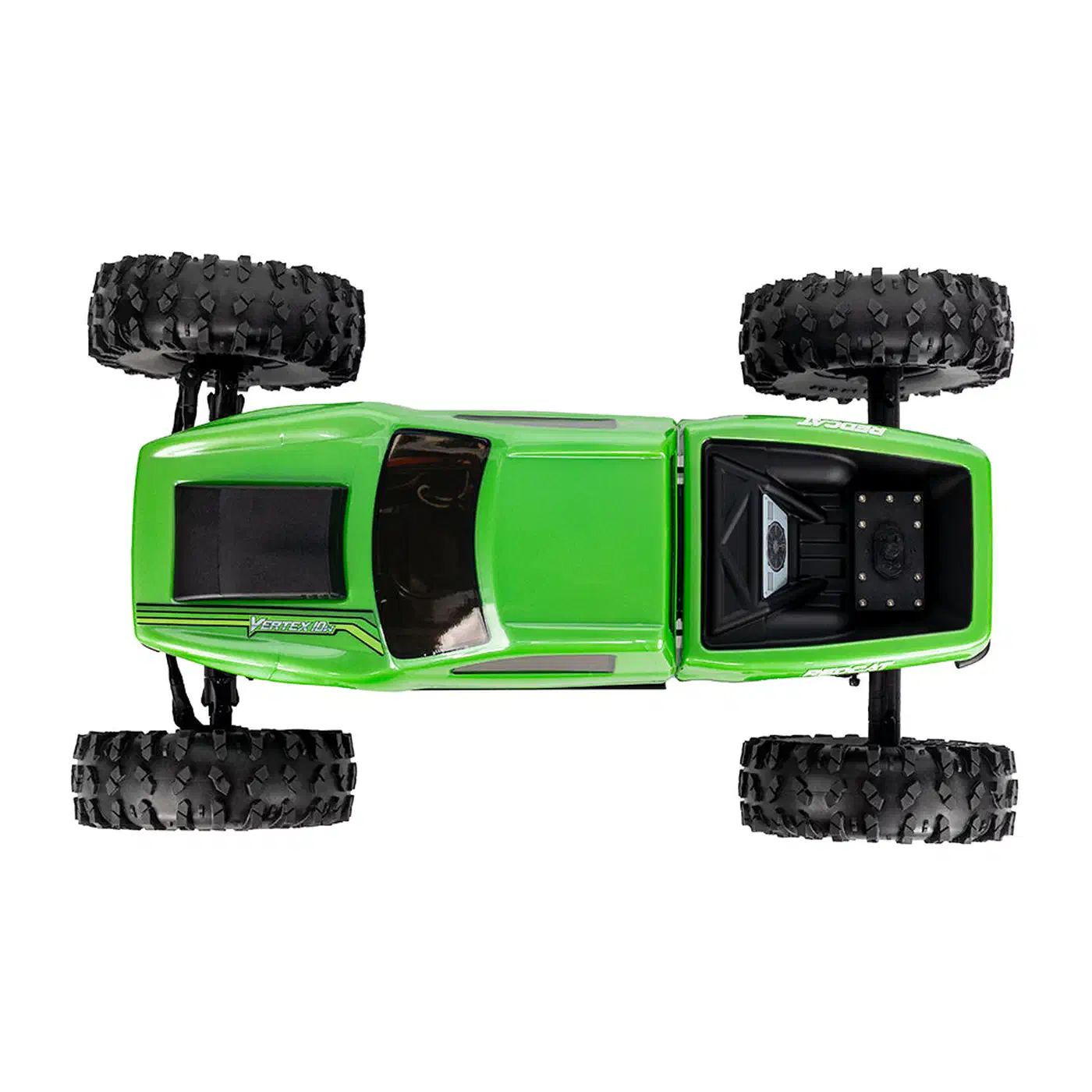
Width costs you something too: a wider rig is harder to thread through tight rock gates and narrow indoor gaps, so the standard Vertex-10 stays the nimbler choice when the line is confined.
The stability gain compounds with the rest of the 10W’s geometry. Its longer 330mm wheelbase and taller 2.2 inch wheels also steady the rig on uneven ground.
Vertex-10W vs Vertex-10 spec comparison
The two rigs differ in more than width.
| Spec | Vertex-10 (standard) | Vertex-10W (wide) |
|---|---|---|
| Length | 445mm | 463mm |
| Width | 254mm | 278mm |
| Height | 207mm | 206mm |
| Wheelbase | 316mm | 330mm |
| Ground clearance | 64mm | 74mm |
| Wheel width | 1.2 inch | 1.4 inch |
| Wheel diameter | 1.9 inch | 2.2 inch |
| Motor | Hobbywing 1700kv brushless | Hobbywing 1700kv brushless |
| Chassis | 3mm carbon fiber | 3mm carbon fiber |
The width jump proves the name: 278mm minus 254mm is the 24mm the badge promises. The wheelbase and clearance both grow with it, so the 10W is a bigger rig on every axis but height.
What both Vertex-10 models share
Both rigs ride a 3mm flat-rail carbon fiber chassis, picked to blend durability with light weight. That shared frame is why the width choice isolates so cleanly: the stance changes while the platform stays put.
Both use portal axles and carry a 58-degree steering rating for a tight turning radius. The wider 10W keeps that same figure despite its stance, so it does not give up lock to gain width.
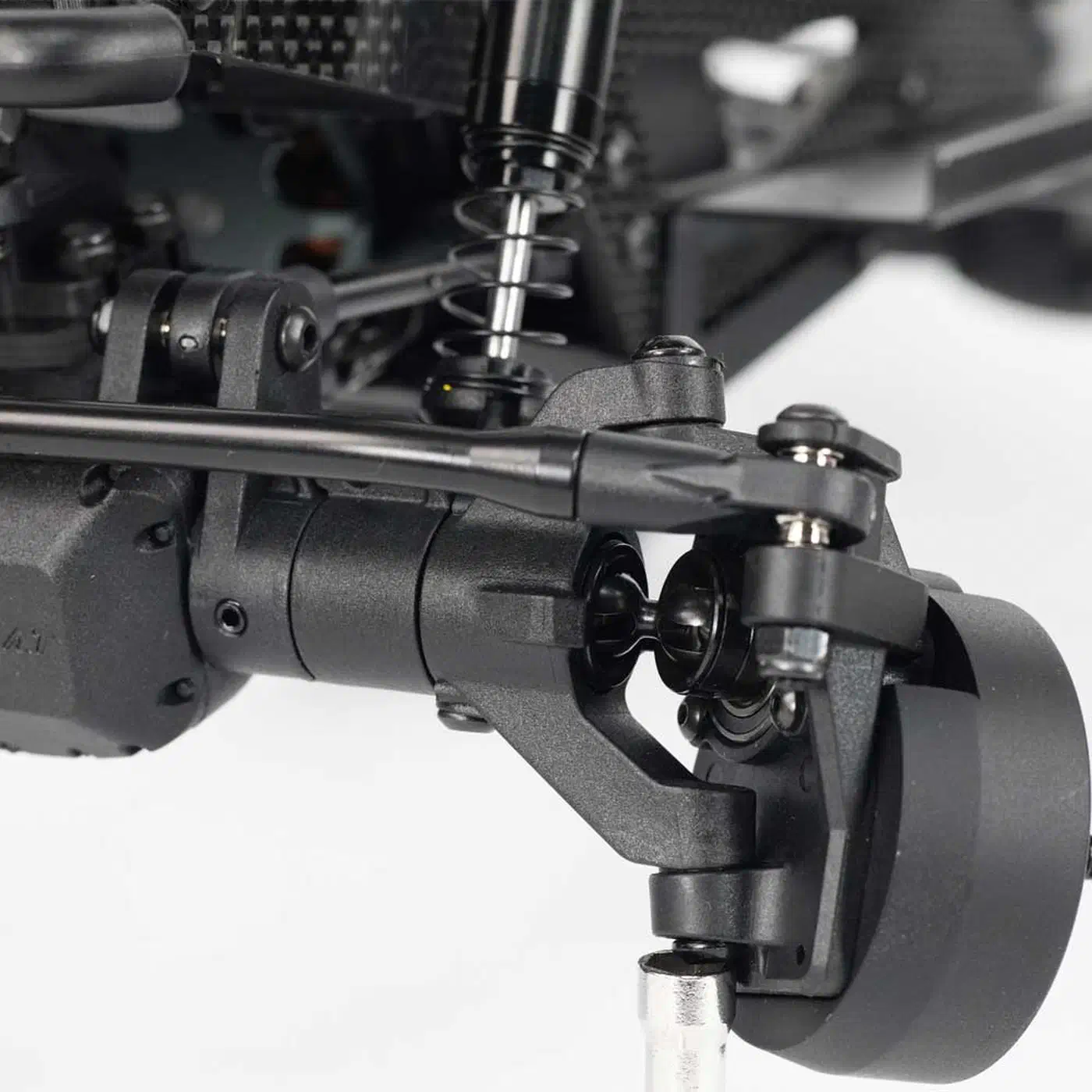
Both run aluminum-bodied, oil-filled air-emulsion shocks, plus aluminum chassis and suspension links. A clipless body mounting system gives each a clean shell. And each sells as an RTR and as a pre-built slider kit.
What ships in the Vertex-10W RTR
The RTR arrives pre-assembled and drives once you add a battery. It runs a Hobbywing WP-10BL60 1700kv brushless motor and plastic 2.2 inch beadlock wheels.
The electronics are complete. You get a 60A programmable brushless ESC (2-4S ready, integrated fan, 10A BEC), an HX-50BL 50kg servo, and the RTX-4C 4-channel radio. Everything needed to drive is in the box except the power.
You supply a 2S-4S LiPo, a charger, and 4 AA cells for the transmitter. No battery ships with the rig. Two RTR colors are offered, dark gray and electric green.
The slider version instead ships a pre-assembled chassis with a pre-cut, unpainted cab-only body. It leaves motor, ESC, radio, wheels, tires, and battery to the builder, so it suits someone who already owns electronics.
Which Vertex-10 should you buy?
Pick the Vertex-10W for outdoor rock, off-camber side-hills, and open trail. The planted, tip-resistant feel counts for more there than squeezing through gaps.
Pick the standard Vertex-10 for tight indoor courses and narrow rock gates. Its 24mm-narrower track threads lines the wider rig cannot.
The RTR-versus-slider call is separate. Choose the RTR if you want to add a battery and drive. Choose the slider if you already own electronics and want a head start on a custom build. At launch the standard RTR listed at $499.99 and the 10W RTR at $529.99, so confirm the current street price before you buy.
Either way, the two rigs share one platform, so the real decision is the width. Buy the stance that suits your terrain, and the rest of the crawler comes along unchanged.