

A divorced transfer case sets the Enduro24 Sendero apart

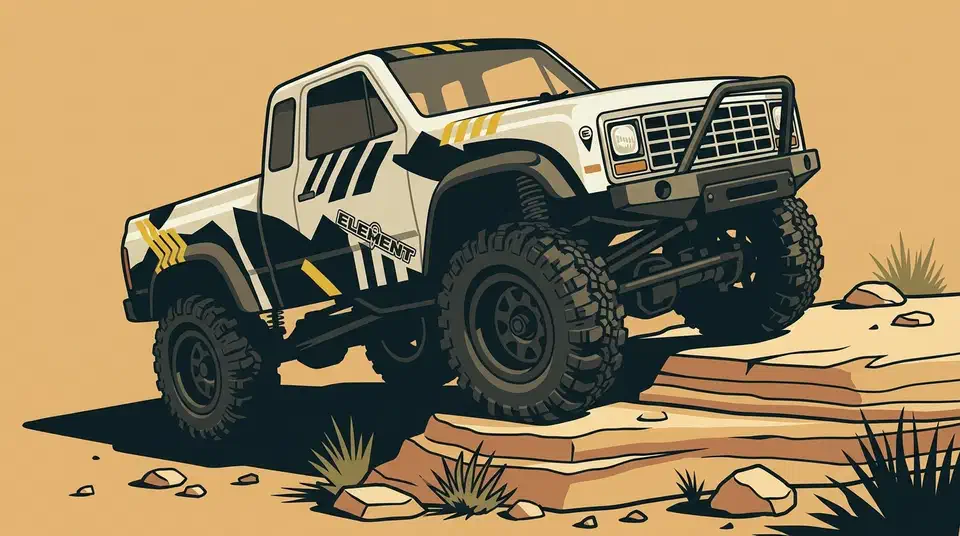
The Element RC Enduro24 Sendero drives its axles through a divorced transfer case, a standalone gearbox that sits apart from the transmission. Every rival micro crawler uses one combined transmission bolted to a center skid. Element also mounts the motor up front, so the heaviest part of the truck sits over the front tires on climbs.
Key Takeaways
- The Enduro24 Sendero is a 1/24 4WD trail truck from Element RC.
- Its motor and gearbox feed a separate transfer case mounted mid-chassis.
- The forward motor sits over the front tires to keep them planted.
- Metal frame rails and 4-link suspension copy a full-size trail truck.
- Gear reduction is 62.6 to 1, so the tiny motor crawls slowly.
What is a divorced transfer case on an RC crawler?
A transfer case is the gearbox that takes power from the transmission and splits it between the front and rear axles. On most trucks it bolts straight onto the back of the transmission, so the two form one block. “Divorced” means the two are separate units, joined by a short driveshaft.
Full-size trail rigs have used divorced cases for decades, but at 1/24 scale the layout is rare.
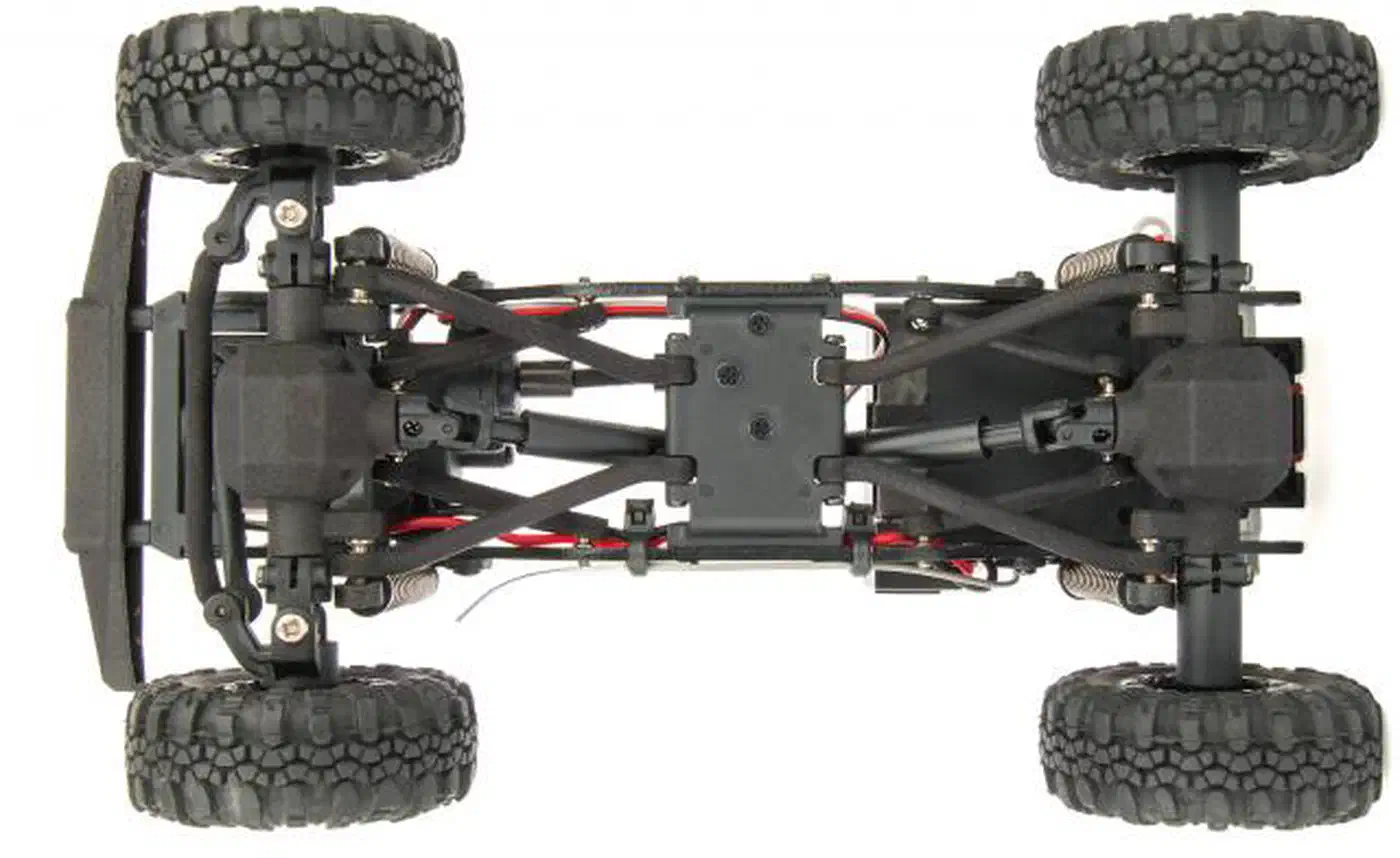
On the Sendero the motor and transmission sit up front, behind the front axle. A short shaft runs back to a transfer case mounted near the middle of the chassis. From there, telescoping center driveshafts feed both axles. The Enduro24 product page says the split layout gives a lower center of gravity in a compact space, and frees up room under the body for a custom interior.
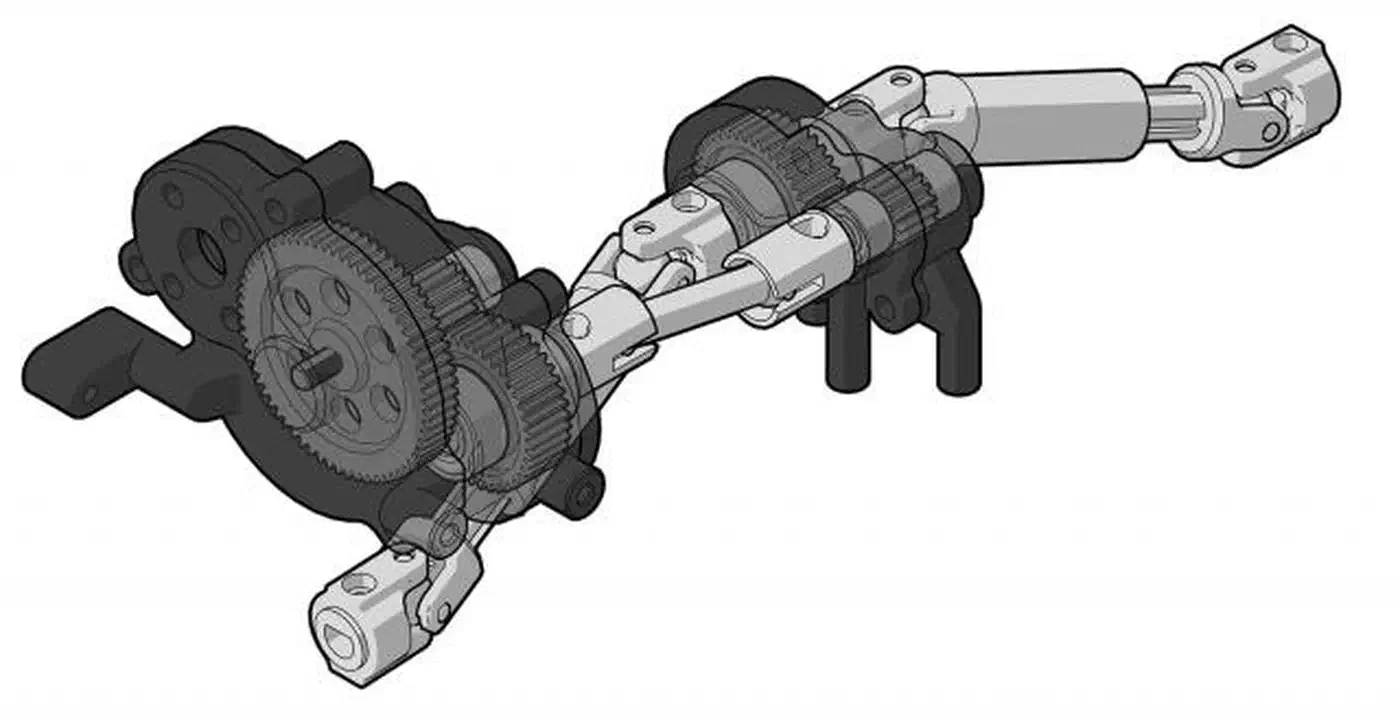
How does the Sendero differ from a center-skid SCX24 or FCX24?
Nearly every micro crawler hangs a single combined transmission off a skid plate under the middle of the chassis. That one block holds the motor, the gears and the outputs to both axles. The Axial SCX24 , the FMS FCX24 Power Wagon and the larger 1/18 Traxxas TRX-4M all work this way.
The Sendero is the only mainstream micro that splits the two apart. Moving the gearbox forward drags the motor forward with it, and that changes where the weight sits.
| Layout | Center-skid micros | Enduro24 Sendero |
|---|---|---|
| Transmission position | Middle of chassis, on a skid | Up front, behind the front axle |
| Transfer case | Built into the transmission | Standalone, mounted mid-chassis |
| Motor position | Mid-chassis | Over the front axle |
| Weight bias | Center | Front |
| Room under the body | Crowded by the skid block | Open for an interior |
The forward bias helps on ascents. However, a nose-heavy truck can feel less settled going back down a steep face, and on off-camber lines a center or rear bias gives the back tires more to hold onto.
Articulation still comes from the links, the shocks and the axles, and the Sendero runs molded 4-link suspension at both ends like its rivals do. Moving the transfer case shifts weight and frees up space, while the chassis twists over a rock exactly as far as it did before.
Parts are the other trade-off. The Enduro24 scene is thin next to the SCX24, which has years of brass, tires and chassis plates behind it. Hop-ups do exist: PowerHobby sells a 15g brass middle skid plate for the platform, and AsiaTees stocks aluminium parts. The catalog is still much shorter.
Why put the motor over the front tires?
The motor is the heaviest single piece of the electronics package, so where it sits decides how the truck balances. Element bolts it forward, over the front axle. As the truck tips nose-up on a climb, weight keeps pressing the front tires into the rock instead of rolling back off them.
On a center-biased rig the front end goes light on the same obstacle, so the tires skate and the climb stalls.
Gearing does the other half of the work. The 1i RC release writeup calls the 62.6:1 total reduction impressive for the class, and it is what lets a micro-sized motor produce usable torque at walking pace.
| Stage | Teeth | Ratio |
|---|---|---|
| Spur and pinion | 64/12 | 5.33:1 |
| Transmission | 40/16 | 2.5:1 |
| Transfer case | 40/17 | 2.35:1 |
| Axle ring and pinion | 24/12 | 2:1 |
| Final drive | 62.6:1 |
Four reduction stages instead of three is the cost of the divorced layout.
What comes in the Enduro24 Sendero RTR box?
The box holds everything except a screwdriver. The truck ships with a 2-in-1 receiver and ESC combo, a 2.4GHz two-channel radio, a chassis-mounted steering servo, a single-cell LiPo and a charger.
The rolling chassis reads like a shrunken full-size truck:
- Vertical metal chassis rails in place of a plastic tub
- Injection-molded 4-link suspension front and rear, on steel pivot balls
- Soft coil-over shocks
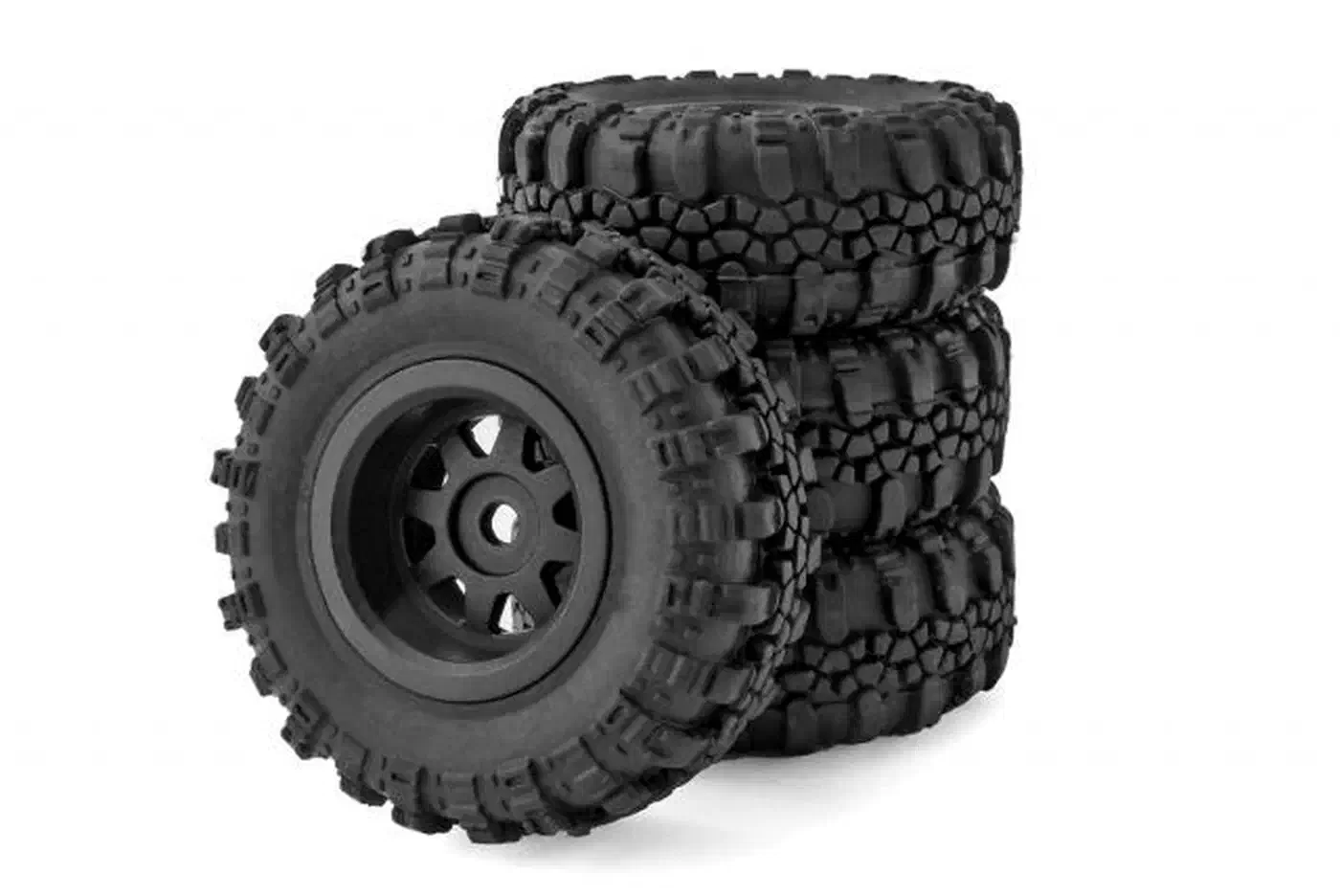
- Soft-compound rubber tires on one-piece wheels with 7mm hexes
- Telescoping center driveshafts and a removable front bumper
The body is a single-piece polycarbonate Sendero shell, sold in black and yellow as #20180 and red and blue as #20181. Associated’s spec sheet puts the truck at 215mm long and 102mm wide on a 128mm wheelbase.
The Sendero is no longer the newest micro on the shelf. RC Driver’s hands-on review treats it as a serious small-scale trail truck rather than a toy, and buyers still cross-shop it against the SCX24, FCX24 and Redcat Ascent-18. Stock comes and goes, so check availability before picking a color.
You buy this truck for the layout and live with the short parts catalog. If you want a 1/24 truck that climbs on its nose weight and leaves room under the body for a driver figure, the Sendero is the only one built this way.