

China's phones now carry 1,000mAh more battery than yours

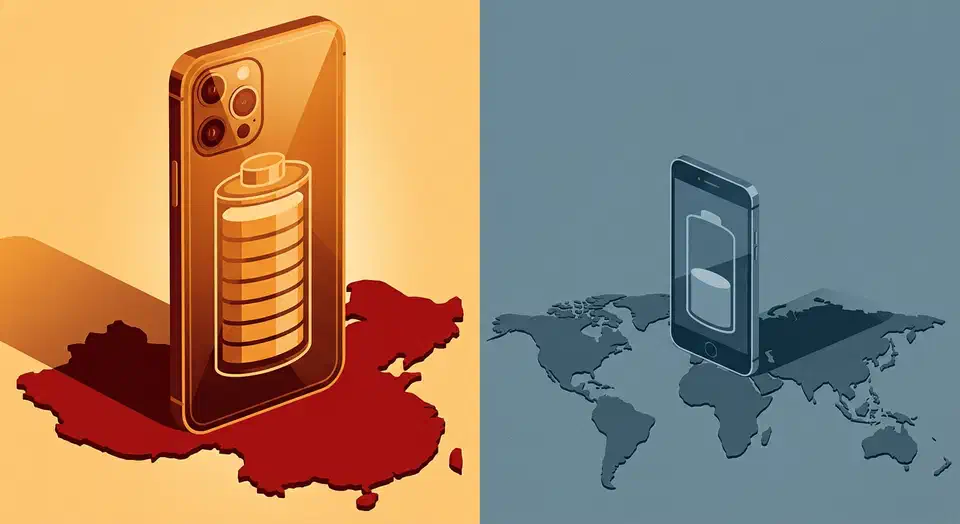
China’s 1,000mAh battery lead over the rest of the world is now a measured number. Counterpoint Research puts the country more than 1,000mAh ahead on average phone battery size. The global average reached 5,291mAh, and phones with 6,000mAh or more jumped from 10% to 29% of world sales in a year.
Key Takeaways
- Chinese phones average over 1,000mAh more battery than the rest of the world.
- The global average hit 5,291mAh, up about 400mAh in a year.
- Big-battery phones jumped from 10% to 29% of world sales in twelve months.
- Shipping rules keep the biggest cells inside China, even though the engineering travels fine.
- Samsung’s S26 Ultra still ships 5,000mAh while it tests far larger cells.
How big China’s battery lead is now
The average smartphone battery worldwide reached 5,291mAh. That figure comes from Counterpoint Research and its Global Handset Model Sales Tracker. It is a rise of about 400mAh in one year, the biggest yearly jump since late 2021.
Phones with 6,000mAh or more made up 29% of world phone sales, up sharply from just 10% a year earlier. A niche is now close to a third of the market.
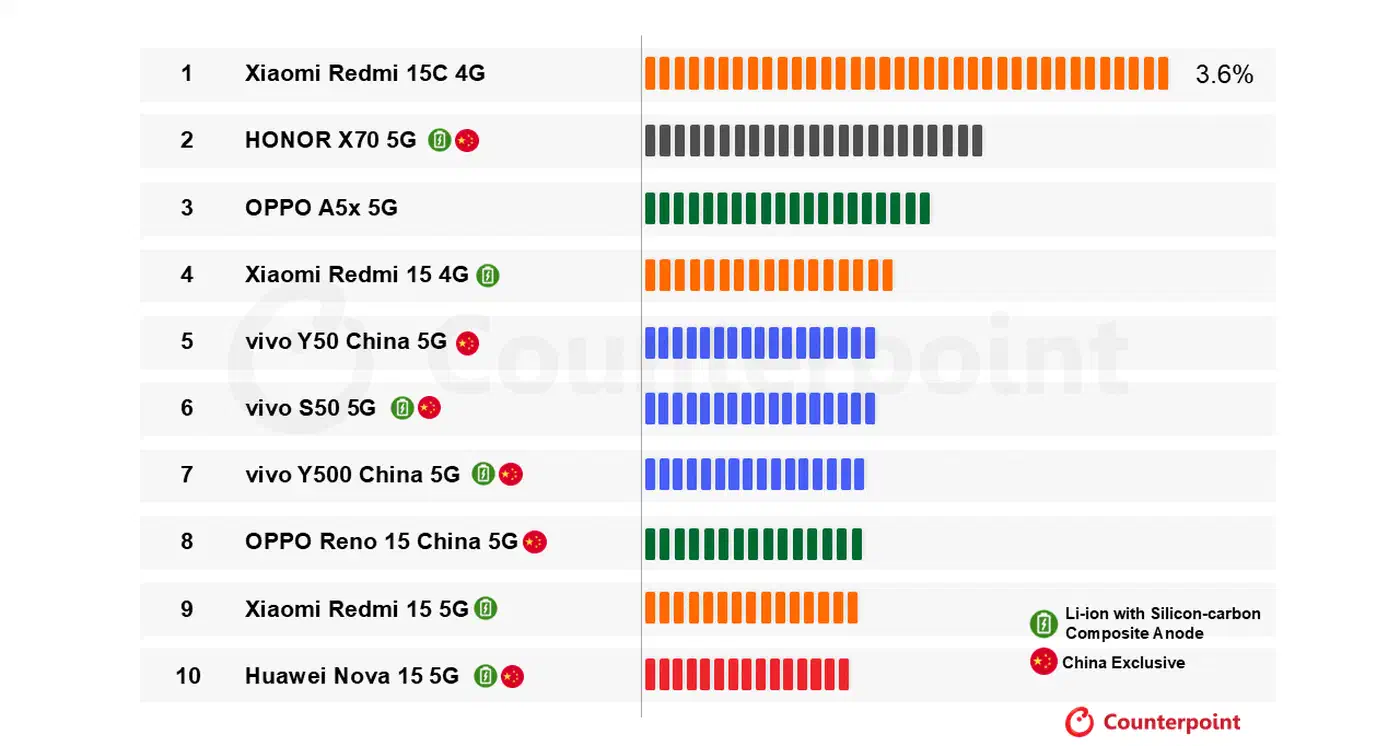
Chinese brands own that segment outright. vivo, Xiaomi, OPPO and Honor took every one of the top 10 best-selling spots in the 6,000mAh-plus list. Six of those ten models never leave China. The result is a lead of more than 1,000mAh in average capacity over everywhere else.
What silicon-carbon changed
Silicon-carbon cells hold more energy in the same space than the older lithium-ion cells. So capacity can climb without the phone getting thicker or heavier.
That killed the old design problem. For years, a bigger battery meant a chunkier phone. Thin flagships paid for their looks with short runtime. Silicon-carbon breaks that trade, so uptake has been quick. Six of the top 10 best sellers over 6,000mAh already use it.
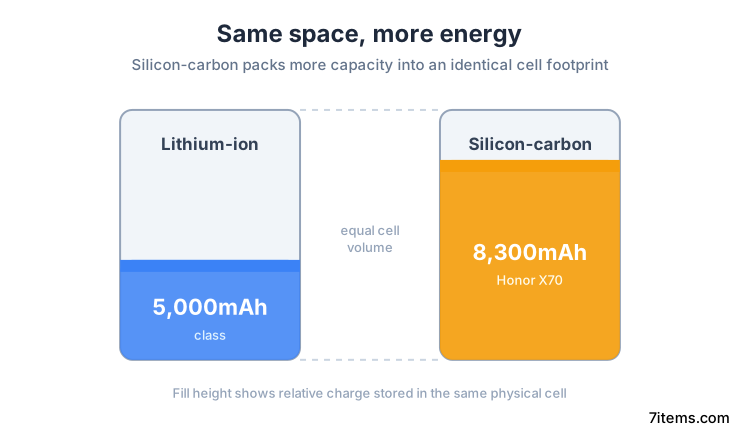
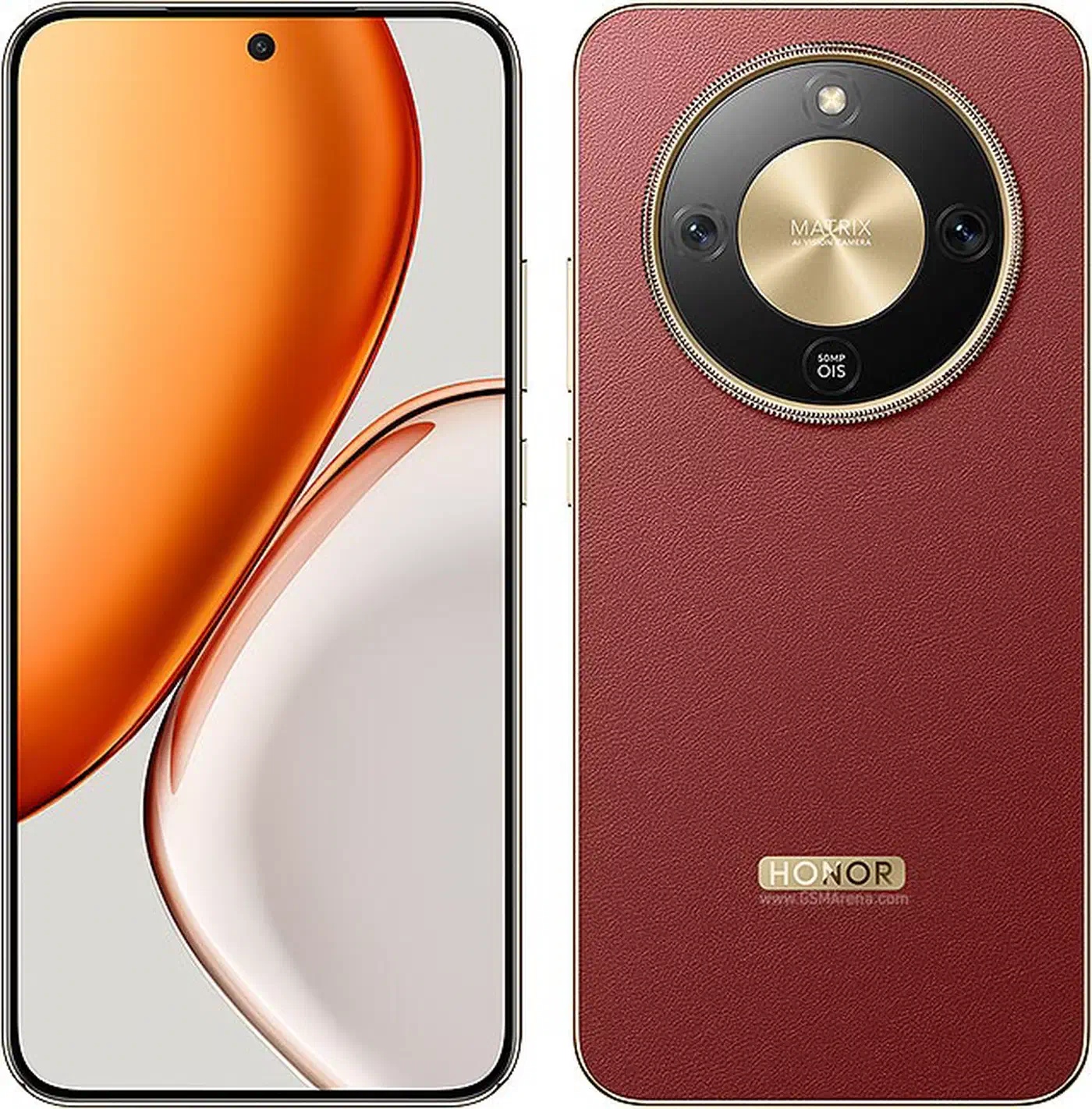
The reach goes from cheap to premium. The Honor X70 5G leads on raw capacity at 8,300mAh. It uses third-generation Qinghai Lake battery tech with 80W wired and wireless charging. At the other end, Xiaomi’s Redmi 15C 4G was the single best seller in the segment, with a 3.6% sales share. Big batteries are now a mainstream, affordable feature, reaching well beyond halo phones.
| Phone | Capacity | Where you can buy it |
|---|---|---|
| Honor X70 5G | 8,300mAh | China only |
| Xiaomi Redmi 15C 4G | 6,000mAh class | Global (best seller) |
| Samsung Galaxy S26 Ultra | 5,000mAh | Global |
The China-only row at the top is the whole point: the biggest cells stay home.
Why the big batteries stay in China
Most coverage gets this part wrong. Other brands can build these batteries; they just do not ship them. Three things hold the big cells back, and only one is about engineering.
The first is technology readiness. Many brands outside China are still waiting for silicon-carbon to mature, and some are betting on solid-state cells instead. Home-market strategy adds to that. Chinese brands launch their biggest cells at home first, where the supply chain and the regulators sit closest. Counterpoint’s Senior Analyst Harshit Rastogi ties the two together.
As a result, China has opened a lead of over 1000mAh in average battery capacity compared to the rest of the world.
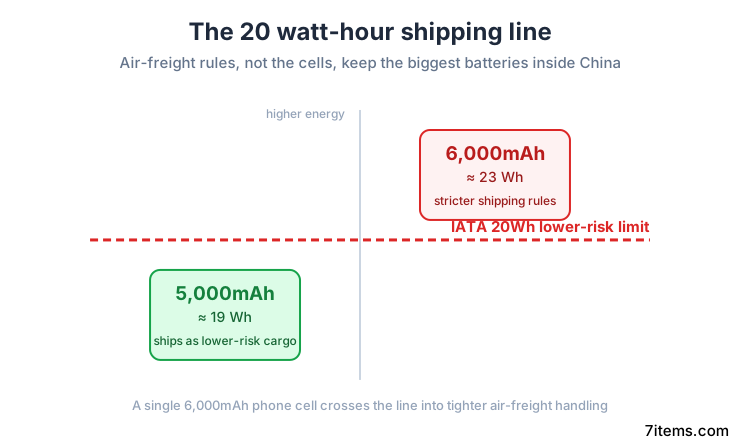
Regulation is the least understood of the three. Counterpoint says global rules on battery size slow how fast big cells reach other markets. It does not name the rule, but the one usually cited is air freight. The IATA lithium battery standards treat a single cell up to 20 watt-hours as lower-risk cargo. A 6,000mAh phone cell sits above that line, at about 23 watt-hours. That pushes it into stricter shipping rules. So the barrier is shipping paperwork rather than any limit in the cells themselves.
What the rest of the world ships instead
The Samsung Galaxy S26 Ultra ships with a 5,000mAh battery. That is about the global average, and well under the Chinese flagships at the same price.
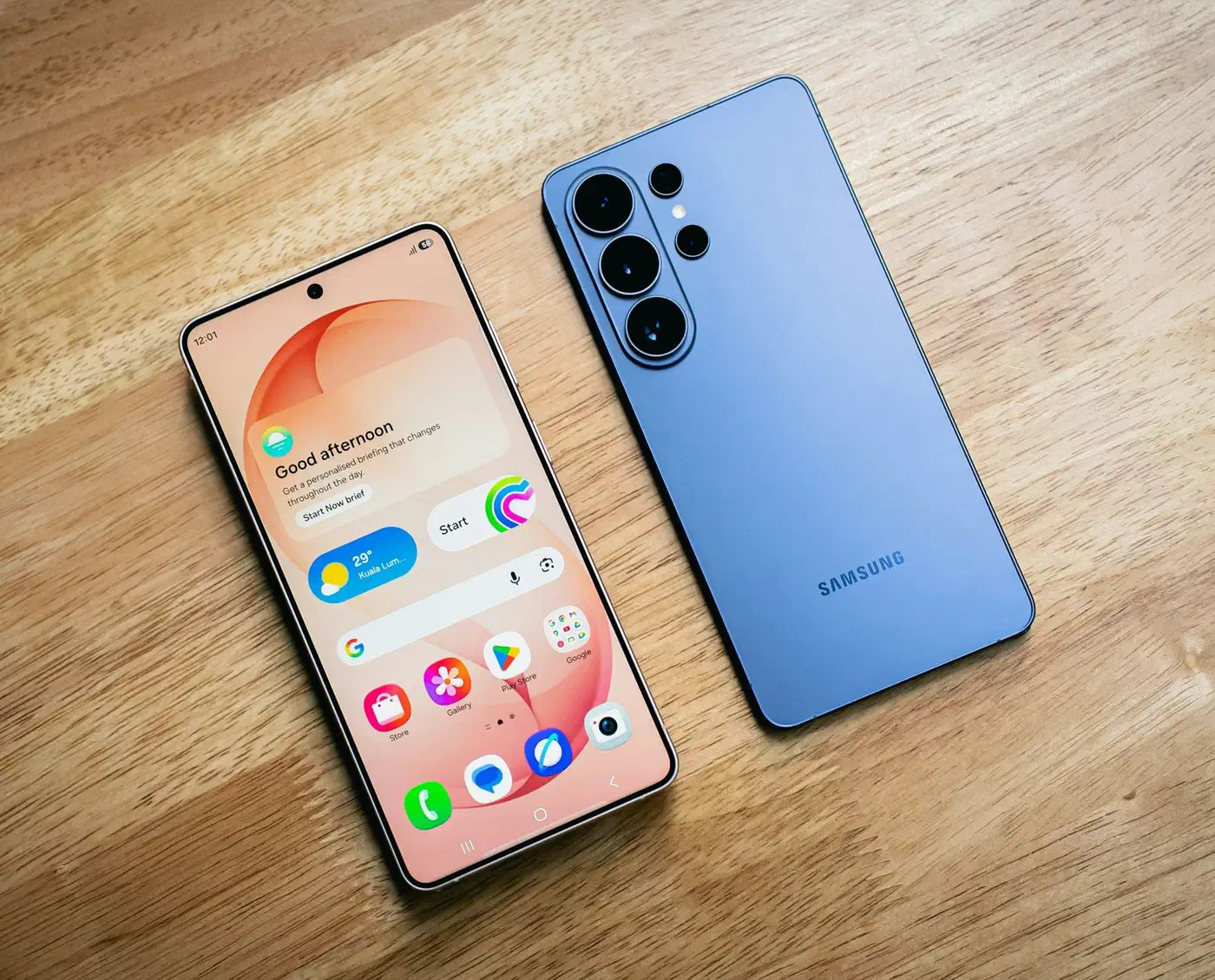
Samsung clearly can build one. Leaked documents reported by Notebookcheck show the company testing silicon-carbon cells far larger than anything it sells, including stacked multi-cell packs. Meanwhile Chinese flagships already pass 7,000mAh on shelves today. The technology is ready, but the phone Samsung sells lags well behind it.
For a buyer, a phone bought in Europe or North America carries roughly a generation less battery than one bought in Shenzhen. That reflects choices about markets and rules, well within what engineers can already do.
Does the gap keep widening?
Counterpoint expects capacity to keep rising, but more slowly. Silicon-carbon uptake should ease off soon.
Memory shortages are expected to make 2026 one of the weakest years for the smartphone market, with shipments declining around 12% YoY, while also driving a structural rise in BOM costs.
Rising parts costs push brands toward tighter specs and shorter phone lineups. That pressure works against another 400mAh jump next year. The industry is aiming at key milestones in 2027, with mass production due in 2028.
So the lead most likely stays wide for a couple of years, rather than closing soon. The engineering caught up fast, but the rules and the market timing decide who gets the big battery, and both of those move slowly.