

QHD reaches a full 500Hz on Samsung's Odyssey OLED G6


The Samsung Odyssey OLED G6, model G60SF, is the world’s first 500Hz OLED gaming monitor. This 27-inch QHD QD-OLED hits a 0.03ms response time, so motion looks superb. The refresh is real, but you trade 4K sharpness to reach it, and its 678-nit HDR trails a brighter Asus rival.
Key Takeaways
- The Odyssey OLED G6 (G60SF) is the world’s first 500Hz OLED monitor.
- It stays at 1440p because 4K at 500Hz needs more bandwidth than cables carry.
- Motion looks stunning, but sustained HDR tops out near 678 nits.
- The Asus XG27AQDPG uses the same panel, costs less, and gets brighter.
- Only three 500Hz QD-OLEDs exist, and the G6 is one of them.
What is the Samsung Odyssey OLED G6 (G60SF)?
Samsung calls the Odyssey OLED G6 the world’s first 500Hz OLED gaming monitor. The Samsung Newsroom launch announcement uses model number G60SF and puts the refresh rate front and center. It is a shipping product you can buy today, already past the trade-show concept stage.
The core panel is a 27-inch QD-OLED, 26.5 inches of it viewable. It runs at native 2560x1440 (QHD), 16:9, with a 500Hz refresh and a 0.03ms gray-to-gray response time.
It carries VESA DisplayHDR True Black 500, NVIDIA G-Sync Compatible support, and AMD FreeSync Premium Pro. Samsung adds OLED Safeguard+ burn-in protection and Pantone Validated color. The standout trait is the Glare Free matte finish, which most glossy rivals do not offer.
Connectivity is where the G60SF plays it safe. The PCWorld review lists two HDMI 2.1 ports, one DisplayPort 1.4, a USB-B upstream feeding two USB-A 3.2 Gen 1 ports, and a 3.5mm audio jack. There is no USB-C and no built-in speaker. The MSRP sits at $999.99, about $100 above the Asus alternative.
Why does 500Hz mean QHD instead of 4K?
A flagship in 2026 shipping at 1440p looks odd until you check the cable math. 4K at 500Hz needs more bandwidth than DisplayPort 1.4 or HDMI 2.1 can carry today. QHD is the resolution that lets the panel actually reach 500Hz on the connectors people already own.
That choice costs pixel density. The 26.5-inch 1440p panel lands at about 110 pixels per inch. A 4K 27-inch screen sits near 163 PPI, a big jump. PCWorld calls sharpness the expected weak point of a 1440p OLED, and plenty of 4K monitors cost the same or less.
The refresh ceiling also needs frames to feed it. Competitive esports titles like CS2, Valorant, and DOTA 2 can approach 500fps at 1440p on a strong GPU. Heavy AAA games will not come close, so treat 500Hz as headroom for esports rather than a number every game reaches. Below the ceiling, frame pacing stays smooth because both FreeSync Premium Pro and G-Sync are supported.
The motion clarity of an ultra-high-refresh OLED really must be seen to be believed.
How bright is the Odyssey OLED G6 in HDR?
HDR brightness is where the marketing rating and the measured reality split apart. Samsung’s “peak brightness 1,000 nits” claim and the True Black 500 rating both carry fine print. The 1,000-nit figure is measured at 3% APL (Average Picture Level), the tiny bright-window case that rarely shows up in real content.
Sustained brightness runs far lower. PCWorld measured the highest sustained HDR brightness at 678 nits. The same-panel Asus XG27AQDPG reached 953 nits and stayed brighter in every HDR scene. That gap is the G60SF’s weakness in HDR.
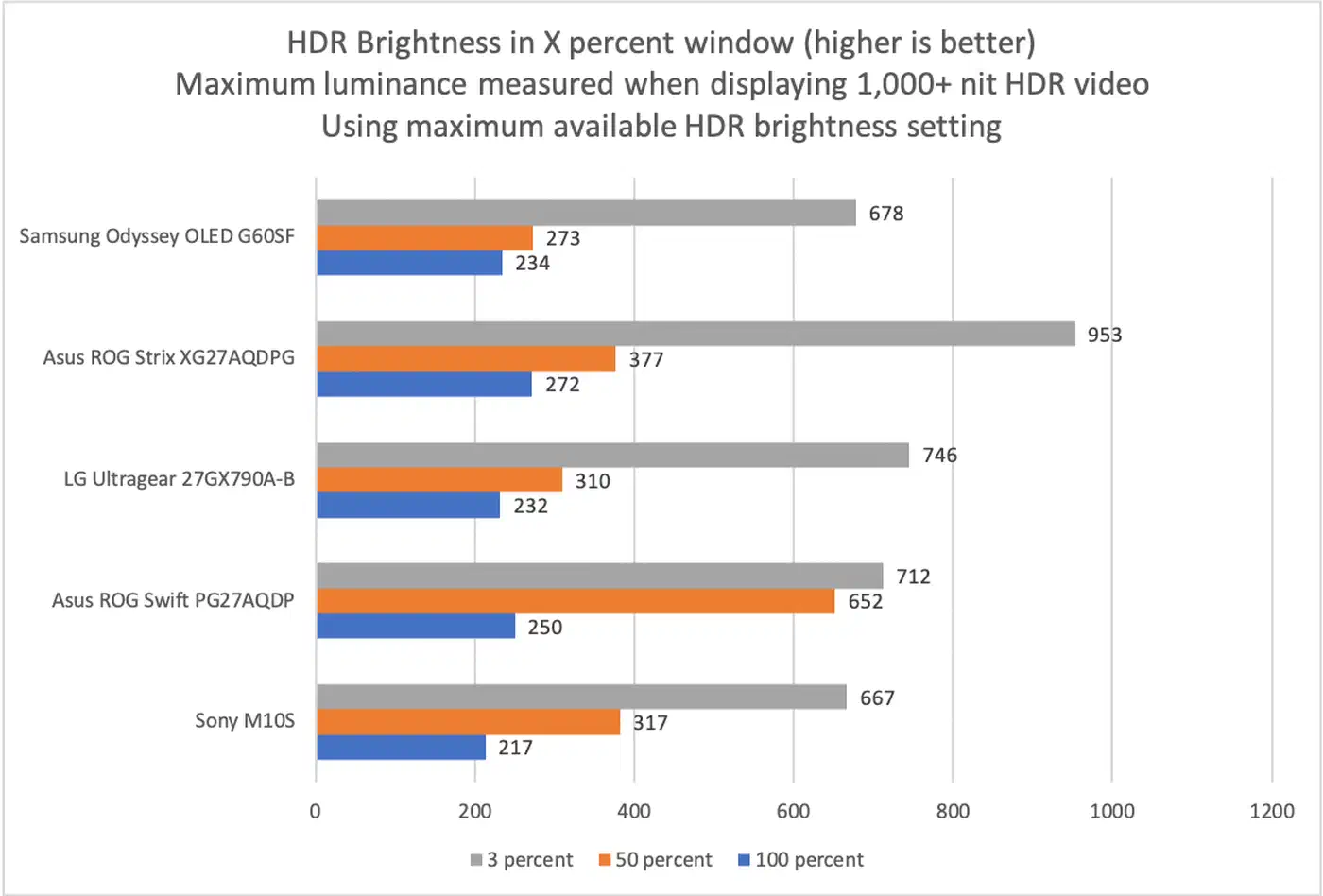
SDR brightness holds up better. The G60SF pushes up to 320 nits in SDR, well above the roughly 250-nit norm of 2024 OLEDs. That extra headroom helps in bright rooms and next to sunlit windows.
The matte coating cuts both ways. Glare Free reduces reflections, but it also lowers perceived contrast and vibrance next to a glossy panel.
Odyssey OLED G6 vs Asus XG27AQDPG vs MSI MAG 272QP QD-OLED X50
Only three 500Hz QD-OLED monitors exist, and two of them share the exact same panel. The field is the Samsung G60SF, the Asus ROG Strix XG27AQDPG, and the MSI MAG 272QP QD-OLED X50. Samsung and Asus both use the identical Samsung QD-OLED, so the differences come down to coating, features, and price.
| Feature | Samsung G60SF | Asus XG27AQDPG | MSI MAG 272QP X50 |
|---|---|---|---|
| Panel | Samsung QD-OLED | Same QD-OLED | QD-OLED |
| Coating | Matte Glare Free | Glossy | Glossy |
| Sustained HDR | 678 nits | 953 nits | Not tested here |
| Resolution / PPI | 1440p / ~110 | 1440p / ~110 | 1440p |
| USB-C | None | None | 15W only |
| MSRP | $999.99 | ~$899 | Not listed |
The Asus wins most objective rounds. It gets far brighter in HDR, adds Extreme Low Motion Blur for cleaner motion at 120Hz and 240Hz, ships with a Windows control app, and offers more precise gamma and color menus. It also costs about $100 less.
Samsung’s edge is aesthetic. It has the matte Glare Free coating, a metal build instead of plastic, and a CoreSync RGB light ring. The MSI adds a USB-C port, but its 15W of Power Delivery cannot charge a laptop, so it is a minor perk.
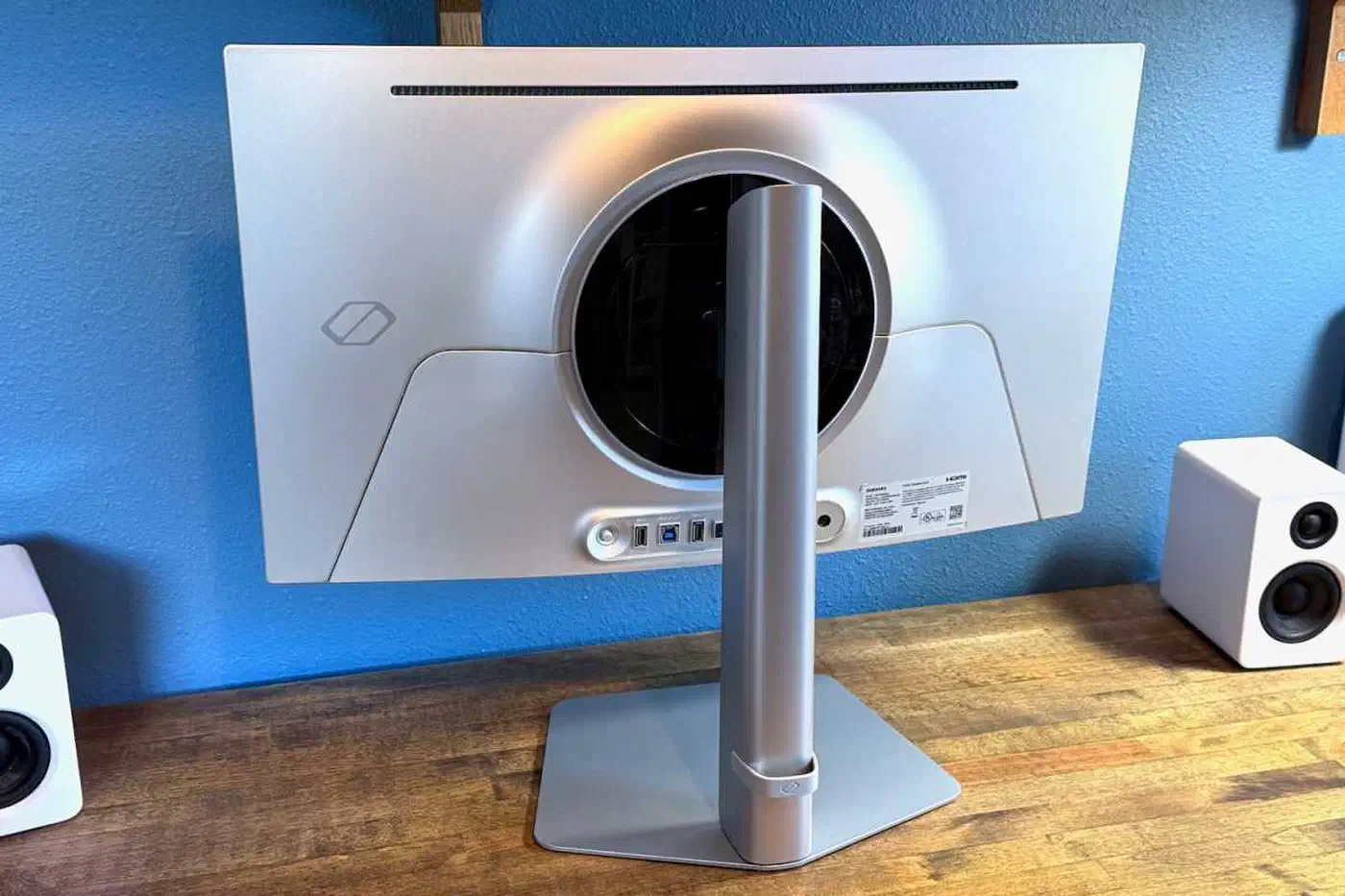
If I were choosing between these monitors today, I would personally buy the Samsung. I prefer Samsung’s design. I also prefer the matte finish.
Who should buy 1440p at 500Hz?
The decision comes down to what your eyes value more. Choose the 1440p 500Hz G60SF if you play competitive esports and want the cleanest possible motion. Choose a 4K 240Hz OLED instead if you want desktop sharpness and cinematic single-player games, and can live with a lower frame ceiling.
For a pure esports player, the G60SF earns its price. Its motion clarity is top tier, its matte finish suits bright rooms, and its build feels premium. Just go in knowing the Asus is the more complete monitor on paper, and that you are paying a small premium for Samsung’s design and coating.