

Adjustable keys cost the Huntsman V3 HE some raw speed

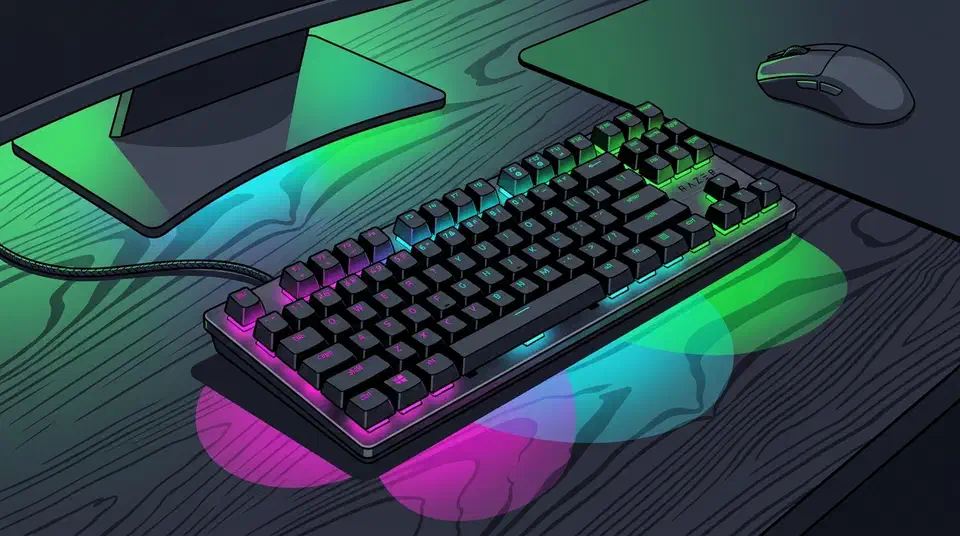
Razer Huntsman V3 HE latency measures 0.60 ms on the company’s own test. That leaves Razer’s newest flagship behind its analog optical boards, which hit 0.48 ms in the same run. What you get for that 0.12 ms is actuation you can set anywhere from 0.1mm to 4.0mm.
Key Takeaways
- The Huntsman V3 HE is Razer’s first Hall effect keyboard family.
- Razer’s own numbers put it 0.12 ms behind its optical line.
- Actuation adjusts anywhere from 0.1mm to 4.0mm, per key.
- Both models are wired only and poll at a true 8,000Hz.
- Players who never tune their keys should stay on optical.
What Razer shipped, and at what price
Razer announced the Huntsman V3 HE Magnetic line in a Tenkeyless at $139.99 and a Mini 65% at $119.99, according to The Gadgeteer’s launch coverage . Both boards are wired only and run true 8,000Hz polling.
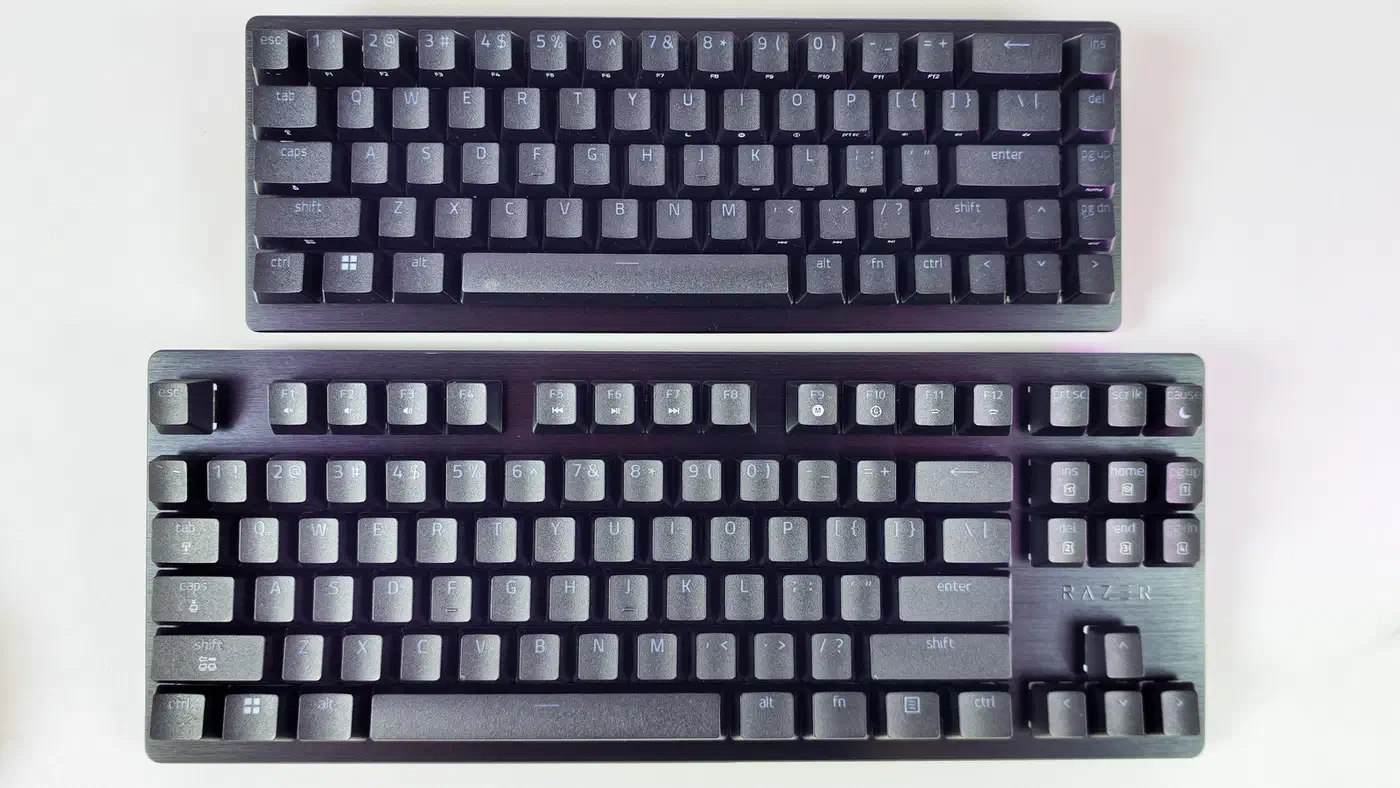
The switches are contactless, so nothing touches to register a press. Actuation lands anywhere across the full travel from 0.1mm to 4.0mm, and each key can sit at its own point. Razer rates them for 100 million keystrokes and sets the factory default at 2.0mm with 40g of force.
They are not hot-swappable, and Razer says pulling one would degrade the board’s performance.
The Razer optical line stays on sale beside this one, so the comparison stays inside Razer’s own catalogue.
| Huntsman V3 HE Magnetic | Huntsman V3 Pro 8KHz | |
|---|---|---|
| Sensing | Hall effect magnetic | Analog optical |
| Published latency | 0.60 ms | 0.48 ms |
| Polling | 8,000Hz | 8,000Hz |
| Actuation range | 0.1mm to 4.0mm | 0.1mm to 4.0mm |
| TKL price | $139.99 | $169 |
Razer’s lineup usually charges more for more speed, so a cheaper board that is also the slower one reads oddly.
Why Huntsman V3 HE latency sits behind optical
An optical switch reports a beam that is either broken or unbroken. That is a binary event with nothing to interpret, so the controller can act on it the moment it flips.
A Hall effect sensor reads a magnetic field that changes strength continuously as the key falls. The board samples that field and runs each sample through an analogue-to-digital converter. It then turns the number into a travel position and checks that position against your threshold.
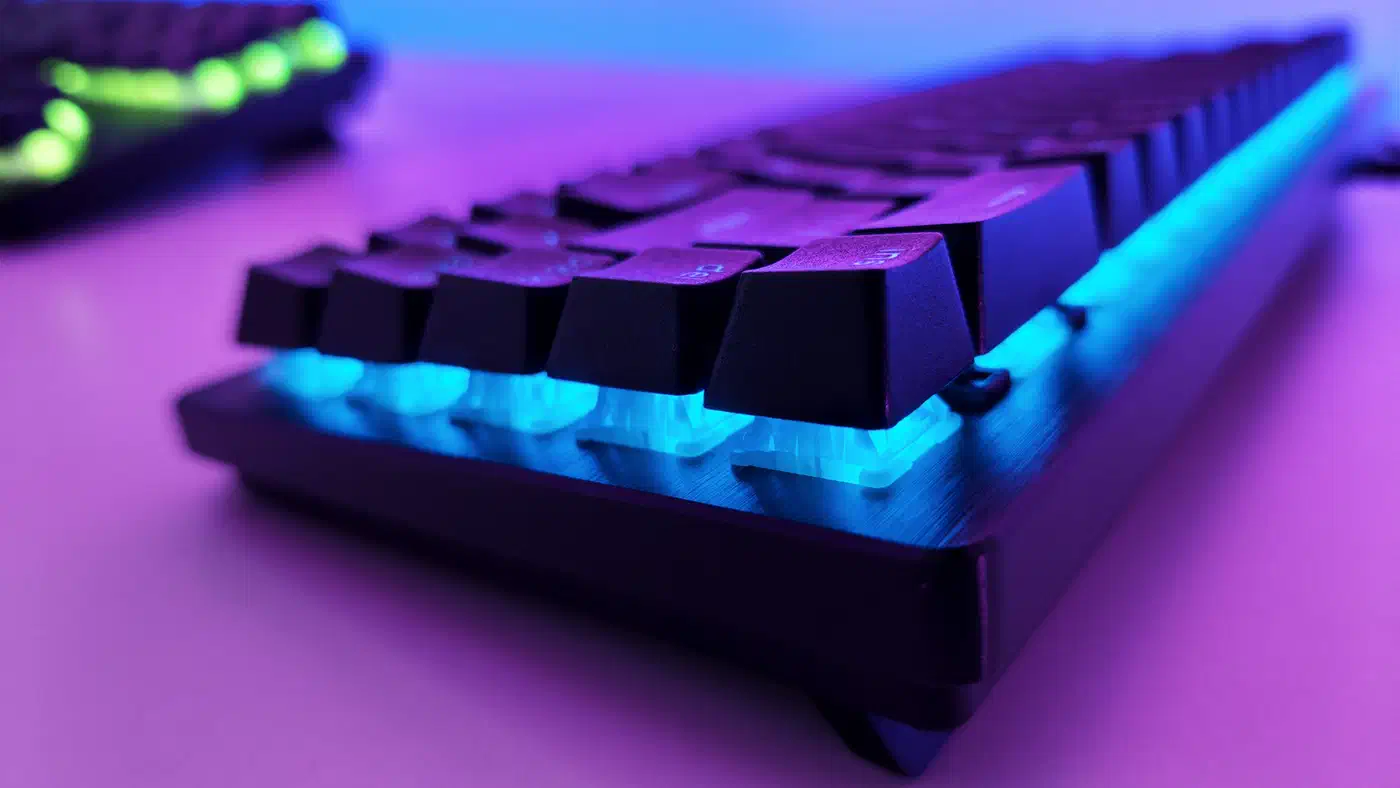
Every one of those steps costs time, and the conversion step is the expensive one. The 0.12 ms gap is what it costs to measure a key’s position rather than just detect a press.
The same physics that slows the board is what makes it adjustable. A threshold you can move to any point in the travel only exists because the board knows where the key is at all times. An optical switch that only knows open or closed has nothing to move.
While our analog optical keyboards remain the benchmark for players seeking the absolute best in esports performance, the Huntsman V3 HE Magnetic 8KHz line is designed for competitive players looking for the best magnetic keyboard.
Razer measured from switch actuation to the signal arriving at the host USB port, across 20 runs, with every board set to 0.1mm actuation. That is a bench figure for one link in the chain. Your monitor, your frame rate and the game server all add far more than 0.12 ms on top.
Against other magnetic boards that 0.60 ms looks good. Razer claims it runs about 8 percent ahead of the nearest competing Hall effect keyboard it tested.
What adjustable actuation is worth in practice
Rapid Trigger resets a key the instant your finger starts lifting, with a reset threshold as low as 0.1mm. In a shooter that means you stop moving sooner, which tightens your hitbox during a counter-strafe. Optical switches cannot do it, because resetting on the way up requires knowing how far up you have gone.
Per-key tuning helps outside those moments too. Daniel Rubino set WASD to 1.2mm for shooters and left everything else at 2.0mm for typing, which is the sort of split a fixed actuation point makes impossible.
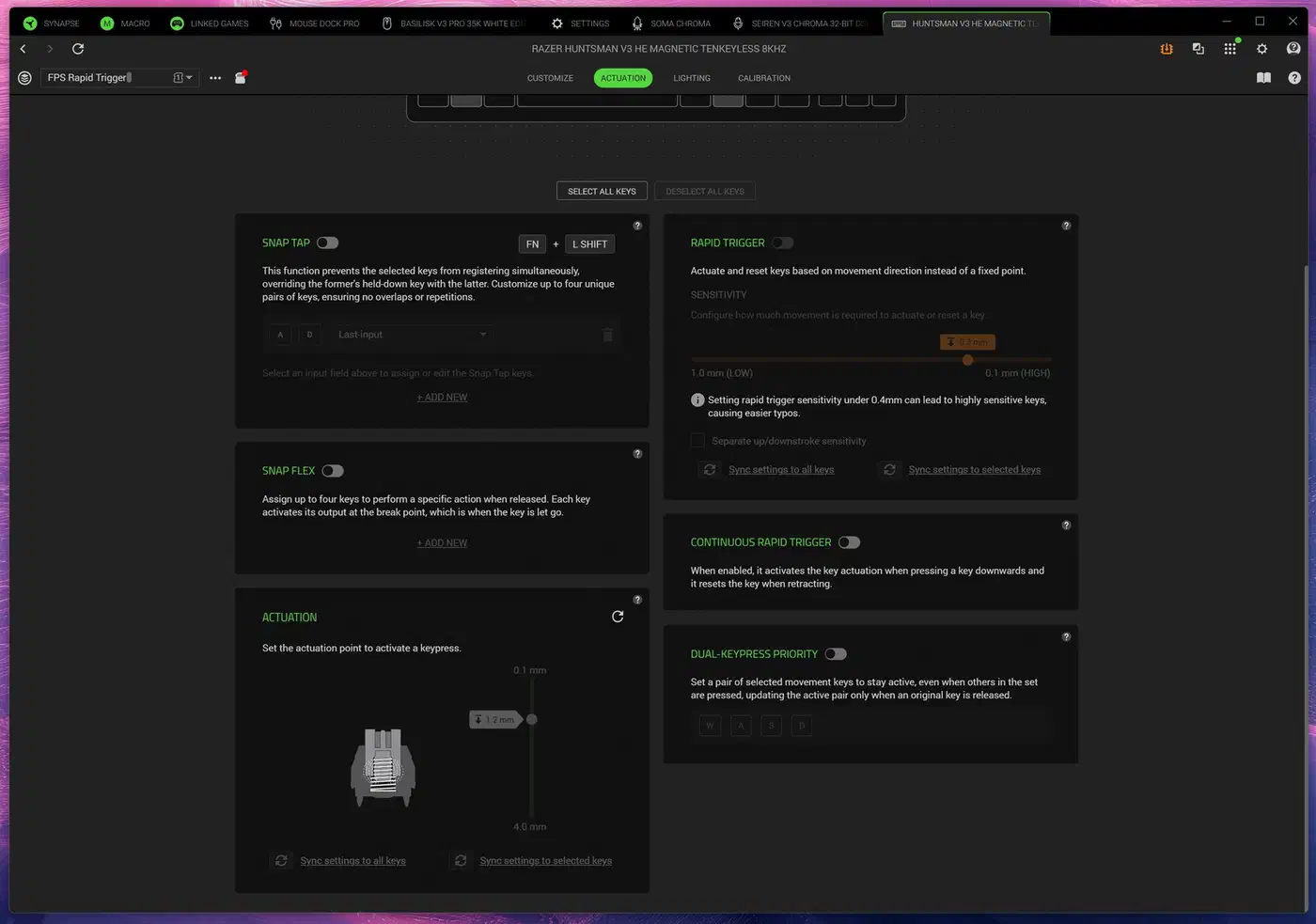
Snap Tap gives priority to your most recent input between two paired keys. Snap Flex binds one action to a press and another to the release. Dynamic Keystroke fires up to four actions at different depths.
So the trade is 0.12 ms, roughly a tenth of the time a single frame stays on a 240Hz screen, against a movement technique that changes how duels end. Windows Central’s review scored the line 4.5 out of 5 and rated the customisation highly while still pointing buyers at the optical boards for pure speed.
I can’t measure latency myself, but the keyboards feel snappy. Movements in Counter-Strike 2 and Valorant felt crisp, and Rapid Trigger made counter-strafing easier.
No reviewer has yet put a test rig on this board, so 0.60 ms is still Razer’s own figure from Razer’s own bench.
Which Razer keyboard should a competitive player buy?
Buy optical if you play one shooter, never open the settings, and want the lowest input latency Razer sells. The Huntsman V3 Pro line still holds that spot.
Buy magnetic if you want Rapid Trigger, per-key actuation, or you play games where movement keys carry more weight than click speed. Left untuned, all it does is cost you the 0.12 ms.
Neither one suits a wireless setup. Both models take a cable and there is no wireless version in this family.
Hall effect boards drift near magnets and metal desks, so Razer built a three-step recalibration tool into Synapse. Snap Flex and Dynamic Keystroke also take practice before they help you.
Also check your game’s rules before you enable anything. Some competitive titles allow Rapid Trigger while banning the paired-key features that sit next to it in the same settings tab.