

A light beam gives the Gateron KS-22 100 million presses

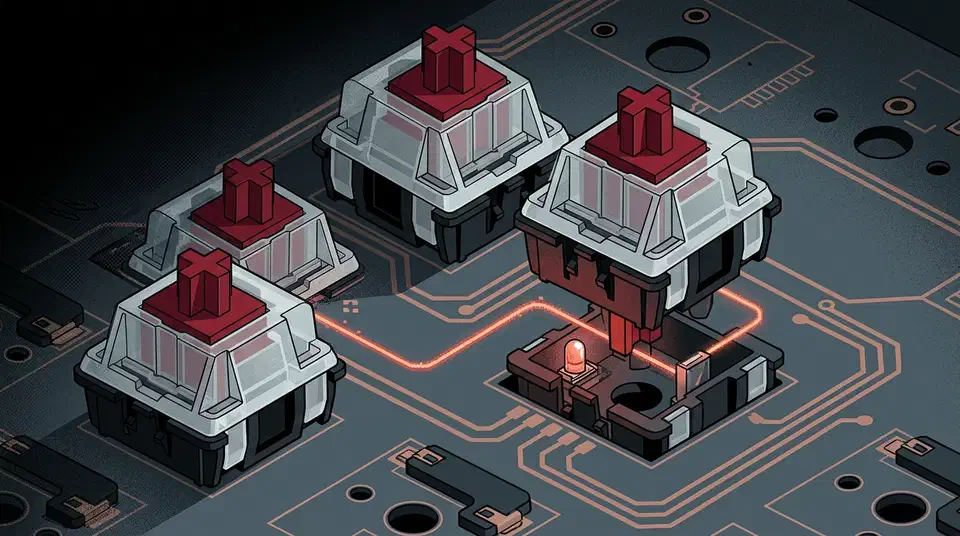
The Gateron KS-22 optical switch fires when a plastic flag on its stem breaks an infrared light beam, with no metal contact leaf involved. That one design change earns its 100 million keystroke rating and skips the debounce delay. Yet a plain optical switch feels about as fast as its mechanical twin.
Key Takeaways
- The KS-22 senses each press with a light beam in place of a metal contact.
- With no metal to wear out, it lasts about 100 million presses.
- Skipping debounce gives optical a tiny 5ms edge on paper.
- A plain optical switch feels about as fast as a mechanical one.
- Optical switches only fit optical-wired boards, not normal hot-swap ones.
How does the Gateron KS-22 optical switch work?
An optical switch and a mechanical switch share a stem, a spring, and a plastic housing. As switch teardowns at Voltcave show, the two types differ only in how the press gets detected.
A normal mechanical switch closes a circuit with a curved metal contact leaf that touches a plate. The KS-22 has no such leaf. Instead, tiny infrared transmitters and receivers sit on the circuit board. A small piece of plastic on the stem blocks the light beam when the key goes down. The board reads that break and fires the key.
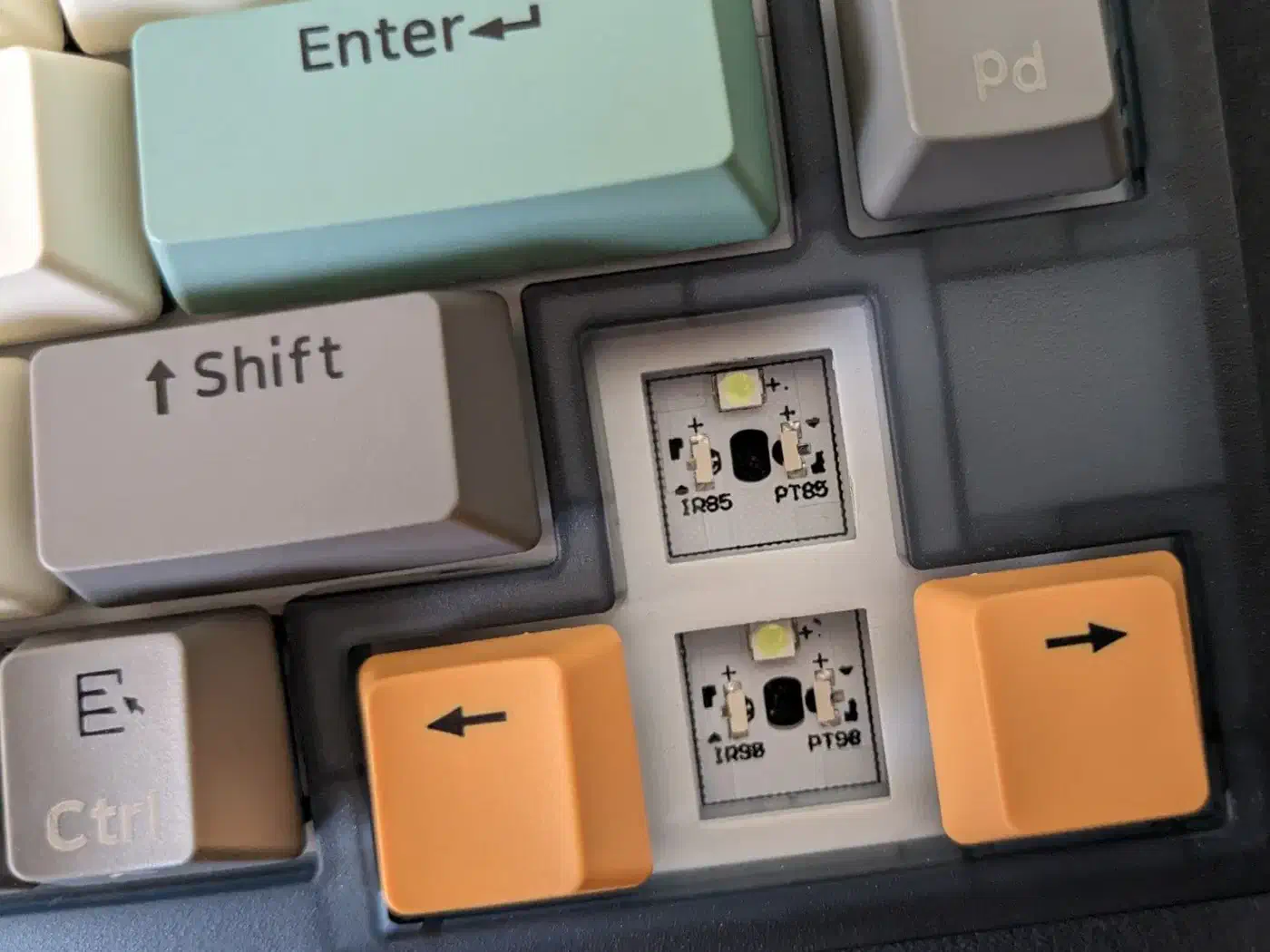
Keychron’s guide says the optical switch uses light to trigger the key , so no physical contact is needed to send the signal.
Razer is the one named exception: its optical switches put the sensor inside the switch and fire when the beam completes, rather than when it breaks. That is the same contactless principle with a different layout.
Why the Gateron KS-22 reaches a 100 million keystroke rating
Nothing physical wears at the contact point, because there is no exposed metal leaf to bend, pit, or corrode over millions of presses. Take out the rubbing metal and you take out the main thing that ages a switch.
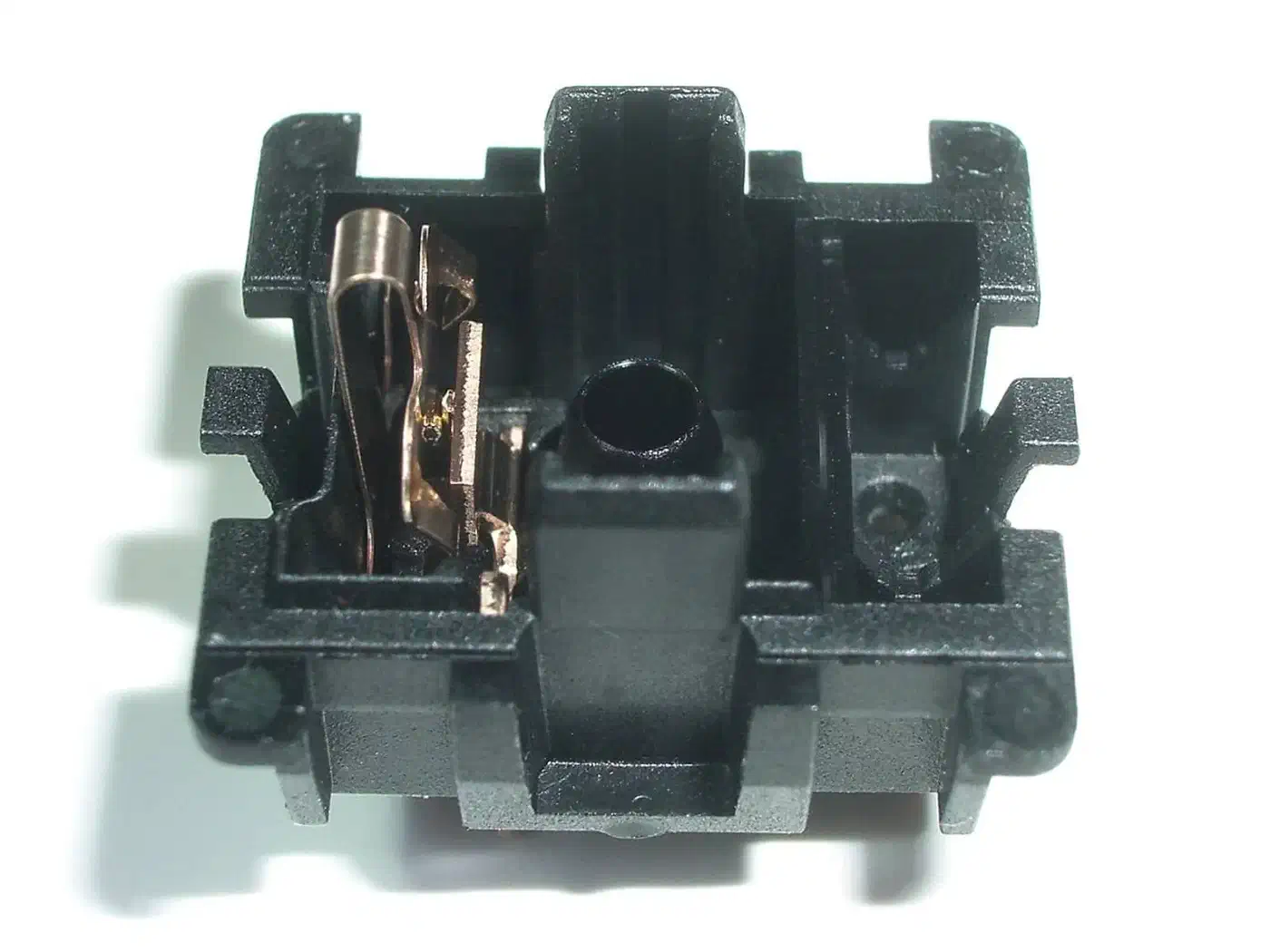
Gateron’s own mechanical switches are rated around 50 million clicks. The KS-22 optical doubles that to the 100 million mark. Keychron states the same doubling: about 50 million presses for a traditional switch, about 100 million for an optical one.
For context, only a handful of mechanical switches reach 100 million.
| Switch | Type | Rated lifespan |
|---|---|---|
| Gateron KS-22 optical | Optical | ~100 million |
| Cherry MX Red, Speed Silver, Black, Brown | Mechanical | ~100 million |
| Kailh Box | Mechanical | ~80 million |
| Gateron mechanical (typical) | Mechanical | ~50 million |
| Most other mechanicals | Mechanical | ~50 million |
The optical design wins a second durability point too. With no metal leaf at the contact, dust and moisture have nothing to gum up. Still, keep the number in perspective. Fifty million presses is already a decade or more of daily typing. So the longer rating is a real plus, but it rarely decides a purchase on its own.
Does an optical switch always feel faster? The debounce myth
This is where the marketing gets ahead of the hardware. On paper, an optical switch has a speed edge. It has no contact bounce to filter out, so it skips the debounce delay a mechanical switch needs. That is worth roughly a 5 millisecond head start.
In practice, that edge nearly vanishes. In a hands-on reaction test, a plain optical switch came out only about 0.0078 milliseconds quicker than a Gateron mechanical. No human feels a gap that small.
Standard optical switches won’t really give you much of an upper hand in-game.
Razer is the real outlier again. Independent tests put its optical switches 10 to 40 milliseconds ahead of a standard mechanical, depending on the game. That gap comes from its in-switch, beam-completes design. It is big enough to feel in a fast shooter. A plain KS-22 is not.
So buy the KS-22 for its lifespan and its smooth linear feel, not for a reaction-time boost you will never notice. Whether the 5 millisecond figure shrinks at modern 8000Hz polling rates has not been tested here.
Where the Gateron KS-22 fits, and where it can’t go
Most spec sheets skip the buying reality: optical switches only work in optical-wired keyboards. The infrared parts live on the PCB, so you cannot drop a KS-22 into a normal mechanical hot-swap board. Keychron says you cannot convert a hot-swap mechanical board to optical. The trigger method and the PCB are too different.
Variety is thin as well. Gateron makes a single tactile optical, the KS-22 Brown, alongside its linear versions. The mechanical world, by contrast, offers dozens of tactiles from many brands. Gateron is also nearly the only company selling loose optical switches. That leaves you far fewer parts to mod with than the huge mechanical market.
Optical boards need no soldering, so swapping parts is quick. Modern linear opticals also type smoothly enough to rival budget mechanical linears. They skip the scratch you get from stock Cherry MX Reds. For a first keyboard where you want long life and a clean feel with no mods, the KS-22 makes sense. For a tinkerer who wants to tune and swap, a mechanical hot-swap board is still the wider road.