

23.5 mm³/s flows through the Revo High Flow nozzle

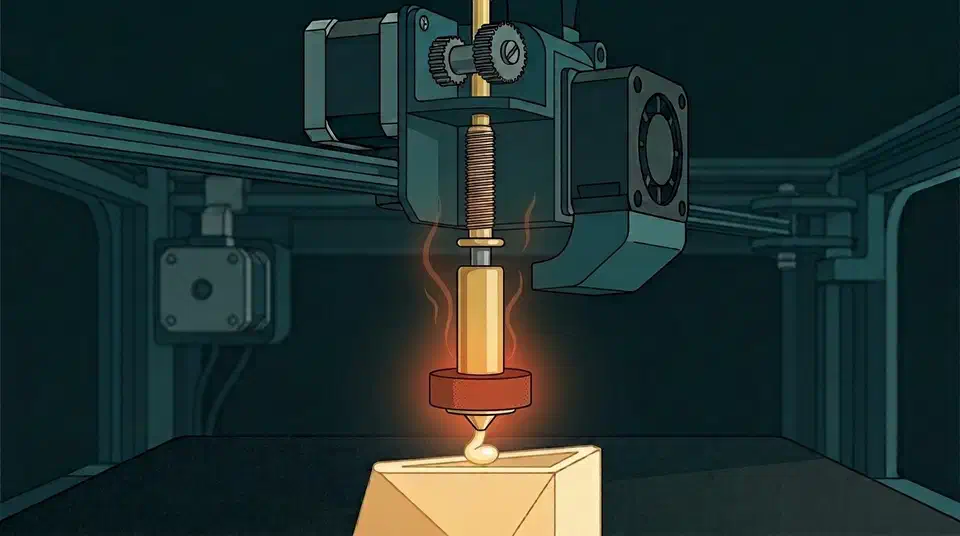
The Revo High Flow nozzle reached 23.5 mm³/s in an independent flow test, close to 70% more than the 14 mm³/s a stock Revo managed on the same rig. A pressed-in brass slug with four bores does the work. The melt zone sets your hotend’s ceiling long before heater watts do.
Key Takeaways
- The Revo High Flow hit 23.5 mm³/s in testing, close to 70% over a stock Revo.
- A brass dome thins the filament and heats it from inside, so it melts faster.
- The melt zone caps your hotend while the heater still has watts to spare.
- Budget about half a watt of heater power for every mm³/s of flow.
- Below roughly 150 mm/s on a 0.4mm nozzle, you don’t need high flow.
What is volumetric flow and why it caps print speed
Volumetric flow is how much melted plastic a hotend can push out per second, counted in cubic millimeters per second. It’s the speed ceiling on a printer. You can change nozzle size, layer height, or line width all you like, but the hotend still caps how fast plastic leaves the tip.
Ellis’ Print Tuning Guide turns that into a speed with one line of arithmetic: speed = volumetric flow / line width / layer height. A hotend good for 24 mm³/s at 0.4mm width and 0.2mm layers tops out near 300 mm/s.
Run it the other way to shop for a hotend. Say you want to print at 250 mm/s with a 0.45mm line and 0.2mm layers. Multiply those three and you need 22.5 mm³/s. A stock Revo, rated near 11 mm³/s in Ellis’ reference table, won’t get you there. Slicers like PrusaSlicer let you set the limit per filament, so a print never outruns the melt zone.
How much faster is the Revo High Flow nozzle
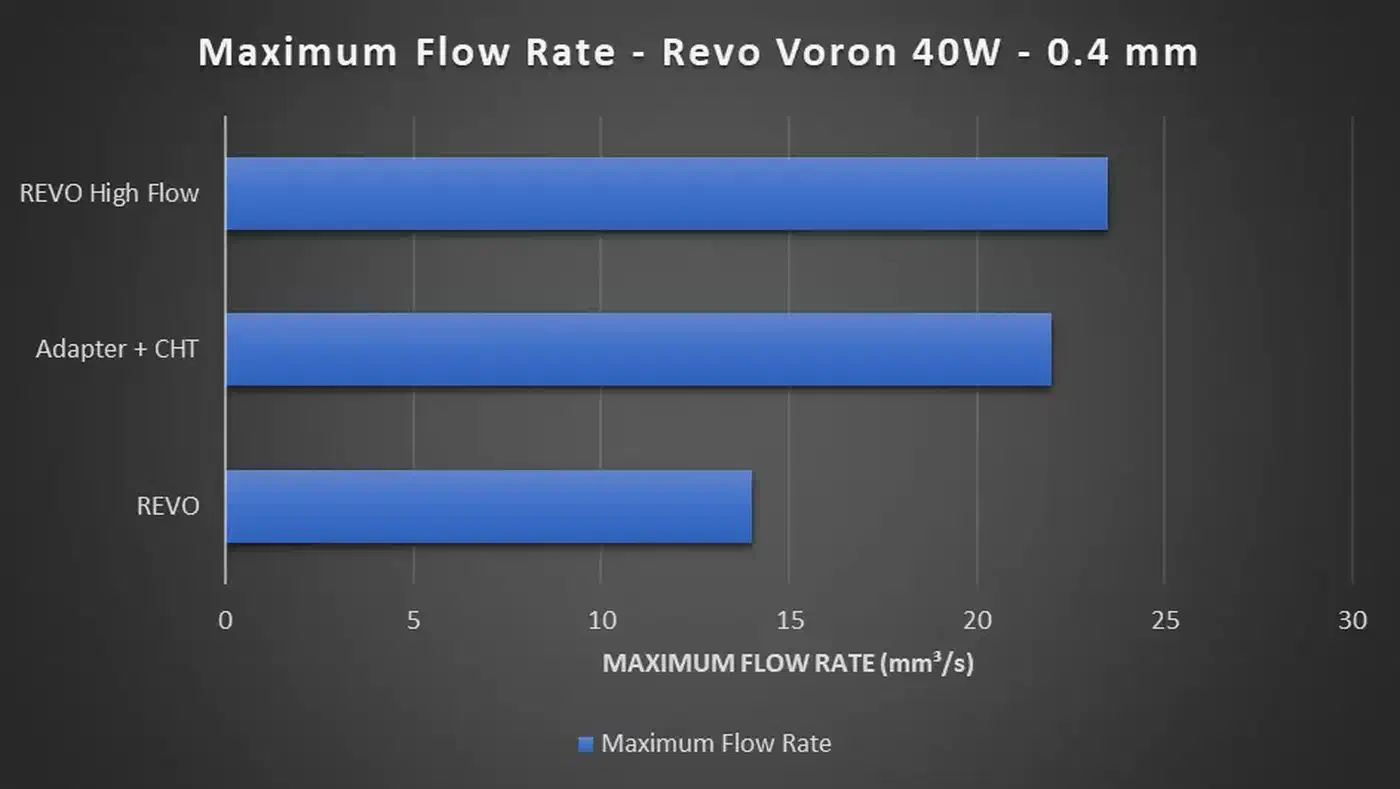
Stefan Hermann of CNC Kitchen ran a meander test at 0.4mm on an LDO Voron 2.4. He started at 5 mm³/s and raised the rate by 1 mm³/s every millimeter of height until extrusion fell apart. The stock Revo broke down at 14 mm³/s. A Bondtech CHT on a V6 adapter reached 22. The Revo High Flow held to 23.5 mm³/s, which works out to about 260 mm/s at 0.2mm layers.
It performed the best and increased the flowrate capability by almost 70% compared to the reference achieving 23.5 mm³/s which would be 260 mm/s printing speed at 0.2 mm layers and therefore even beating the CHT.
A second method, the blob test, put the same three nozzles at 16, 22 and 24 mm³/s. The high-flow nozzle also held its rate across a wide range instead of sagging early. That consistency is worth as much as the peak number, because real prints swing between infill and thin walls.
Most rows below are Ellis’ approximate values for a 0.4mm brass nozzle; the two marked as measured come from the bench tests above.
| Hotend or nozzle | Flow at 0.4mm (mm³/s) | Notes |
|---|---|---|
| E3D V6 | 11 | The long-standing baseline |
| E3D Revo, stock | 11 | Measured at 14 on one test rig |
| Dragon SF | 15 | Standard flow |
| Mosquito | 20 | Standard flow |
| Bondtech CHT | 22 | Four-bore insert, V6 thread |
| Revo High Flow | 23.5 | Measured, CNC Kitchen |
| Dragon HF, Rapido HF | 24 | Longer melt zone |
| Rapido UHF, Mosquito Magnum | 30 | Longest melt zone |
Why a small brass insert melts plastic so much faster
Plastic is a poor conductor of heat. A nozzle can sit at 220°C and the core of the filament still arrives cold, so melting is the slow step in the whole chain. Older high-flow designs answered that with length: a Volcano keeps filament inside the hot section for longer.
The Revo High Flow takes a different route because it has no room for length. A brass slug is press-fit into the nozzle body, carrying a teardrop dome and four bores that run down to the tip. The dome spreads 1.75mm filament out into a section roughly 1mm thick and heats it from the inside as well as the outside.
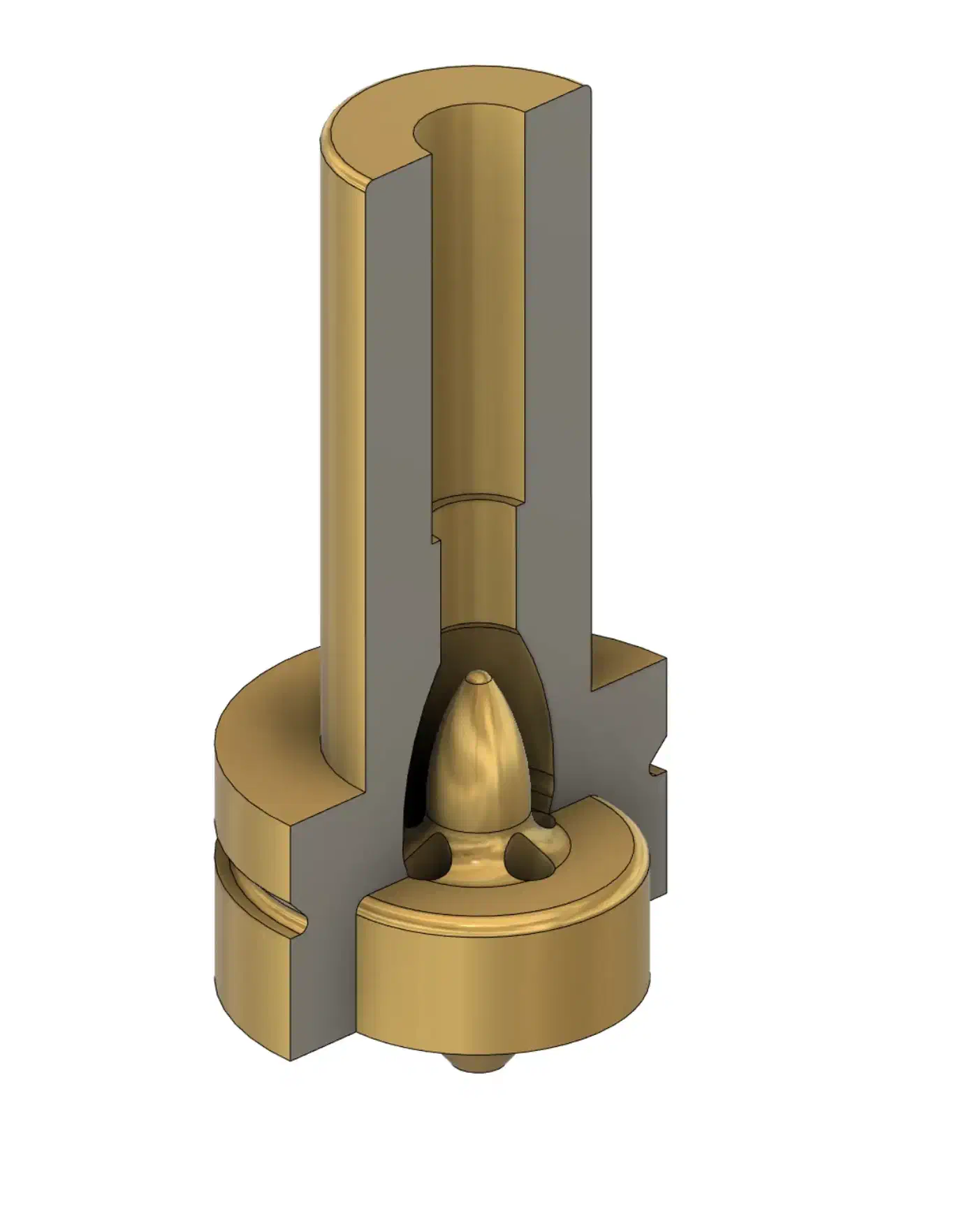
The result is close to double the contact area and more than 60% extra dwell time in the melt zone. This is Bondtech’s Core Heating Technology, and E3D licensed it. Thomas Sanladerer of Tom’s 3D points out that a fixed-length Revo could never grow a Volcano-style melt zone. That left licensing the four-bore design.
His automated test rig ran 0.6mm nozzles on PLA at 210°C against a stock Revo, a V6 and a Volcano V6. The Revo High Flow was the only one that could sustain 24 mm³/s without raising the temperature to 230°C. A temperature bump buys flow at the cost of consistent extrusion, and it leaves more filament cooking in the melt zone.
The half-watt rule that proves your hotend is melt-limited
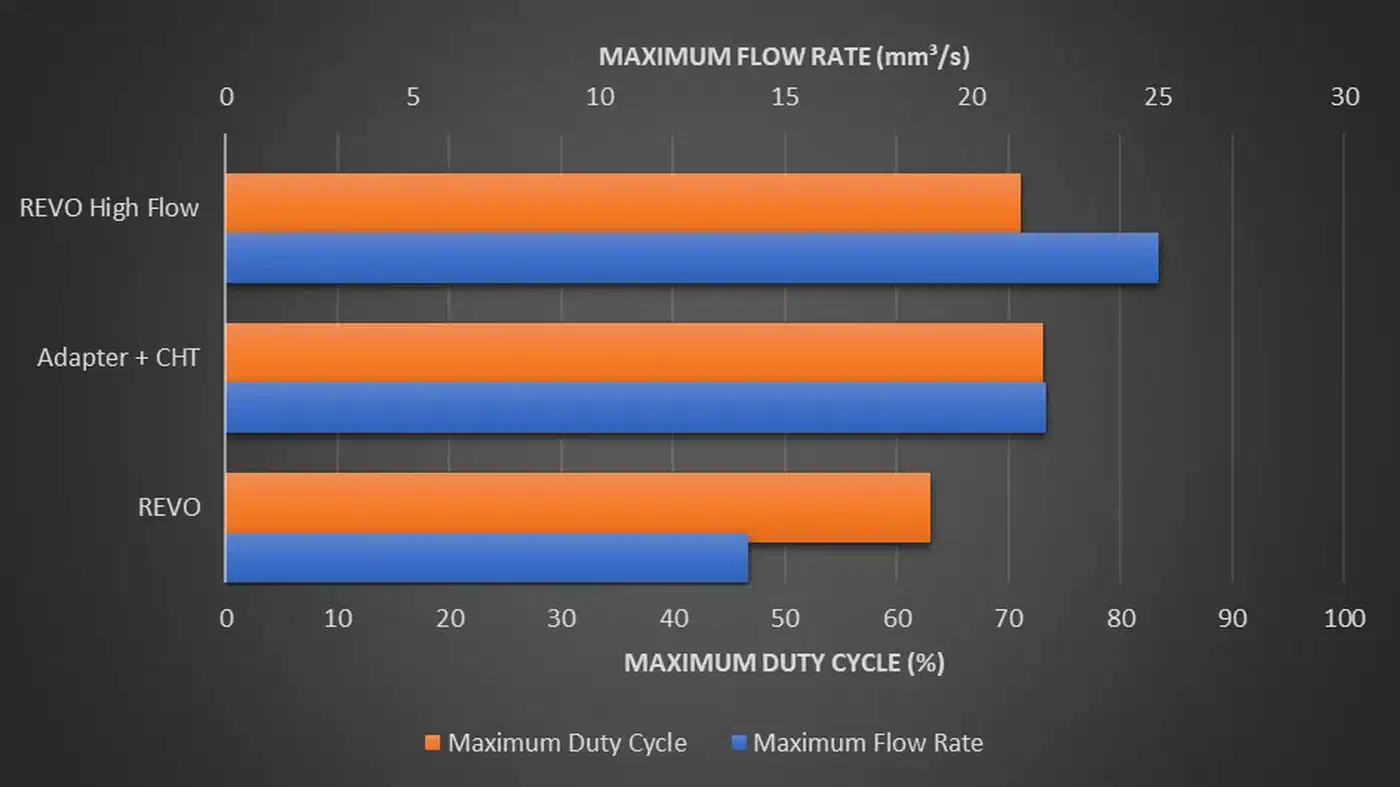
Watch the heater duty cycle during a flow test and the assumption that hotends run out of watts falls apart. At its 14 mm³/s limit the stock Revo pulled 63% duty on a 40W core. The CHT hit 73% at 22 mm³/s. The Revo High Flow sat at 71% while pushing 25 mm³/s, so it never came close to needing the optional 60W core.
Most of that power never melts anything. With part cooling running and the sock fitted, a Revo needs 33% duty at 180°C just to hold temperature. At 290°C it needs 65%, with no filament moving at all. Pull the sock off and 290°C costs 82%, which leaves almost nothing spare for melting, so leave the sock fitted.
Put the idle figures next to the extrusion figures and you get a rule of thumb: roughly half a watt of heater power per mm³/s of flow. At a brisk 10 mm³/s, only about 5W is doing the melting. Everything else leaks away through the heat break, radiation, and the part-cooling fan blowing over the block.
So a bigger heater rarely buys flow. The 60W core earns its place at 0.8mm and above. It also helps with high-temperature materials, where the block runs hot enough that idle draw eats the headroom.
How to measure your printer’s maximum volumetric flow rate
Ellis’ method finds the ceiling of your own hotend and extruder in about fifteen minutes, and the number it gives you goes straight into the slicer.
Raise the extrude-only limit
Open printer.cfg, find the [extruder] section, and set max_extrude_only_distance to 101 or higher, then restart. Klipper blocks long single extrusions by default, and the test needs one 100mm move at a time.
Heat the hotend to your print temperature
Bring the nozzle to the temperature you print at. Flow scales with heat, so testing 15 degrees hot gives you a number your prints will never reach.
Mark a 100mm length of filament
Stick a piece of tape on the filament at the 100mm mark above the extruder inlet. Tape is quick to move, and you’ll be re-marking it after every run.
Extrude at rising speeds
Switch to relative extrusion and push 100mm at increasing feed rates. The gcode wants mm per minute, so multiply your target mm per second by 60.
M83
G1 E100 F300
G1 E100 F420
G1 E100 F540
G1 E100 F660
Find where the feed drops below 100mm
After each move, check the tape. Once less than 100mm has fed into the extruder, you’ve passed the ceiling. That is your rough maximum.
Convert extrusion speed to volumetric flow
Multiply the extrusion speed in mm/s by 2.4 for 1.75mm filament. So 10 mm/s of filament becomes 24 mm³/s of plastic. For 2.85mm filament, use 6.37 instead.
Set a slightly lower limit in your slicer
Drop a few percent below what you measured and enter it as the filament’s volumetric limit. Real prints add resistance the bench test never sees, and underextruded walls cost more than the speed you saved.
Should you buy one
If you print with a 0.4mm nozzle below about 150 mm/s, the nozzle isn’t your bottleneck. A high-flow one will change nothing you can see. Print quality between the stock and high-flow Revo in PLA came out indistinguishable.
Flow starts to bite at 0.6mm and above, where every layer carries more plastic. E3D’s own published figures for the High Flow range claim 18 mm³/s at 0.4mm, 22 at 0.6mm, 28 at 0.8mm and 35 at 1.0mm in PLA at 220°C. Those are conservative next to what the independent rigs measured, which is the right direction for a vendor to err in.
The nozzle runs about £32.50 from E3D , several times a plain brass one. The plain High Flow is brass, so abrasive filament chews it. E3D now sells ObXidian and HT-A versions that fix that, and a ruby tip survives carbon fiber even longer. And cold pulls are difficult: Hermann, who does this for a living, managed exactly one. Flexibles are worth a search before you commit, since four-bore nozzles have drawn TPU complaints.
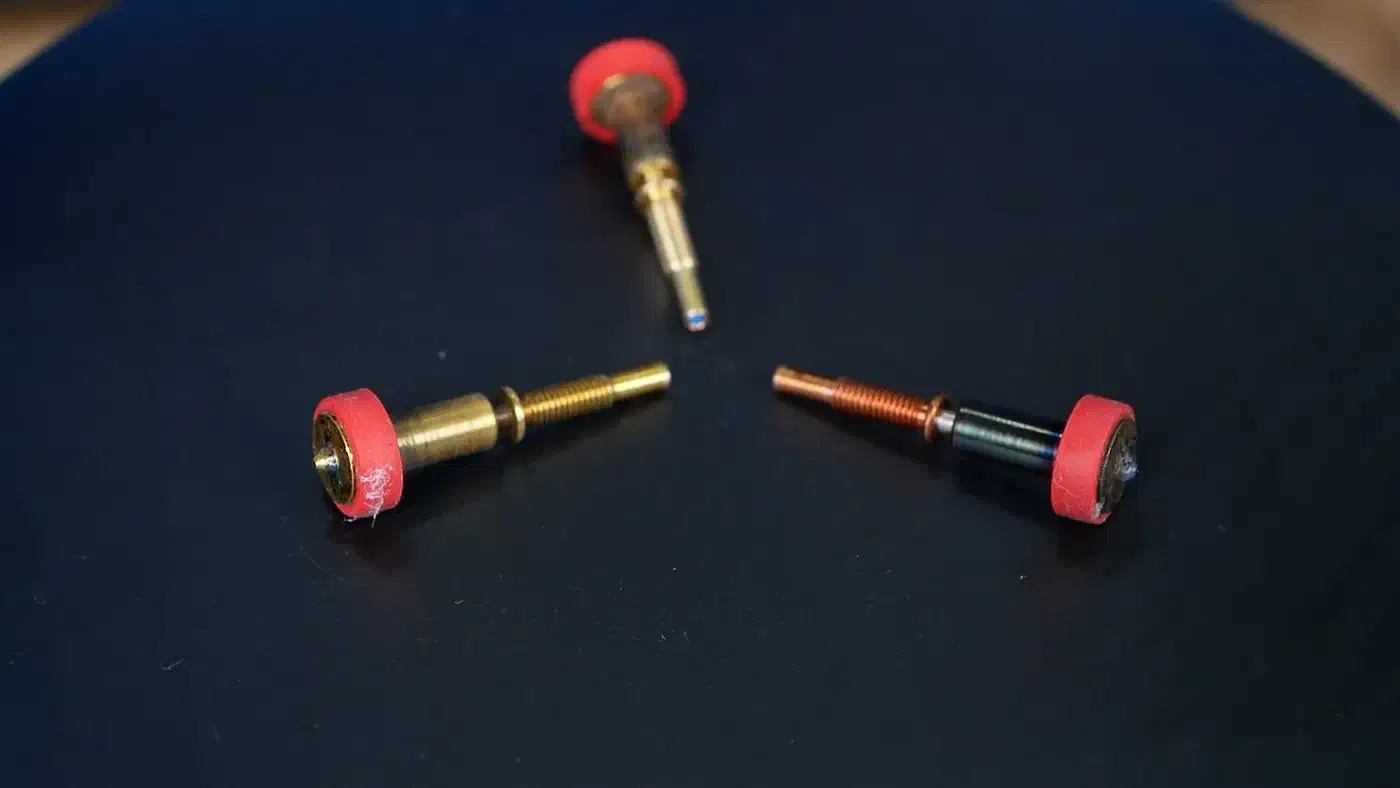
A Rapido Ultra High Flow with a CHT insert has a far longer melt zone and beats it on outright flow. The Revo case rests on the quick-change system you already own, and other printer makers are moving the same way: on the refreshed Prusa XL+ , high-flow nozzles ship as standard.
Now, of course, the question is, do you need one? And the answer is simple, probably not. For 40 bucks, sure, Revo is already an expensive ecosystem to buy into, so might as well.
If you already run Revo and you’re buying a nozzle anyway, buy the high-flow version. It costs a little more and takes nothing away. If you’re chasing a number, measure your own printer first, then decide whether the melt zone is what is holding you back.