

Prusament PETG Recycled cuts spool CO₂ by 56 percent

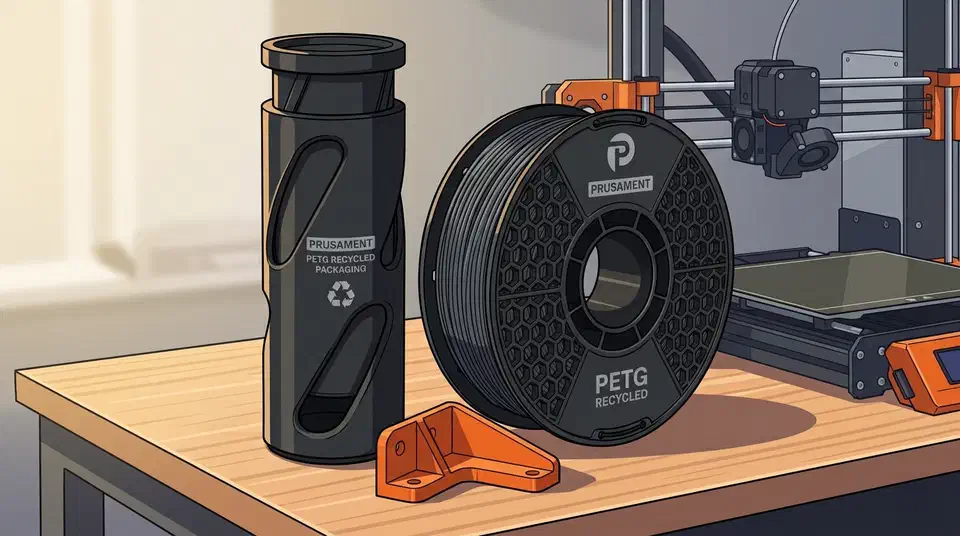
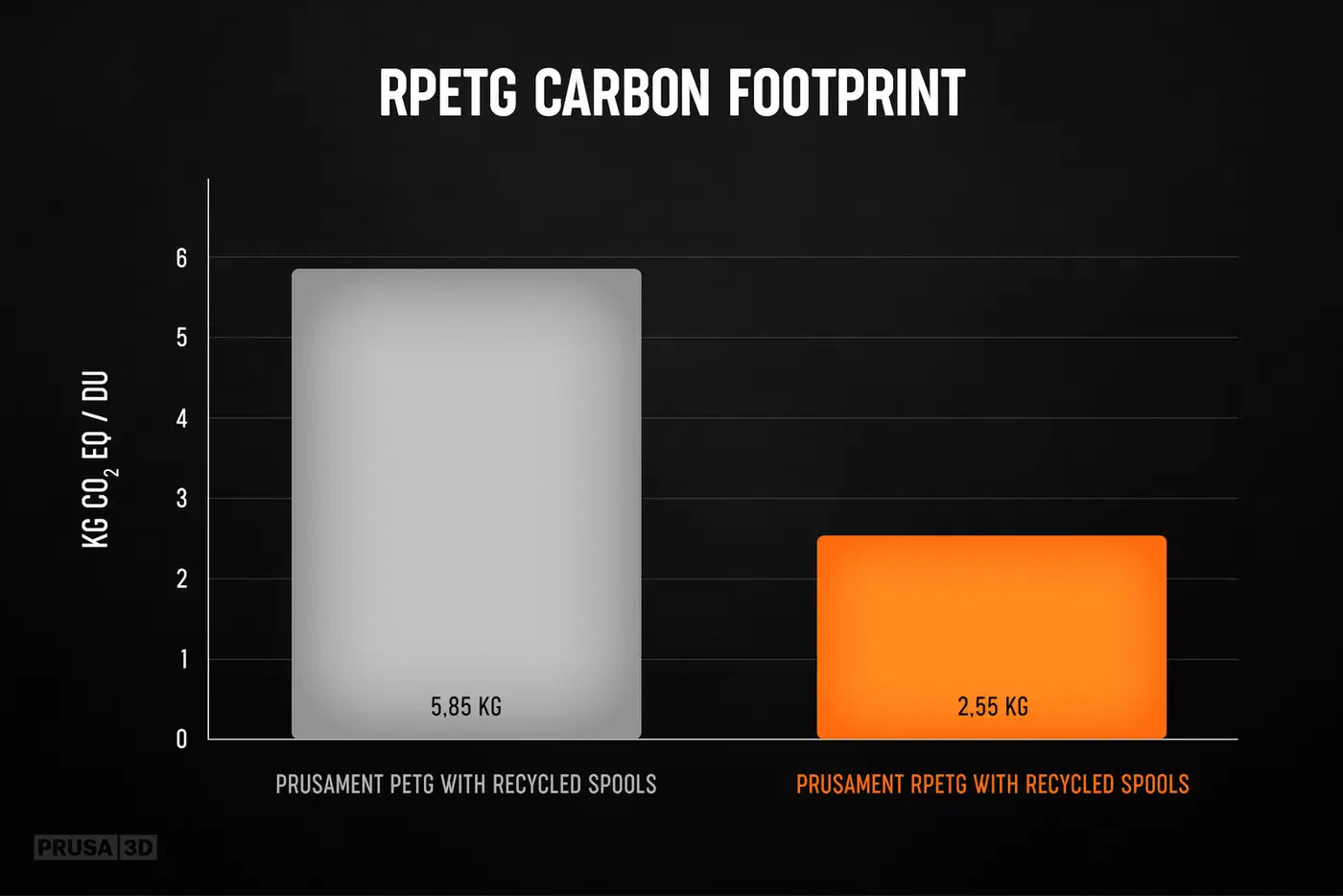
Prusament PETG Recycled emits 2.55 kg of CO₂ for every kilogram of filament, against 5.85 kg for virgin Prusament PETG. That is a 56 percent cut, or 3.3 kg saved per 2 kg spool, backed by a life-cycle assessment Prusa ran before launch. The feedstock is factory scrap from Prusa’s own PETG production.
Key Takeaways
- One kilogram of the recycled filament makes 2.55 kg of CO₂ instead of 5.85 kg.
- The savings come from skipping new granulate and its shipping.
- The plastic is factory scrap left over from making PETG.
- Every spool arrives a different color, because the scrap color shifts batch to batch.
- Print settings stay the same: 250°C nozzle, 80°C bed, no enclosure needed.
What does the 56 percent CO₂ cut measure?
Virgin Prusament PETG carries 5.85 kg of CO₂ equivalent per kilogram. The recycled version carries 2.55 kg. Across a full 2 kg spool, that works out to 3.3 kg less CO₂, which Prusa states as a 56 percent reduction.
The Prusa launch post on PETG Recycled and its life-cycle assessment names the mechanism: the drop comes from skipping the shipping and making of new granulate. The polymer is the same and the factory is the same; only the granulate step changes.
The same pattern holds for the sibling material, Prusament PLA Recycled. Its emissions fell 57 percent, from 5.76 kg to 2.47 kg CO₂ per kilogram. Both materials show almost the same CO₂ cut, which is what you expect when the saving comes from the recycling step itself, and that step works for any plastic.
Independent numbers back the size of that cut. The Association of Plastic Recyclers life-cycle study puts 100 percent recycled PET at 0.91 kg CO₂ per kilogram against 2.23 kg for virgin resin, a 59 percent drop, and the Society of Plastics Engineers puts the whole range for recycled 3D-printing feedstock at 30 to 80 percent. Prusa’s 56 percent sits in the middle of that range.
The catch is that not every recycled PETG reaches that mark. A Filamentive roundup lists Kimya’s recycled PETG at only a 35 percent cut, so Prusa sits at the high end for the material. The likely reason is the feedstock itself: clean single-source factory scrap instead of mixed post-consumer waste.
| Material | Virgin CO₂ per kg | Recycled CO₂ per kg | CO₂ cut |
|---|---|---|---|
| Prusament PETG | 5.85 kg | 2.55 kg | 56% |
| Prusament PLA | 5.76 kg | 2.47 kg | 57% |
How to read a filament life-cycle assessment without getting sold
A life-cycle assessment number means nothing until you know four things about it. Prusa’s study is unusually well documented, so it works as a checklist you can carry to any green filament claim.
Start with where the boundary sits. Prusa’s study runs from mining or farming the raw resource, through transportation, to packing the filament into its box. Shipping the spool to your door sits outside that line, and so does whatever happens to the print after you are done with it.
Then check what else was measured. Carbon is one output among several. The study also reports acidification (SO2 equivalent) and eutrophication (PO4 equivalent), and Prusa says it ordered every impact category, not just the flattering one.
Look at what the model counted. Prusa lists manufacturing, transportation, water use, power for producing molded parts, and the extra grinding step the recycled versions need. The grinding energy is included in the total.
Last, ask who did the work and with what tool. The study used SimaPro 9.3.0.2 from PRe Sustainability, and was authored by Ing. Marie Ticha, who has worked in the field since 1993 and helped write the ISO 14040 and ISO 14044 standards. A named analyst and a named model are rare on a filament spool, and both raise the confidence you can place in the figure.
Still, these sources do not publish the full study data, the per-stage breakdown, or an end-of-life figure, and no independent lab has re-run or peer-reviewed it. The third-party filament sellers who repeat Prusa’s figure copy the result without auditing the method. So the 56 percent is a number you can trace to a method, but not yet recompute yourself.
Factory scrap is not post-consumer recycling
The word “recycled” covers two very different supply chains, and this filament is the industrial-scrap kind. It is made only from waste generated during the manufacturing of Prusament PETG. That excludes failed prints, bottles, and customer returns.
Prusa turns that into a selling point. Because the input is its own material, the output is what the company calls 100 percent pure Prusament. It carries the same tight tolerance as virgin stock. The Prusament PETG Recycled material page repeats the claim in one line: every batch is 100 percent recycled Prusament PETG, so every batch has a different color.
The industry term for this grade is pre-consumer, or post-industrial, recycled content. Filamentive, itself a recycled-filament maker , describes it as “typically single source, free of contamination” with “performance on par with virgin material,” which is the independent reason Prusa can promise virgin-grade quality. The same page notes the flip side: post-consumer recycling diverts waste that “often ends up in landfills,” the harder and more useful job this filament does not do.
Diverting your own factory scrap is better than pelletizing it into landfill or downcycling it. Still, it is a closed internal loop, and post-consumer recycling pulls on the wider waste stream in a way this does not. The plastic never left the building in the first place.
There is also a supply limit. The amount of recycled filament is capped by how much virgin Prusament PETG the company makes. Neither source states how many kilograms of scrap fill one recycled spool. So nobody outside Prusa can size the diverted-waste claim.
What the recycled spool costs you at the printer
A greener filament is only worth loading if it prints like the original. This one does. The print profile is ordinary PETG, unchanged from virgin stock:
Extruder: 250 +/- 10°C
Heated bed: 80 +/- 10°C
Part-cooling fan: about 50 percent
Enclosure: not required
Print surface: PEI or glass
Manufacturing tolerance is +/-0.05 mm. That is tight for the market, but an independent spec database lists standard Prusament PETG at +/-0.02 mm , so the recycled grade runs a touch looser than Prusa’s virgin flagship. In practice the recycled spool should still feed and flow the same through a profile you already use. Temperature resistance is 68°C, with the usual PETG character: tough, low warping, strong layer adhesion, and a glossy finish.
The usual PETG annoyances still apply. Expect some stringing, poor bridging, very strong bed adhesion, and harder support removal, and forget about acetone smoothing.
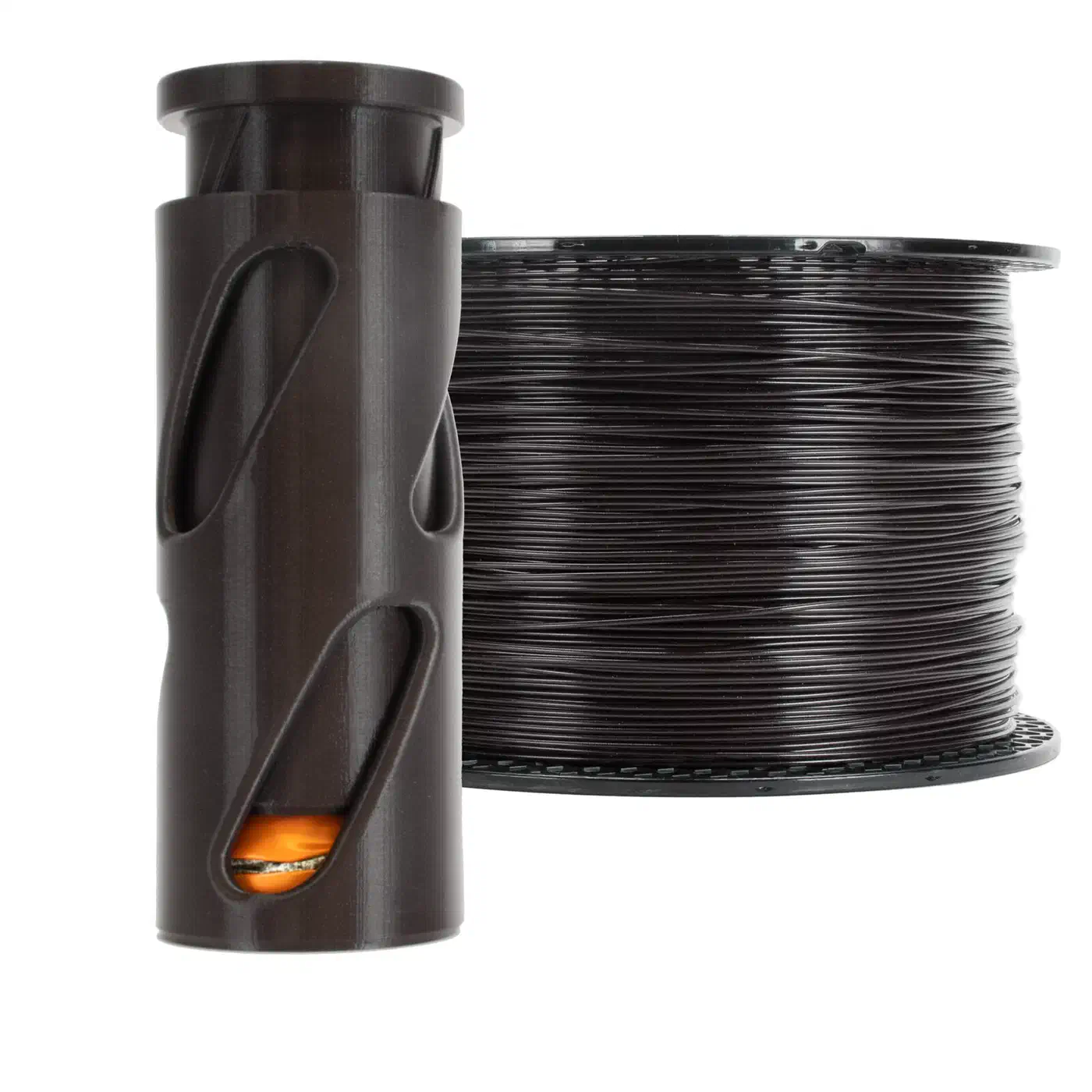
The one real trade is color. Every batch arrives a different, unspecified color, because it inherits the color of the scrap it came from. That is fine for functional parts and useless for a matched multi-part build. It also ships on 2 kg spools rather than the usual 1 kg, which changes spool-holder clearance on some printers.
Is Prusament PETG Recycled worth switching to?
For functional printing, yes. Jigs, brackets, enclosures, printer parts, anything where strength counts and color does not, this is an easy swap. You get the same PETG behavior with a lower carbon number and no change to your workflow.
When color counts, no. A random batch color rules it out for display models, matched assemblies, and anything you plan to reprint later in the same shade. That single limit decides most buying calls.
The carbon case is modest for one person. Saving 3.3 kg of CO₂ per spool adds up fast at Prusa’s production scale. For a single hobbyist, it is close to a rounding error against a printer’s own running energy. Buy it for the parts you print, and treat the lower footprint as a bonus.
Two open items remain. No independent lab has published a mechanical comparison of recycled versus virgin Prusament PETG, so the parity claim is the vendor’s own. Pricing has also moved: the launch post listed 54.44 USD, while the material page now shows 44.99 USD for the standard color and 46.99 USD for recycled black, so check the live figure before you buy. For a filament you will print anyway, a traceable 56 percent carbon cut at the same price is a straightforward win.