

Humidity flips the winner between PPA-CF and PA6-CF
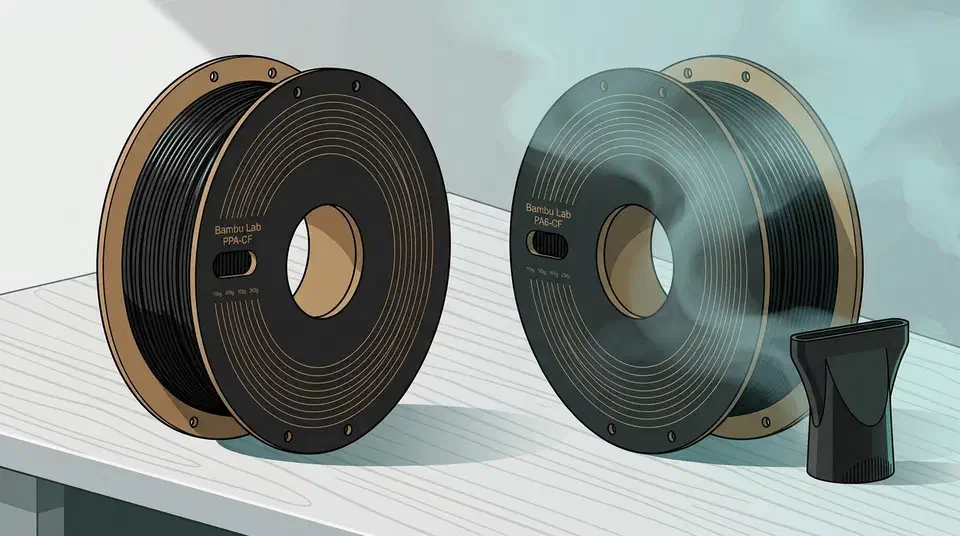
In the PPA-CF vs PA6-CF matchup, the spec sheet lies about who wins. PPA-CF is stronger, stiffer and takes more heat, but PA6-CF bonds its layers 3.6 times better. The real tiebreaker is water: wet PA6-CF sheds a third of its strength, while PPA-CF barely moves. So pick by job, not by headline number.
Key Takeaways
- PPA-CF is stronger, stiffer and takes more heat on the spec sheet.
- PA6-CF bonds its layers about 3.6 times better, so parts snap less.
- Humidity is the real divider: wet PA6-CF loses a third of its strength.
- PPA-CF shrugs off moisture, dropping only about 3 percent when wet.
- PPA-CF needs 100 to 140°C drying that most hobby dryers cannot reach.
What is the real difference between PPA-CF and PA6-CF?
Both are chopped-carbon-fiber nylons from Bambu Lab , and on the shop floor they act almost the same. Each needs an enclosed printer, a hardened-steel or high-flow nozzle, and glue on the plate. The split comes down to chemistry.
PPA stands for polyphthalamide, a high-performance nylon with an aromatic backbone. PA6 is ordinary nylon 6. That aromatic backbone is why PPA-CF resists the water and heat that plain PA6 soaks up.
Bambu’s own carbon-fiber usage guide sorts them by environment. It pitches PPA-CF for near-metal strength plus stability in humid and hot air. PA6-CF, in contrast, gets framed as high rigidity for long-term use in dry conditions.
On the dry spec sheet, PPA-CF leads on almost every headline: 208 vs 151 MPa flexural strength, 9860 vs 5460 MPa stiffness, and a 227°C heat rating against 186°C. The twist the store page buries is that on layer bonding and on wet parts, this ranking flips.
Where PPA-CF wins on strength, stiffness and heat
PPA-CF is the premium engineering pick, and Bambu’s dry-state numbers back that up cleanly. Its flexural strength reaches 208 MPa against PA6-CF’s 151 MPa, a 38 percent edge. So a bracket in PPA-CF resists bending force far better before it yields.
Stiffness widens the gap further. PPA-CF’s flexural modulus is 9860 MPa, roughly 80 percent higher than PA6-CF’s 5460 MPa. In plain terms, it flexes less under the same load, which is what you want in a jig or a tool that must hold a shape.
Heat is the third win. PPA-CF holds its form up to a 227°C heat-deflection point, 41 degrees past PA6-CF’s 186°C. That margin is what pushes PPA-CF into engine-bay and near-heat parts where PA6-CF would soften.
Bambu’s PPA-CF store page markets this as being 48 percent stronger and 102 percent stiffer than PA6-CF. Read that claim carefully, though. The baseline there is a generic “normal PA6-CF” rated at 141 MPa, which is weaker than Bambu’s own PA6-CF at 151 MPa. Measured against the right column, the real gap is closer to 38 percent.
One number stays level. In-plane impact toughness is near-tied, 41.7 vs 40.3 KJ/m2. Therefore PPA-CF’s advantage lies in stiffness, strength and heat rather than raw toughness across the print face.
Where PA6-CF wins on layer bonding and forgiveness
Now the counterweight, and it is the number most spec dumps skip because it lives on the Z axis. PA6-CF’s interlayer adhesion, measured as Z impact strength, is 15.5 KJ/m2 against PPA-CF’s 4.3 KJ/m2. That 3.6x gap makes PA6-CF far harder to split along its print lines.
This counts because most 3D-printed parts fail at the bond between layers first, before the solid plastic gives way. So a part that takes impact or bending across those layers often outlives a stronger-on-paper part, because the weak seam is stronger to begin with.
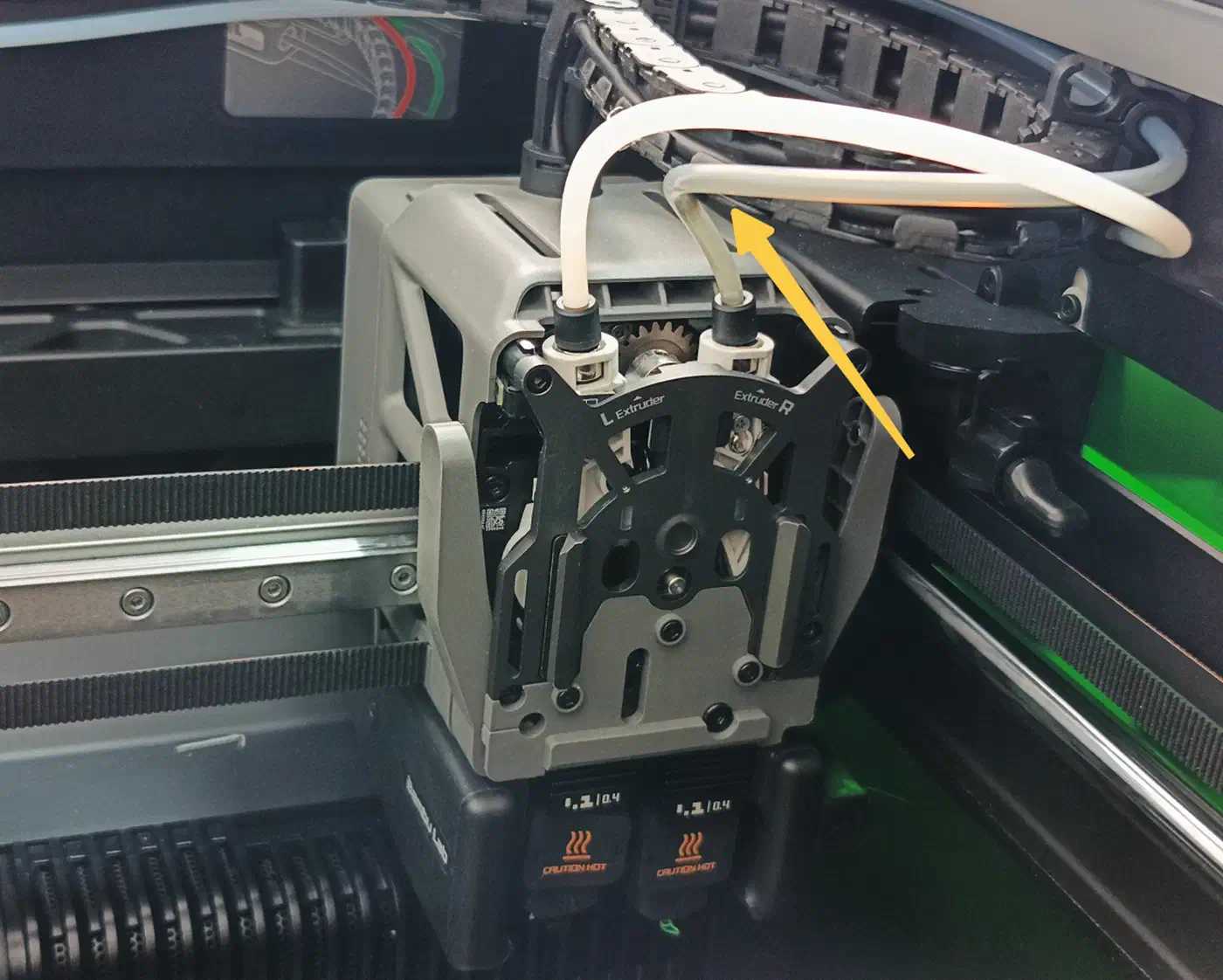
Handling favors PA6-CF too. Bambu describes PET-CF, PPA-CF and PPS-CF as brittle and prone to breakage in the feed path, while PA6-CF is more flexible and needs no extra nozzle securing on the H2D. The practical effect is fewer mid-print snaps and cleaner support removal on thin features.
That makes PA6-CF the pick for functional parts with impact, snap-fits, near-living hinges, and tall prints where Z strength decides whether the piece survives a drop.
How humidity flips the verdict
Water reverses the whole comparison. Nylon drinks it from the air, and that is what separates these two in service.
Humid PA6-CF drops from 151 to 95 MPa strength, down 37 percent, and its stiffness falls from 5460 to 3560 MPa, down 35 percent. Humid PPA-CF, by contrast, barely flinches: 208 to 202 MPa strength and 9860 to 9620 MPa stiffness, both under a 3 percent loss.
Water absorption explains the split. At 25°C and 55 percent humidity, PPA-CF saturates at 1.30 percent moisture against Bambu PA6-CF’s 2.35 percent. That lower uptake is why PPA-CF keeps its numbers while PA6-CF gives them back.
Here is every axis side by side, all in the dry state unless noted:
| Property (dry, XY unless noted) | PPA-CF | PA6-CF |
|---|---|---|
| Flexural strength | 208 MPa | 151 MPa |
| Flexural modulus (stiffness) | 9860 MPa | 5460 MPa |
| Impact toughness (XY) | 41.7 KJ/m2 | 40.3 KJ/m2 |
| Interlayer bond (Z impact) | 4.3 KJ/m2 | 15.5 KJ/m2 |
| Heat deflection (0.45 MPa) | 227°C | 186°C |
| Water absorption (25°C, 55% RH) | 1.30% | 2.35% |
| Flexural strength, wet | 202 MPa | 95 MPa |
| Oven drying temperature | 100-140 C | 80°C |
The upshot: a damp PA6-CF part in service can end up weaker than a dry PPA-CF part by a wide margin, even though PA6-CF looked competitive on the dry sheet.
Moisture also shows up at print time. Internal water flashes to steam in the hotend, which causes stringing, oozing and a rough surface. Bambu illustrates the point with a boat printed wet versus dry, and the wet hull looks visibly hairy.
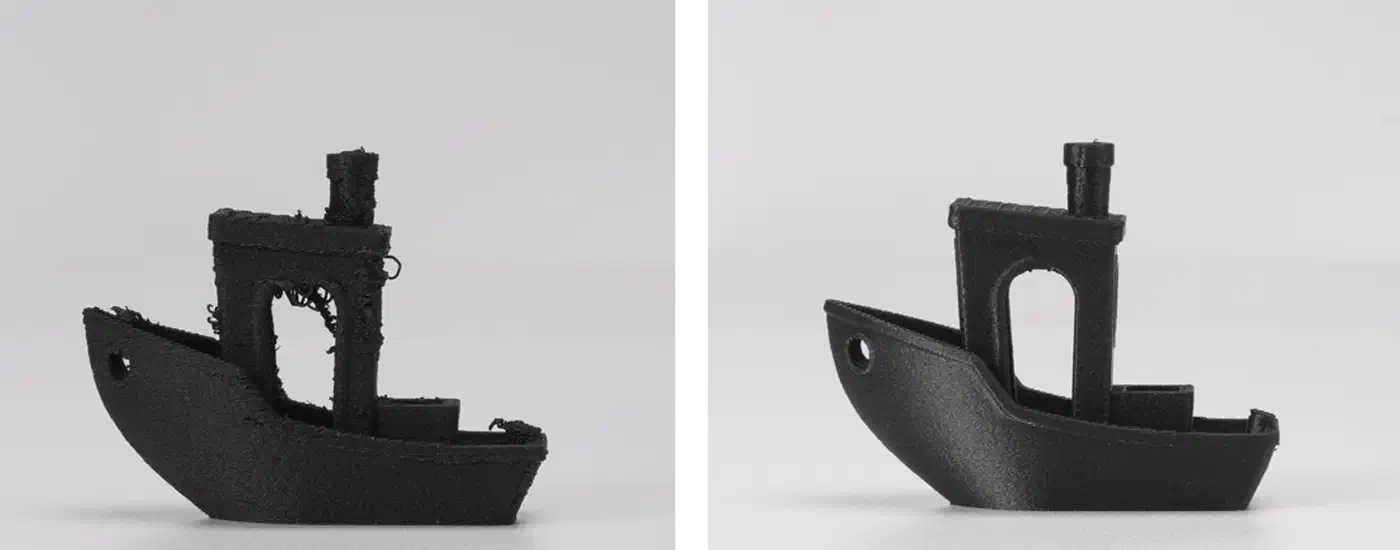
The decision rule follows from that. For parts that live in humid air, outdoors, or near water, PPA-CF’s stability can outweigh PA6-CF’s layer-bond edge. For climate-controlled dry use, PA6-CF’s toughness comes back into play.
Bambu publishes retained-strength figures rather than a full soak curve, and it does not confirm whether the “humid nylon gets tougher” plasticizer effect seen in some third-party testing applies to its exact PA6-CF blend.
Drying and hardware both filaments demand
Both share the same strict hardware list, then split hard on drying, which is where real buyers ran into trouble.
The shared rules: an enclosed printer is required, the P1P and A1 series are out, only hardened-steel or high-flow nozzles work, a 0.6 mm nozzle is recommended, glue-assisted printing is a must, and the AMS series is not compatible. So far, so equal.
PA6-CF dries at 80°C for 8 to 12 hours in a convection oven, while PPA-CF needs 100 to 140°C for the same span. Both can dry at 80°C for 12 hours in the AMS HT, which sidesteps the heat problem if you own one.
The trap is that consumer filament dryers commonly top out near 70°C, well below PPA-CF’s oven range, and a food oven risks fumes. Buyers hit this wall the week PPA-CF launched at USD 99.99, and the worry was concrete.
I just ordered the Sunlu S4 but it only goes to 70 degrees. If that doesn’t do the trick I might have wasted $99.99 on a roll.
Bambu’s support account replied on the same thread with a workaround: a 70°C dryer still works if you run it 18 to 24 hours with the lid cracked so moisture can escape. It is slower, but it saves the roll.
Print settings pushed buyers the same way. Forum users reported roughly 240 to 310°C at the nozzle and a 100°C-plus bed for PPA-CF, which nudged many toward X1-class machines. Treat those as user-reported figures rather than an official spec, since Bambu’s read sources give no PPA-CF print-temperature number. The same thread’s claim of 12 to 18 percent carbon-fiber content is user-read from the data sheets and unconfirmed.
PPA-CF is tougher against moisture in service, but it is still hygroscopic on the spool. Both need airtight storage with desiccant after every dry.
Which one should you print?
Choose PPA-CF when the part runs hot, lives in humid or wet conditions, or must stay rigid under sustained load, and you own a dryer or oven that reaches past 100°C. It is the humidity-and-heat specialist.
Choose PA6-CF when the part takes impact across its layers, needs to flex rather than shatter, sits in a dry indoor spot, and you want the easier 80°C drying routine. It is the tough, forgiving workhorse for dry rooms.
The override beats every other factor: if the part will ever get damp, lean PPA-CF regardless of the dry-state numbers, because wet PA6-CF hands back most of its advantage. Everything else is a tie-break once moisture is off the table.