

ASA holds 80 percent impact where ABS fades in UV light

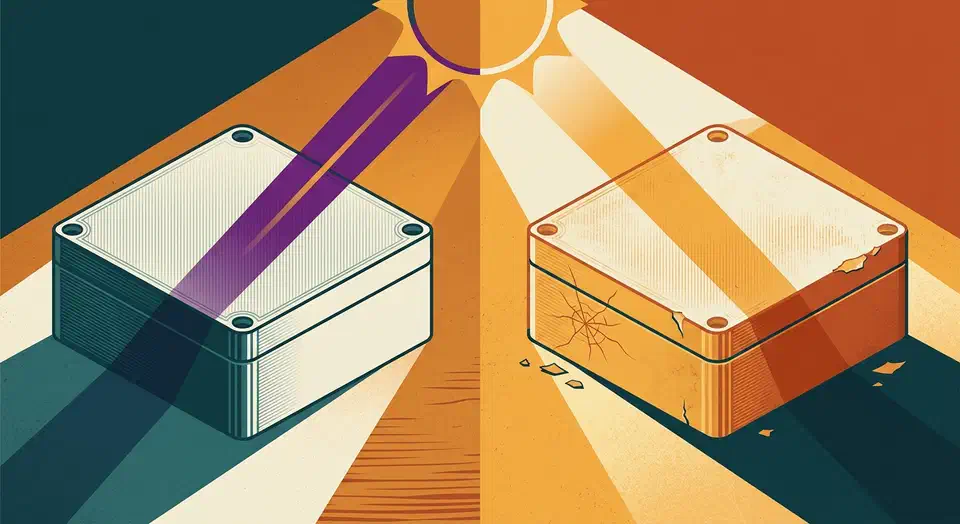
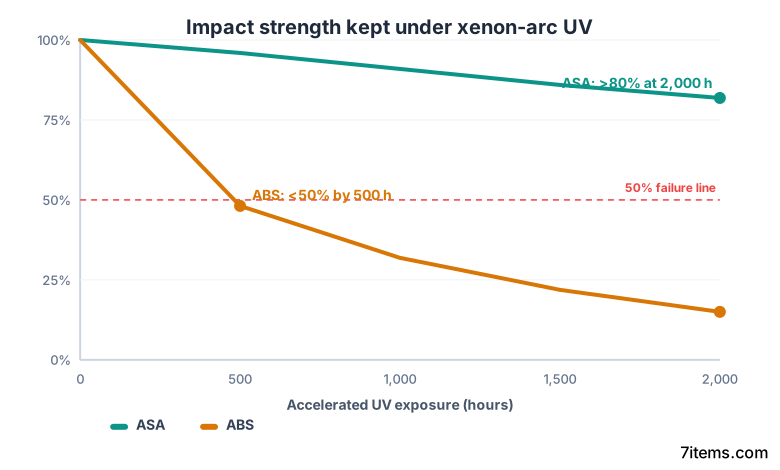
In the ASA vs ABS matchup under sunlight, ASA wins by a wide margin. Under the same xenon-arc UV test, ASA keeps over 80% of its impact strength at 2,000 hours, while ABS falls below 50% inside 500 hours. Their strength and stiffness nearly match. The real trade is finishing, and acetone is the dividing line.
Key Takeaways
- ASA keeps over 80% of its punch after 2,000 hours of UV testing.
- ABS loses more than half its impact strength in under 500 hours.
- On strength, stiffness and heat, the two are basically a tie.
- ABS smooths glassy in an acetone bath, but ASA needs sanding and priming.
- ASA prints about 10°C hotter, so check your hotend can hold 260°C.
What makes ASA resist UV when ABS does not?
Both plastics use almost the same recipe. Each is a hard base plastic mixed with a soft rubber to make it tough. That rubber is the only real difference between them, and it decides everything else.
ABS uses a rubber called polybutadiene. It carries weak chemical bonds that soak up UV light. The light then snaps the plastic chains apart. You see it as chalking, yellowing, cracking and lost impact strength, as LayerX3D’s ASA vs ABS guide lays out.
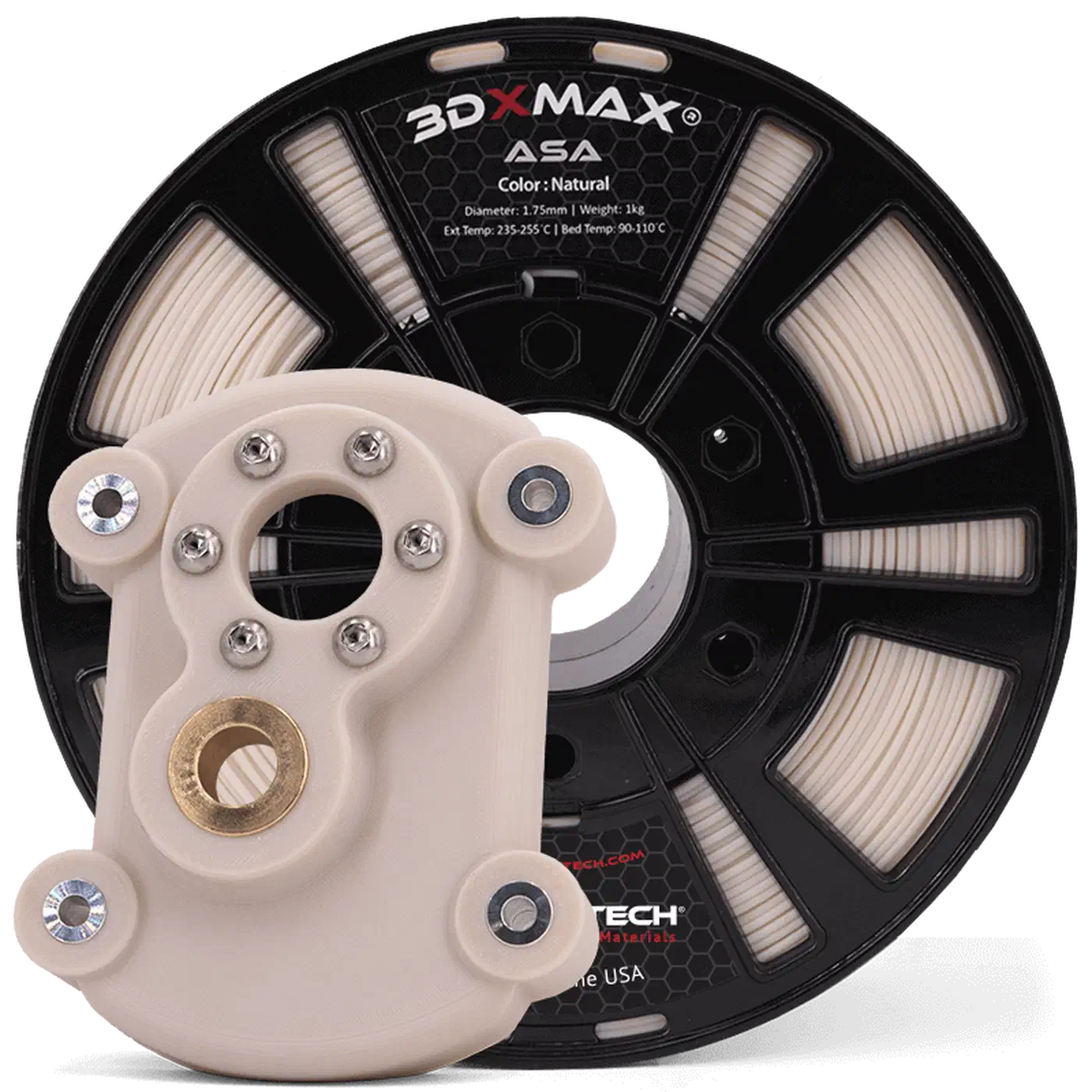
ASA swaps in an acrylic rubber that lacks those weak bonds. With no easy target for sunlight to grab, it breaks down far more slowly. The rubber that makes ABS tough is the first thing sunlight eats. 3DXTech makes the same point from the filament maker’s side.
So ASA is not a lucky accident. Chemists built it on purpose to fix this one weak spot in ABS.
How much impact strength does each material keep under UV?
Under the ASTM G154 xenon-arc UV test, ASA keeps more than 80% of its impact strength at 2,000 hours. ABS usually drops below 50% inside 500 hours under the same test.
Color tells the same story on a slower clock. ASA stays under dE 3 after five years outside, while ABS yellows within three to six months. A dE 3 shift is a color change most people would not spot with the two parts side by side.
These are sped-up lab hours rather than calendar hours. They rank materials against each other well, but they do not turn cleanly into years on a roof. A rough rule of thumb from Intertek’s xenon-arc exposure lab puts 2,000 lab hours near five years outside in a mild climate. In a harsh sunbelt like Florida, figure closer to two years. So treat those numbers as a range.
The 80% figure comes from broad lab testing rather than one named spool, so read it as how ASA behaves as a class rather than a spec stamped on any single reel.
In practice, an ABS part outdoors does not fail on day one. It fades, then it cracks the first time something knocks it.
ASA vs ABS mechanical properties compared
On the bench, the two materials read almost identically across every static property.
| Property | ASA (FDM) | ABS (FDM) |
|---|---|---|
| Tensile strength | 28-34 MPa | 27-38 MPa |
| Flexural modulus | 1,800-2,100 MPa | 1,900-2,200 MPa |
| Notched impact (Charpy) | 18-22 kJ/m² | 15-20 kJ/m² |
| Impact (Izod, 3DXTech grade) | ~321 J/m | ~200-400 J/m |
| Heat deflection temp. | 95-100°C | 88-98°C |
| UV resistance | >80% at 2,000 h | <50% at 500 h |
| Color stability (outdoor) | <dE 3 at 5 years | Yellows at 3-6 months |
The Izod row uses J/m and the Charpy row uses kJ/m², two different tests run on different specimens. Never treat one as a conversion of the other. On static properties the two are a wash: same geometry gives you the same stiffness and the same strength. Everything that separates them is time and sunlight.
Print settings: ASA runs about 10°C hotter than ABS
The temperature bands sit close together. ABS wants roughly 230-250C at the nozzle with a 100-110C bed. ASA wants roughly 240-260C at the nozzle with a 90-110C bed.
That gap is the one hardware check to make before you buy. Your hotend has to hold 260°C continuously, not just peak there. Many stock hotends sag under a long print at that temperature.
Both materials warp hard on open-frame printers. Both want a sealed chamber warmed to about 45-55C. Without one, the layers split apart and the print fails. Keep part cooling low or off for ASA, because too much cooling weakens the bond between layers.
ABS carries the warping reputation, yet 3DXTech reports ASA is often the easier of the two on a well-tuned machine. Plenty of users run it open-frame on a heated bed with the fan off. ASA also flows a touch thicker, which can help bridges sag less, though the gap is small enough to lose in normal print-to-print swings.
Safety is one place the two match. Both filaments give off styrene and acrylonitrile fumes while printing. Both need a sealed printer with a carbon filter or a vent, so never run either in a closed room. And if you print ASA-CF, the carbon-fiber grade, you must use a hardened steel nozzle. The gritty fill chews through brass inside a single spool.
The acetone problem: what you give up by switching to ASA
ABS dissolves in acetone, and that is what makes vapor smoothing work. A quick acetone bath gets a printed ABS part close to an injection-molded finish.
ASA does not dissolve in acetone. The same rubber that buys the UV resistance also shrugs off solvents, so the easy vapor route is gone. The standard ASA path to a smooth face is by hand: sand from 120 grit up through 400-600 grit, then prime before you paint. That is slow hand work, and there is no bath to walk away from.
ASA is not fully closed to chemical smoothing, though. It responds to a stronger solvent called MEK, which Alliance Chemical documents as an ASA and ABS finishing solvent . MEK is far more toxic and flammable than acetone. It needs a fume hood and spark-safe gear, so it is out of reach for most home setups.
Painting is a tie. Both take car acrylic lacquer, polyurethane and two-part epoxy after a light scuff with 320 grit. For outdoor ASA, add a UV-rated topcoat, because the paint fades even when the plastic under it does not.
ABS cement is just ABS melted in solvent, so it grips ABS but does nothing on ASA. Super glue and methylene-chloride cements grip both, and two-part epoxy is the pick for load-bearing joints. On price, ASA runs about 20-35% more per kilogram than plain ABS at the same quality tier. That is tiny on a one-off part, but it shows up once you pass about 50 parts.
Which should you print, ASA or ABS?
If the part sees sunlight in service, print ASA. If it does not, ABS is the cheaper and easier choice. A widely stocked outdoor option is Polymaker PolyLite ASA , and commodity ABS covers the indoor side for less.
Reach for ASA on parts that live outside:
- Outdoor enclosures, sensor housings and rooftop electronics boxes
- Automotive exterior trim and mirror covers
- Drone airframes and mounting hardware
- Signage brackets, garden fittings and utility meter covers
Reach for ABS when the part stays indoors or needs an acetone-smooth face:
- Indoor jigs and fixtures
- Consumer electronics housings
- Tooling mock-ups and master patterns for silicone molds
When neither sunlight nor smoothing is in play, the two perform the same and ABS wins on price. Step up to ASA-CF when you need UV resistance plus extra stiffness, for a structural outdoor bracket or a drone airframe. Budget a hardened nozzle with it. If you need more heat resistance than ASA’s 95-100C limit, neither answer fits, and you are into polycarbonate, PEI or PEEK territory.
An ABS housing left in the field looks and behaves a decade older than the identical part sitting on your bench.